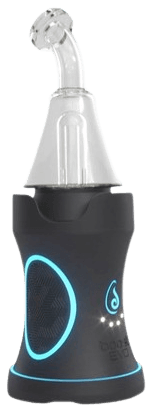
The G Pen Roam was one of the first portable eRigs to pack a complete water filtration system inside a handheld chassis. Released by Grenco Science in 2020, it solved a genuine problem: smooth, water-cooled dabbing without external glass, torches, or spill risk.
The portable eRig market has moved quickly since then. Newer competitors deliver tighter temperature control, longer battery life, and lower prices. We tested the Roam to determine whether its built-in hydrotube still earns the asking price, or whether six years of progress have left it behind.
The self-contained water filtration remains a clever piece of engineering. But aging hardware and stiff competition keep the Roam below current mid-range eRigs in our concentrate vaporizer rankings. The Roam works exclusively with concentrates (wax, shatter, rosin, live resin). It does not support dry herb.
What's in the Box
The kit ships in a hemp carrying case that doubles as travel storage, with compartments for concentrate jars and dab tools. Inside:
G Pen Roam vaporizer
Quartz tank with protective housing and cover
Glass hydrotube and silicone mouthpiece
Charging cable
Loading tool
Cleaning tips (cotton swabs)
The hemp case is a practical touch rather than throwaway packaging. It holds the full kit securely and works as a genuine travel companion.
Zinc alloy body at 200 g houses the full water assembly
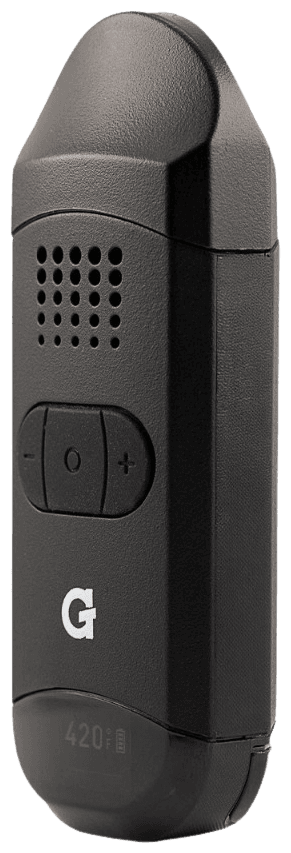
The G Pen Roam measures 127 × 51 × 51 mm and weighs 200 g. The zinc alloy shell feels sturdy, and the slightly thicker base keeps the vaporizer stable when standing upright.
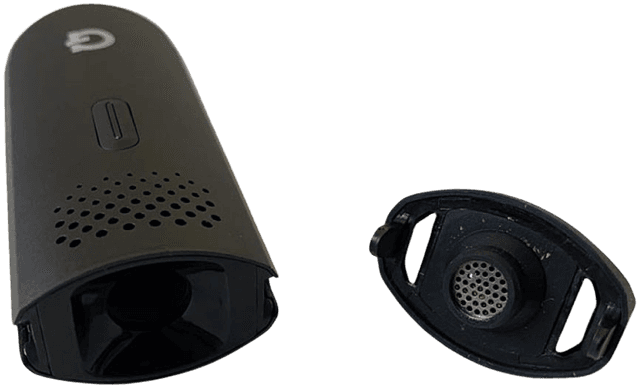
The body splits into two magnetic halves, revealing the glass hydrotube, silicone mouthpiece, and airpath. The entire water filtration assembly hides inside the shell, invisible during use. Grenco Science engineered the internal tube to be spill-proof, and during normal handling the seal holds well.
The atomizer sits at the top behind a protective quartz tank housing that slides out for loading, cleaning, and replacement. A metal-pronged tank cover helps prevent clogging from oversized dabs. The G Pen logo on the front illuminates when powered on, and a three-button interface with a small LCD display handles all controls.
Build quality is adequate for the price bracket, though the overall design clearly reflects 2020 engineering alongside newer eRigs. There is no adjustable airflow control, which limits how much you can tune the draw to your preference.
Whether you own the G Pen Roam or are still deciding — your thoughts and questions are welcome here.
Reviewed by
The VapeExperts Editorial Team
Every vaporizer we cover is bought, lived with, and tested by the same small team. We log temperatures with an external thermocouple, run battery cycles to depletion, and spend at least two weeks on a device before we score it. No manufacturer has ever paid for, previewed, or influenced a review on this site.
Grenco Science sells the Roam in Black and White, plus Dr. Greenthumb's, Lemonnade, and Cookies collaboration editions with custom colorways. All share identical hardware and internals.
Quartz tank delivers clean flavor with limited low-temp range
The G Pen Roam uses conduction heating through a full quartz tank atomizer. Quartz imparts minimal flavor onto concentrates, preserving terpene profiles more faithfully than metal coils. The tank holds roughly 0.1 g of concentrate (about a rice-grain-sized dab). For a breakdown of which concentrate types work best, see our concentrates explained guide.
Heat-up takes approximately 12 seconds, after which the vaporizer vibrates to signal readiness. Temperature spans 600-800°F (315-425°C) across 3 presets.
The water filtration is the Roam's defining feature. Vapor passes through the internal borosilicate glass hydrotube before reaching the silicone mouthpiece, cooling each hit noticeably. The result is a smoother throat feel than any standard dab pen can deliver.
At higher temps near 800°F, clouds thicken considerably but flavor degrades. Community feedback and multiple reviewers confirm the Roam prioritizes smooth, voluminous vapor over terpene purity at the upper end. A Max mode pushes full power beyond 800°F without temperature regulation for heavy clouds or burn-off cleaning.
The 600°F (315°C) floor is a real limitation. Low-temp dab enthusiasts who prefer the 400-550°F range for delicate terpene preservation will find the Roam simply cannot reach those temperatures. Current eRigs routinely start at 200-400°F, making this the Roam's most dated spec.
Two heating modes add some flexibility. Automatic mode holds temperature for 30 seconds before shutting off, functioning as a session vaporizer suited for passing around a group. Manual mode heats only while you press and hold the power button, giving more control over individual hits. Check our how to dab guide for technique tips that apply to both modes.
1300 mAh battery rated for 20 sessions per charge
The built-in 1300 mAh battery is not replaceable. Grenco Science rates it at 20 sessions in automatic mode (30-second heat cycles). A full charge takes approximately 90 minutes.
Pass-through charging means you can vape while plugged in, a feature that partially offsets battery anxiety. This is genuinely useful if you keep the Roam at a desk or nightstand between sessions.
Real-world battery life varies widely based on temperature and usage patterns. Users running higher temperatures or extended manual-mode sessions report fewer cycles. Community feedback on Reddit frequently cites battery life as a top complaint, with some users reporting well under 10 sessions at 750°F+. Leading portable eRigs released since 2024 routinely deliver 35-60+ sessions per charge, putting the Roam's rated 20 sessions below current standards.
Three buttons and haptic feedback keep operation simple
Loading involves sliding out the quartz tank housing, dropping a rice-grain-sized dab onto the heating element, and replacing the housing. The process is straightforward once familiar, though the disassembly has a short learning curve. For buyers new to concentrates, our how to choose a concentrate vaporizer guide covers what to expect.
Five clicks power the vaporizer on. Temperature adjusts via dedicated +/- buttons, and the LCD shows temperature, battery status, and error codes. Haptic vibration alerts confirm heat-up and session end. A thumbs-up icon on the LCD signals readiness; a stop-sign hand warns of overheating.
Filling the hydrotube requires removing the mouthpiece and carefully adding water to the marked line. Some users report difficulty with this step, noting water can pool on top or squirt from the bottom. Once filled, the spill-proof seal holds during normal transport and pocket carry.
Cleaning demands regular attention. Swab the quartz tank with 90%+ isopropyl alcohol after every few sessions to maintain flavor. The glass hydrotube needs periodic soaking in isopropyl for 15-30 minutes. Max mode can burn off stubborn residue from the atomizer, but manual cleaning remains necessary for the airpath and glass. Our eRig cleaning guide covers the full maintenance process.
How It Compares
The portable eRig market has expanded considerably since 2020. Here are three head-to-head matchups VapeExperts buyers ask about most as of May 2026.
G Pen Roam vs. Puffco New Peak
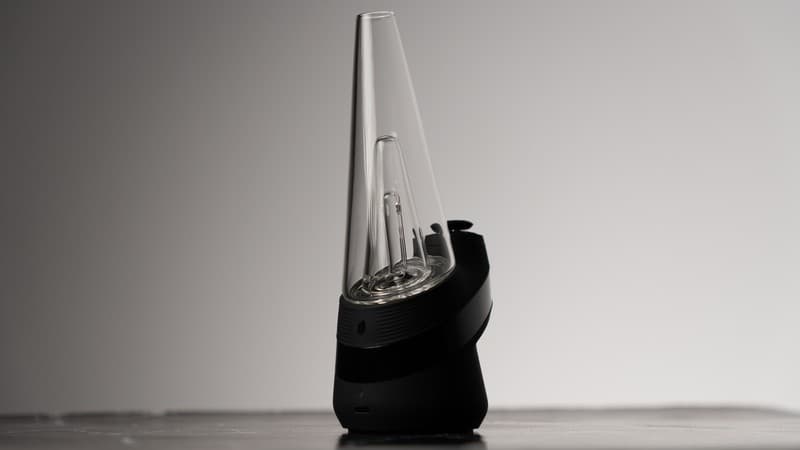
The Puffco New Peak7.5 is a 2024 eRig that outperforms the Roam in nearly every measurable category. It delivers 35 dabs per charge (vs. the Roam's rated 20), heats in 10 seconds, and uses Puffco's 3D ceramic chamber for more efficient extraction.
The Roam's only structural advantage is its self-contained, spill-proof water filtration. The New Peak uses an external borosilicate glass bubbler that sits on top of the base, meaning it cannot be pocketed as cleanly. If truly pocketable water-cooled portability is your non-negotiable priority, the Roam still offers something the Peak doesn't.
The New Peak costs less, ranks higher in our testing, and benefits from a larger accessory ecosystem. For most buyers, it's the stronger choice. For app control and full temperature precision, the Puffco Peak Pro8.5 sits a tier above both. See our full G Pen Roam vs. Puffco New Peak comparison for the detailed breakdown.
G Pen Roam vs. Bomb eRig Aerix
The Bomb eRig Aerix7.5 heats in 5 seconds, offers 1-degree temperature precision across a 200-700°F range, and features a detachable external airpath that simplifies cleaning. It costs less than the Roam while scoring higher in our testing.
Temperature precision is the biggest gap. Where the Roam offers presets starting at 600°F, the Aerix lets you dial in exact temperatures as low as 200°F, opening up the low-temp terpene range the Roam cannot reach. The Aerix's 22 mm ceramic 3D chamber also extracts concentrates more efficiently than the Roam's quartz tank.
The Roam counters with integrated water filtration and its spill-proof design. For buyers who value precise temperature control and easy maintenance, the Aerix is the stronger pick at a lower price. Our full Roam vs. Aerix comparison covers every detail.
G Pen Roam vs. Dr. Dabber Boost EVO
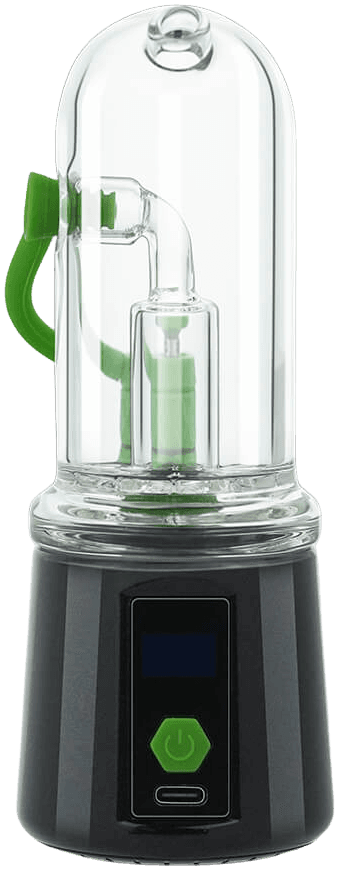
The Dr. Dabber Boost EVO7.5 dominates on battery life: 60 sessions per charge versus the Roam's 20. It offers 6 temperature settings and uses a quartz-to-glass vapor path with zero silicone touching vapor, resulting in cleaner flavor through the full temperature range.
The Boost EVO launched in 2021, so it is not bleeding-edge either, but its magnetic assembly and broader temperature selection give it practical advantages in daily use. It sits at flagship pricing, positioning it as a step up rather than a direct swap.
The Roam wins on compact portability with its hidden hydrotube. The Boost EVO requires its own glass attachment. But for buyers who prioritize endurance and vapor path purity over pocketability, the Boost EVO pulls ahead. Buyers open to induction heating might also explore the Dr. Dabber Switch 28.7, which eliminates atomizer replacement costs entirely.
Who Should Buy the G Pen Roam
Concentrate users who need pocketable water filtration. The Roam is one of very few eRigs where the full water filtration system fits inside the device with zero spill risk. If you travel with concentrates and insist on water-cooled hits without carrying external glass, the Roam fills a niche no current competitor matches.
Beginners who want a simple, torch-free dab setup. Three buttons, haptic alerts, and no app to configure. The Roam's learning curve is genuinely shallow compared to app-controlled eRigs with dozens of settings.
Not the right pick for low-temp terpene chasers. The 600°F floor is too high for the 400-550°F range that preserves delicate flavor compounds. Current alternatives start much lower.
Final Verdict
The G Pen Roam's built-in spill-proof water filtration was ahead of its time in 2020 and remains genuinely useful for portable dabbing. But six years later, the limited temperature range, preset-only control, and middling battery life put it behind every eRig in its price bracket. VapeExperts recommends most buyers look at the Bomb eRig Aerix or Puffco New Peak instead, unless pocketable water filtration is the one feature you refuse to compromise on.