

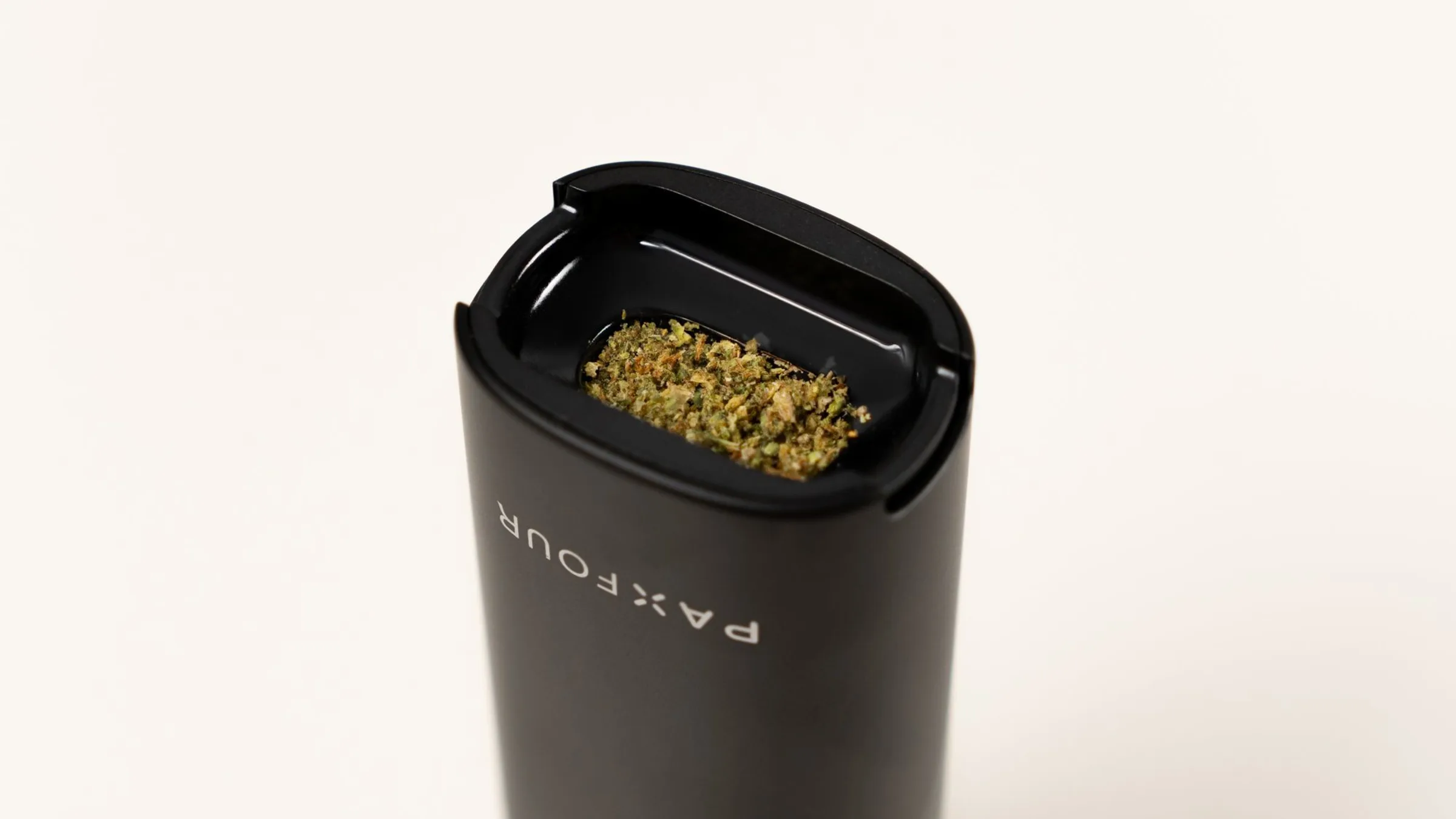
PAX resisted making an all-in-one cannabis vape for years. The California company now sells one, called Trip, alongside its reusable Era pod system.
The reason is the customer, chief of staff and vice president of communications Laura Fogelman told MJBizDaily in an interview published Nov. 5.[1]
"You have to meet the consumer where they are," she said.
One sealed unit holds the oil, heater and battery
Trip is a prefilled all-in-one. The cannabis oil, the heating hardware and the battery sit in a single unit. A Colorado dispensary listing describes USB-C charging and a vapor path that does not touch the internal electronics.
Charging helps a buyer finish the oil. Once the oil is gone, the whole unit is spent, battery included.
Charging a Trip does not make it reusable.
Era works differently. It is a rechargeable battery that takes separately sold, prefilled PAX pods. The battery stays in use from one pod to the next. The pods themselves are not refillable tanks.
According to MJBizDaily's reporting, that difference is why PAX held off for years. An all-in-one throws away a battery and electronics with every empty unit, which conflicts with the reusable model behind Era.
Era pods are still listed
For Era owners, the first fact is simple. Trip is a separate product. It is not an Era pod, and it is not a replacement battery.
PAX's homepage still shows several pod lines, including live rosin, diamonds and high-purity THC. Mission Cannabis Club in San Francisco listed an Era Go battery and several 1-gram PAX pods in an Oct. 28 inventory snapshot.
PAX's flower vaporizers are a separate line again. The PAX 4, PAX Plus and PAX Mini 2 heat ground cannabis you load yourself and take no pods, so Trip changes nothing for their owners.
Nothing we reviewed shows PAX plans to discontinue Era hardware or pods. We also found no public commitment from the company to keep every pod, strain or market, so today's listings say little about next year's local selection.
Trip is on menus in New York and Colorado
We confirmed Trip on two retail menus. NYC Bud in Queens lists a 1-gram Blueberry Haze Trip for $65. Star Buds in Aurora, Colorado, lists a 1-gram Superboof Trip.
Those are single store listings, and prices and stock vary by shop. We did not find a Trip listing at a California retailer, even though PAX is based in the state.
All-in-ones passed cartridges in monthly sales
Fogelman tied the decision to buying habits. "Price and convenience are the largest drivers of purchasing decisions," she told MJBizDaily. She said PAX needed to offer a better alternative inside the disposable category.
Retail data points the same direction. Hoodie Analytics compared the 12 weeks before Green Wednesday in 2024 and 2025 across the stores it tracks. Disposable vapes rose from 8.5% to 11.5% of tracked retail dollars. Cartridges slipped.
Share of tracked retail dollars, 12 weeks before Green Wednesday
Source: Hoodie Analytics
Hoodie also reported that disposable vapes out-earned cartridges during Green Wednesday week in 2025, though cartridges sold more units.
BDSA figures reported by HerbyBud show all-in-ones reaching 51.1% of monthly US vape dollar sales in May 2026, after crossing 50% in April. Over the 12 months ending in May, cartridges still led, with $4.19 billion in sales against $3.8 billion for disposables.
PAX's pitch rests partly on plastic
PAX is not selling Trip on convenience alone. Fogelman said the vape uses ocean-bound plastic in components that do not touch the user's lips.
That material costs more to source and test than conventional plastic, she told MJBizDaily. PAX still has to price Trip against cheaper all-in-ones, and she said the company accepts the pressure on its margins.
Through a partnership with rePurpose Global, Fogelman said, PAX funds the recovery of twice as much plastic as it uses. She called the arrangement plastic-negative.
The plastic is one part of the footprint. The battery is another.
Wen Li is an associate professor at the University of Melbourne whose team modeled the global lithium-ion battery supply chain. He said reducing battery demand was "another very large mitigation opportunity" alongside cleaner production. Li was not commenting on Trip or on cannabis vapes.[4]
California ads must send empty all-in-ones to hazardous waste sites
California already has rules for the end of an all-in-one's life. Under Business and Professions Code §26152.1, ads for integrated cannabis vaporizers must say that an empty unit goes to a household hazardous waste collection facility or another approved facility.[2]
The same statute bars ads from implying these products can go in ordinary trash or recycling. The requirements took effect July 1, 2024. Buyers should call their local program first to check that it accepts vapes with cannabis residue.
One recent California law does not apply here. AB 762, approved Sept. 28, restricts disposable vapes that contain a tobacco product "but not cannabis or a cannabis product." Its limits on nicotine products phase in during 2027 and 2028. It does not ban Trip.[3]
The questions PAX has not answered
Fogelman is scheduled to join an MJBizCon panel on sustainable cannabis hardware and packaging on Dec. 3, according to MJBizDaily.
Her interview left specific questions open. They include how much of each Trip component is ocean-bound plastic, who audits the two-for-one recovery figure, and where an empty Trip can be handed back.
For Era owners, the open question is whether the battery they already own will have pods to fill it in every market where PAX sells today. For now, PAX sells both formats side by side.