

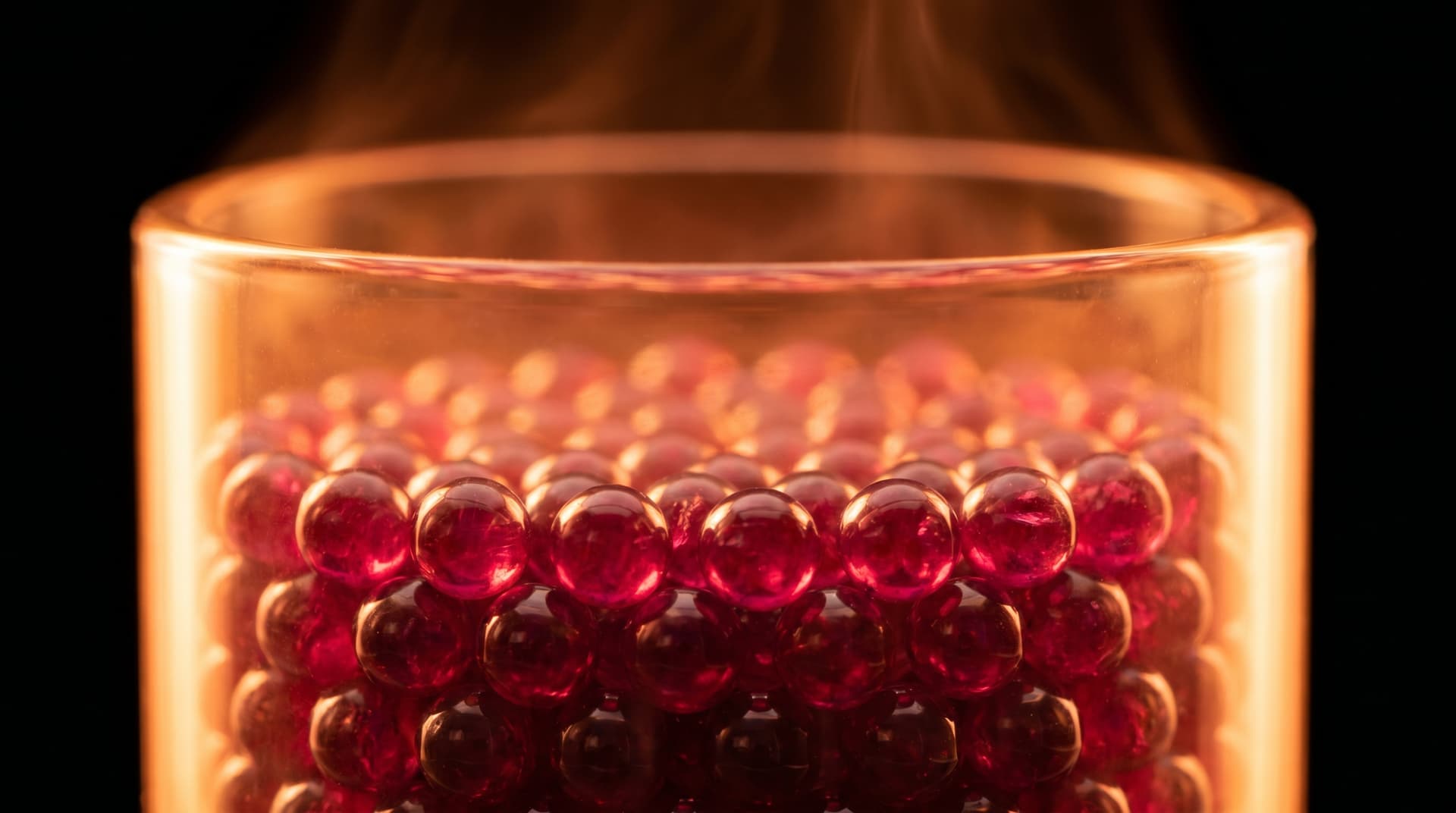
A ball vape is a cannabis vaporizer that pulls air through a chamber packed with heated spheres, so hot air does most of the work. That's convection, and when a hot head rests on a metal bowl, a bit of conduction joins in. The heat stored in those spheres is why ball vapes deliver thick clouds and short sessions.
The hot air vaporizes your cannabis instead of burning it, and the clouds feel closer to a bong rip than a sip from a portable.
Ball vapes started as a DIY niche. Today they come in three main formats: wired desktops, cordless systems and pocket-sized portables.
How ball vapes work: thermal mass does the heavy lifting
Ball vapes store heat energy in a packed bed of spheres, then release that energy into passing air on demand. Other vapes store heat too. What sets ball vapes apart is that the whole bed of hot media sits right in the airflow.
Desktops like the Volcano Hybrid heat air with a single heating element, mixing convection with some conduction. Ball vapes spread the handoff across dozens to thousands of spheres with a huge combined surface area. The heater still supplies the energy. The balls bank it and pass it to the air at every contact point.
Tip
The balls reach target temperature
A PID-controlled coil (in electric models) or a butane torch or induction heater (in portable models) heats the ball chamber. Once the whole bed is hot, the balls hold a reservoir of heat for your draws. The display can hit your setpoint before the balls catch up, so give it a few extra minutes. Cannabis Hardware recommends a full five-minute warm-up in its FlowerPot FAQ.
The setpoints look high because the controller reads the coil, not the air reaching your cannabis. Cannabis Hardware suggests starting at 316°C for the FlowerPot, and MiniNail lists 204-316°C for its Flower Wand, starting at 260°C.
Air threads through the heated ball bed
When you draw, room-temperature air enters the chamber and weaves through the gaps between spheres. Each ball it touches adds a little more heat. How hot the air comes out depends on the bed's temperature and how fast you pull, and a slow, steady draw gives it the most time on the balls.
Hot air extracts your cannabis
The heated air then passes through cannabis sitting in a separate bowl. Because the air carries plenty of heat, the load vapes fast. Where a typical session vaporizer spreads a bowl over several minutes, a ball vape packs it into a few big draws.
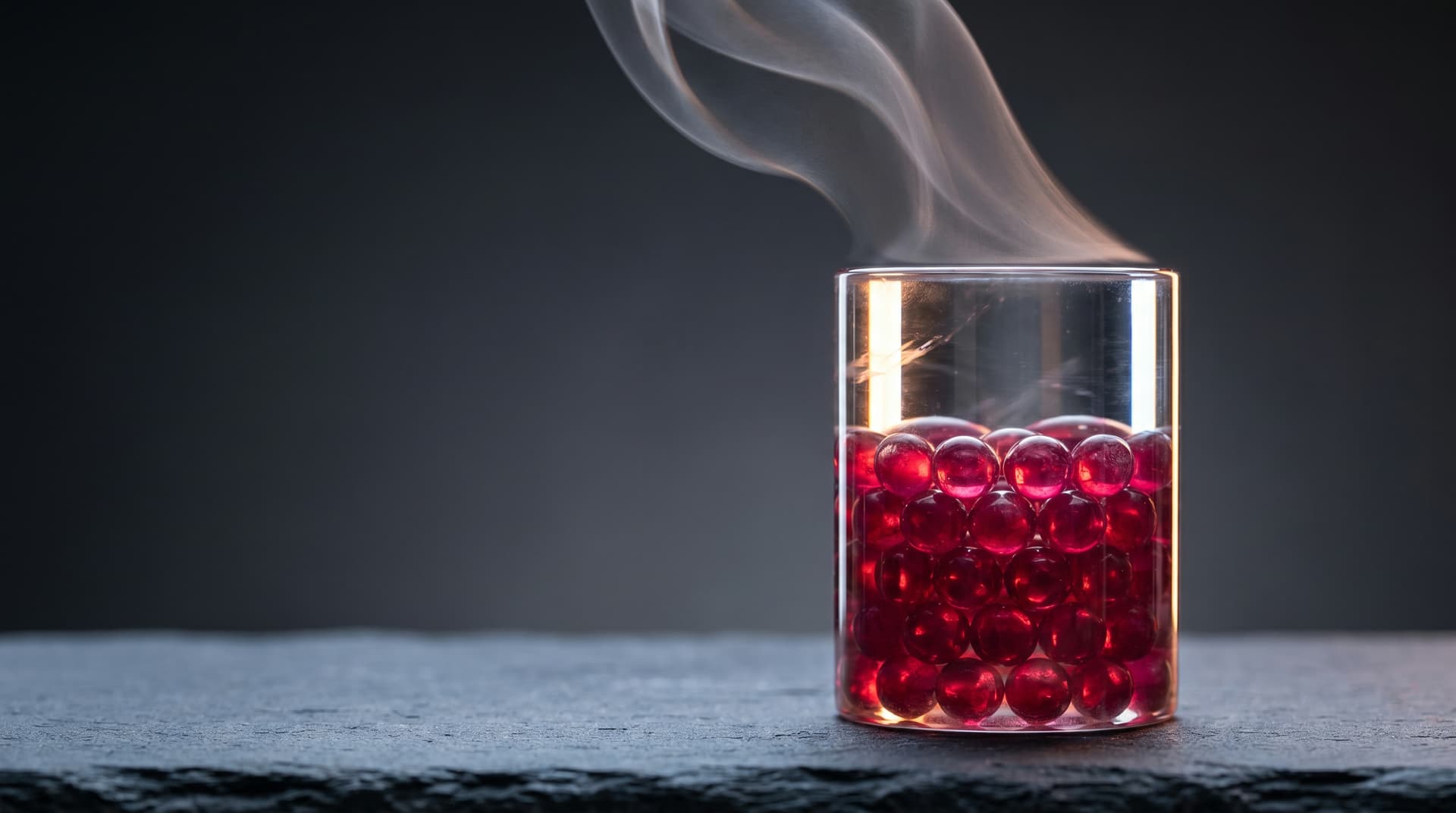
Room-temperature air enters the chamber and picks up heat as it threads between hundreds of hot spheres. Illustration.
Ruby, quartz, zirconia, and SiC: ball materials compared
The type of sphere in your head affects how it stores and gives up heat, and it shapes the flavor too. You'll run into four materials.
Ball size matters just as much. Smaller balls pack more surface area into the same head but make the draw tighter. The Universal Baller uses 2 mm rubies, the FlowerPot B1 takes about 100 3 mm ones, and the Freight Train runs 4 mm rubies. Stick with the size your head is built for.
Ruby (corundum)
Synthetic ruby is lab-grown corundum (aluminum oxide). It's a staple in desktop heads like the FlowerPot B1, the Freight Train and the MiniNail Flower Wand, and we find it tastes clean and neutral. Sapphire balls are the same corundum in a different color. The Universal Baller packs 1,000 rubies in its metal setup and about 500 in its wireless quartz one. Check which setup a kit includes.
Quartz (silicon dioxide)
Quartz balls are an option in the B1 and the MiniNail Flower Wand, and the Universal Baller runs its rubies inside a quartz liner. That Baller quartz setup gave us the best flavor of any desktop ball vape we've tested. Quartz won't heat exactly like ruby, so expect to tweak your settings if you switch.
Zirconia (zirconium dioxide)
Zirconia moves heat much more slowly than ruby. CoorsTek's material data puts its zirconia at roughly a tenth of the thermal conductivity of its alumina. It still works well in a vape, and the Tempest 2 uses zirconia balls as standard in a portable. The stock zirconia gave us smooth hits full of terpene flavor.
Silicon carbide (SiC)
SiC isn't just for torch portables. It's a listed media option for the FlowerPot B1 desktop head. It handles heat differently from ruby and quartz, so plan on new heat settings when you swap it in.
| Material | What it is | Where you'll find it | Good to know |
|---|---|---|---|
| Ruby | Corundum (aluminum oxide) | FlowerPot B1, Freight Train, Universal Baller, MiniNail | Conducts heat well, clean taste |
| Quartz | Silicon dioxide | Option for the B1 and MiniNail, liner in the Universal Baller | Best flavor we tested, in the Baller |
| Zirconia | Zirconium dioxide | Tempest 2 (standard) | Conducts heat far slower than ruby |
| SiC | Silicon carbide | Option for the B1 | Needs its own heat settings |
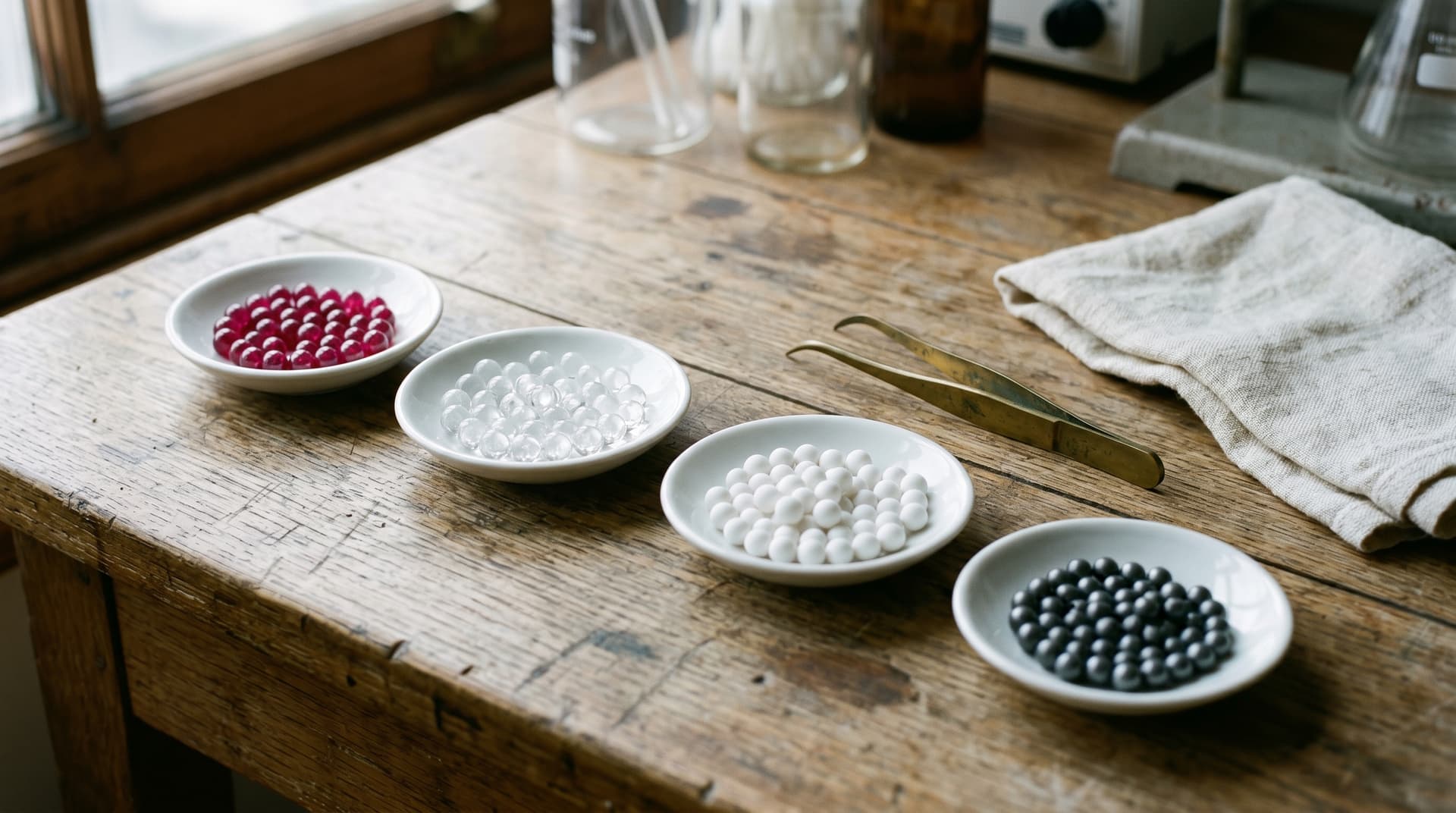
Whatever material you pick, match the ball size and count to your head. Illustration.
Injector vs. diffuser: the two head designs
Ball vape heads connect to the bowl in one of two ways. The style decides which bowls fit, and it's separate from the joint between the bowl and your pipe. A head marked 18 mm doesn't automatically need an 18 mm pipe, since the bowl can have a different connection underneath.
Injector heads sit inside the bowl
In an injector setup, the head's outlet slides into a matching opening in the bowl, with the heated balls above the cannabis. Your draw pulls air through the hot balls, down through the load, and out through a screen at the bottom.
Diffuser heads sit over the bowl
A diffuser fits around the top of the bowl instead of inside it. The head is still above the cannabis, and air still flows down through the load. On a metal bowl, contact with the hot head adds a little conduction on top of the hot air. The FlowerPot B1 ships with a Grade 2 titanium head and a 22 mm screen diffuser, and injector setups exist too.
Injector or diffuser, what really matters is that your head and bowl are a matched pair.
Wired, wireless, and portable: 3 ways to use a ball vape
The ball vape category has grown well beyond its plug-in desktop origins. For a broader look at how convection and conduction systems differ, our dedicated guide covers the full spectrum.
Wired desktop ball vapes
Wired models connect to a PID controller through a coil wrapped around the ball chamber. The coil stays powered, so it keeps topping up the heat between draws, which makes wired setups the go-to for longer sessions at home. This is the original ball vape design. Setup takes a PID controller, coil, head, a stand for the hot head, a bowl, and a water pipe or dry cooler.
Cordless (wireless) ball vapes
Cordless ball vapes use a plug-in docking station to heat the head. You lift the head off the dock and set it on your bowl for cord-free hits. The trade-off: the head starts cooling the moment it leaves the dock. You get a few big hits before it goes back, depending on the head's mass, your starting temperature and how hard you pull.
Portable ball vapes
Portable ball vapes use a butane torch or induction heater to warm a smaller ball chamber you can carry anywhere. The Tempest 2 weighs 46 g with its aluminum heat shield (43 g with the wooden one), not counting the torch or heater. The DynaVap UniDyn with its BallR Cap is another pocket option. Both take some heating technique to master. For step-by-step tips, our ball vape usage guide covers technique for every form factor.
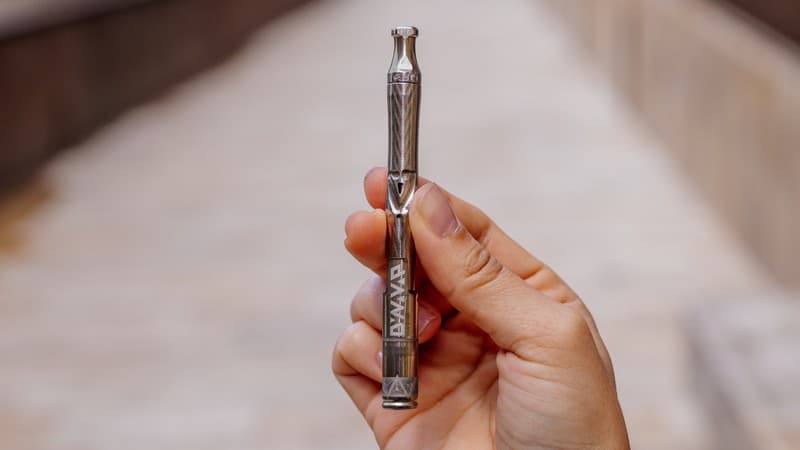
The DynaVap UniDyn with BallR Cap fits in a pocket and runs on a torch or induction heater. No PID controller or wall outlet required.
Ball vapes hit hard because of surface area, not just temperature
A ball vape puts out thick vapor fast because hundreds of spheres create a huge heat-exchange surface. Air touches ball after ball and picks up energy at each one, so it reaches your cannabis carrying plenty of heat.
On a wired setup, the coil keeps feeding the ball bed, so a short pause between hits is usually enough. A cordless head keeps cooling until it goes back on the dock, so each hit off the dock runs a little cooler than the last.
That speed makes small loads go a long way. In our sessions the FlowerPot B1 cleared 0.25 g loads in 1-2 draws, because the hot air pulls the cannabinoids and terpenes out quickly.
That heat comes with a physical cost. The head and coil get very hot, and the metal stays hot for a good while after you switch off. Use the included handle or silicone grip, park the hot head on its stand away from anything flammable, and let it cool fully before you take it apart.
Warning
Once everything is cool, soak the removable balls, bowl and screens in 99% isopropyl alcohol, then rinse and dry them fully. Never get liquid on the coil, cable or controller. Two parts never go in the soak: the MiniNail's wired wand and DynaVap's BallR Cap. Our cleaning guide covers the rest of your gear.
Water filtration turns intense vapor into smooth hits
Many desktop ball vape bowls sit on a standard 14 mm or 18 mm glass water pipe. Ball vapes produce hot, dense vapor, and running it through water takes the edge off. Unlike a bong load, nothing burns. In a 2007 study of 18 adults, a vaporizer delivered THC blood levels similar to smoked cannabis, and exhaled carbon monoxide barely rose.
Without water, a big ball vape hit can feel harsh. With a water pipe, that same hit turns smooth and manageable. If you're considering a ball vape, budget for a quality glass piece with a joint that fits your bowl. Our guide on connecting a vaporizer to a water pipe covers joint sizes, water levels, and draw technique.
Water isn't your only option, though. The Tempest 2 has a visual heat gauge and its own cooling stem for direct draws. Cannabis Hardware sells a dry glass Haze pipe for FlowerPot setups.
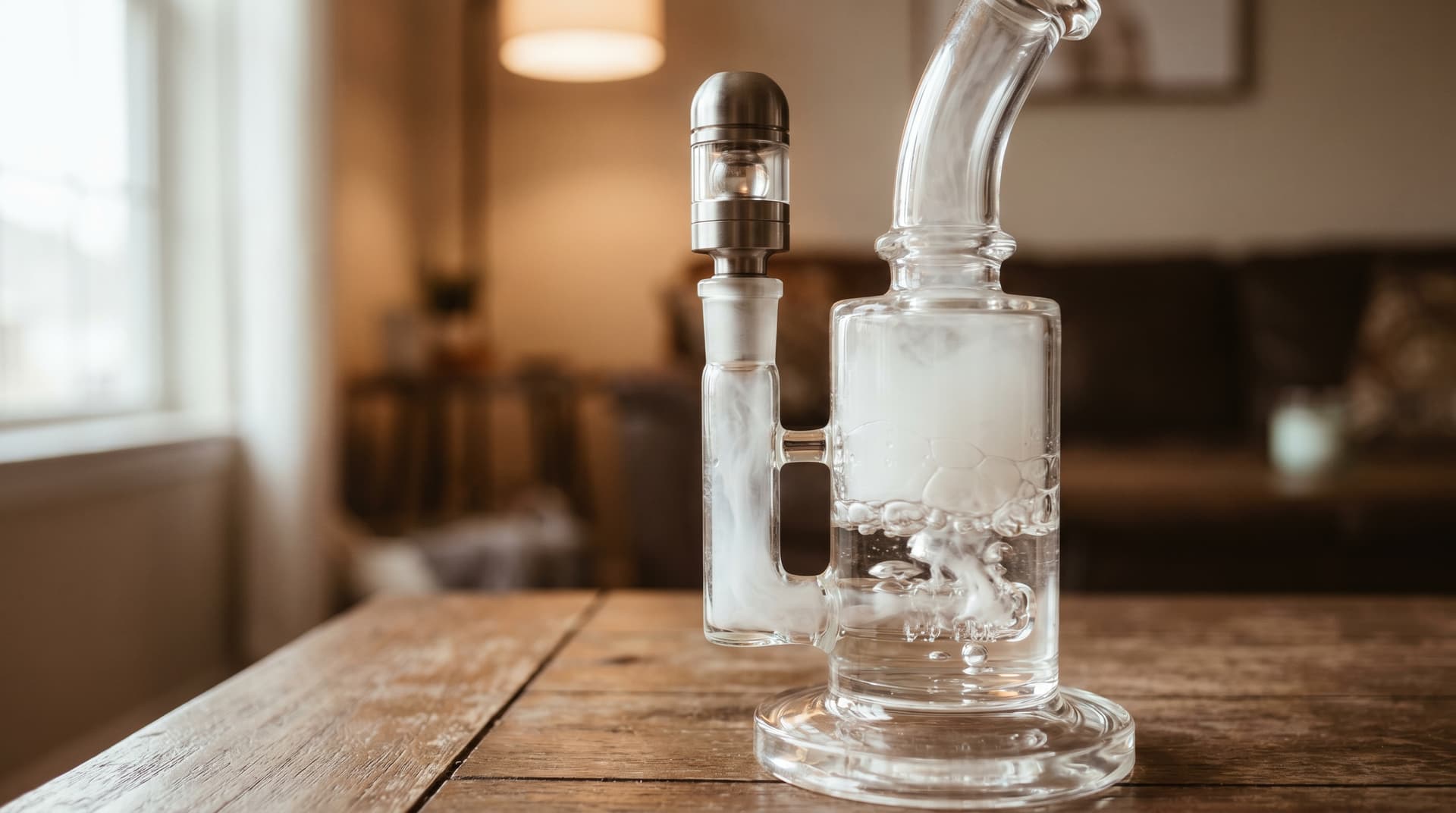
Water is the classic way to smooth out a ball vape hit. Make sure the head fits the bowl and the bowl fits the pipe. Illustration.
What a ball vape costs and what you need
A desktop setup is a head, a coil, a PID controller, a stand, a bowl and a water pipe or dry cooler. At US list prices, complete kits run from $299 for the MiniNail Flower Wand to $515 for the FlowerPot B1, before the glass. Portables cost less: the DynaVap UniDyn is $119 and the Tempest 2 is $225, plus a torch or induction heater.
Who should (and shouldn't) buy a ball vape
Ball vapes are built for cannabis users who want big, dense hits in a short session. They deliver on vapor density and flavor, but they come with real trade-offs, and the format you pick matters as much as the category.
A desktop ball vape makes sense if you want short sessions with dense hits and already own or plan to buy a water pipe or dry cooler. It also helps to have a stable spot at home for hot gear and to enjoy dialing in a modular setup.
A ball vape is the wrong choice if you prefer slow, sip-style sessions, want simple controls, or want zero learning curve. The hits are far more intense than a typical session portable delivers, and desktops mean assembling several parts. Portable ball vapes cut the bulk, but you'll still be handling a torch and a hot cap.
For anyone curious about the right temperature settings, our temperature guide covers ranges for both flavor and extraction. Start from the heating guidance for your head and media, then adjust by taste.
New to ball vapes? Start with the MiniNail Flower Wand, a matched kit with its own PID controller and adapters for most water pipes. Want a guarded desktop? Look at the Freight Train. Our top-rated ball vape overall is a portable, the Tempest 2. Browse our ball vape rankings for picks across every budget and form factor.
Our top ball vape picks
Our current rankings across desktops, cordless systems, and portables, with picks for every budget and setup.
Key Takeaway
- Dense hits, short sessions. Hundreds of heated spheres hand heat to the air across a huge surface
- Material matters. Ruby conducts heat far better than zirconia, and each media needs its own settings
- Water pipe recommended. Water smooths out intense hits, and dry coolers or native stems work too
- Desktops are for home. Steep learning curve, intense hits, multi-part setup
- Best for anyone who wants dense hits and doesn't mind a hands-on setup