

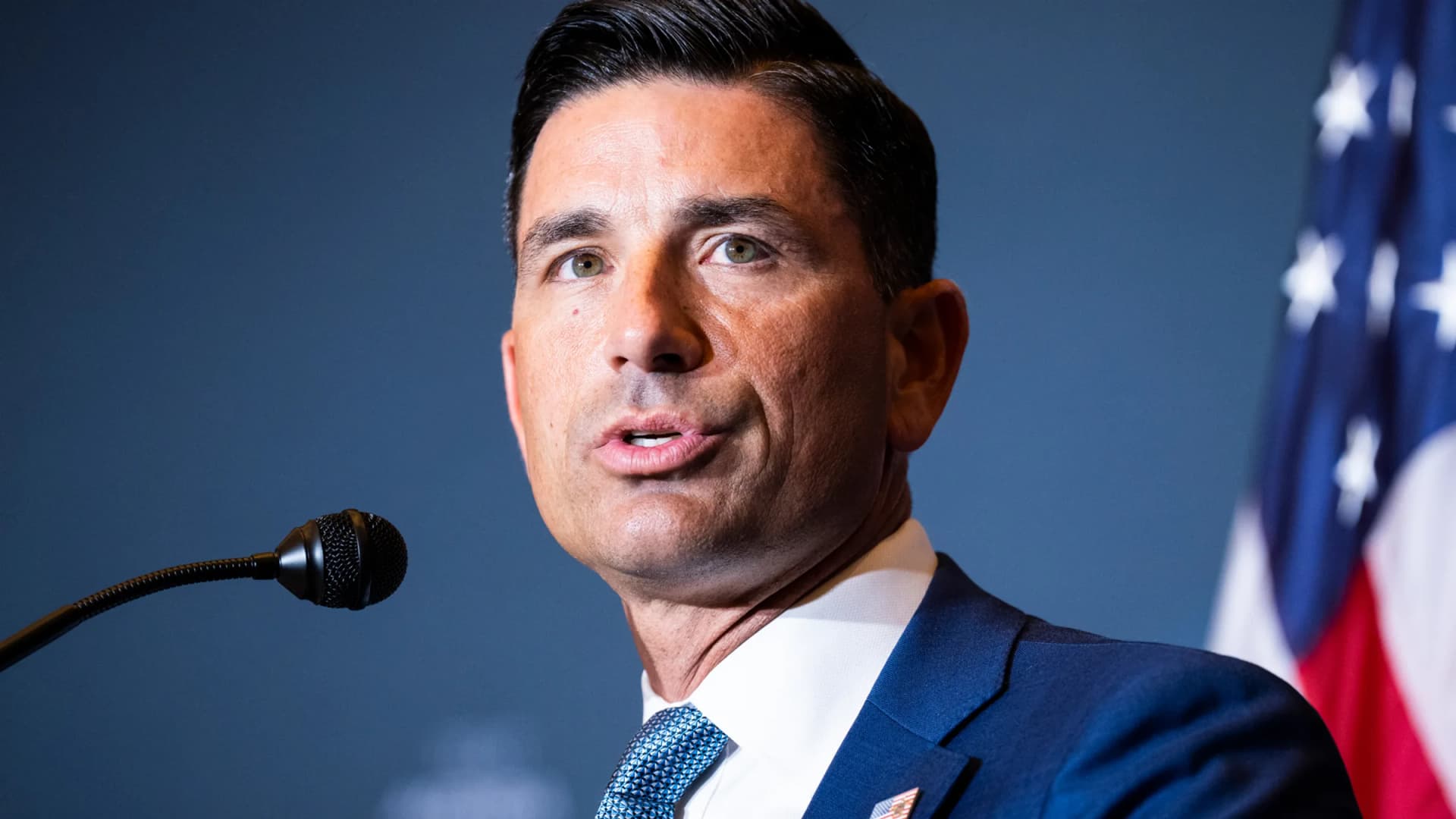
The fight over hemp-derived THC vapes now has a national-security front. Chad Wolf, acting Homeland Security secretary from 2019 to 2021, sent a letter on July 7 asking the House Select Committee on the Chinese Communist Party to investigate possible Chinese links to the U.S. hemp-derived THC supply chain. He also urged Congress not to touch the federal restrictions set to take effect November 12, 2026.[1]
The letter, first reported by Fox News from an obtained copy, went to committee Chairman John Moolenaar, R-Mich., and Rep. Ro Khanna, D-Calif. Wolf, now executive director and chief strategy officer of the America First Policy Institute, asked the panel to examine Chinese involvement in financing hemp and cannabis operations, chemical and cannabinoid manufacturing, illegal cultivation, money laundering, labor exploitation and links between U.S. operations and foreign criminal groups.
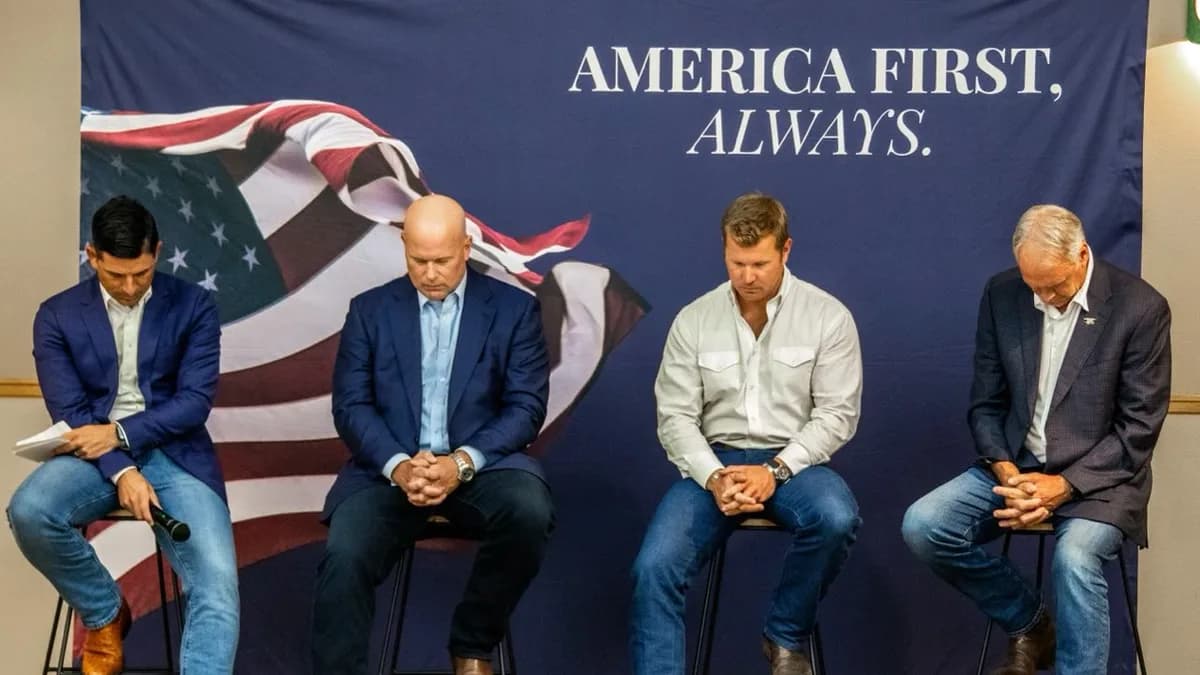
Photo: Rep. Ryan Zinke/Wikimedia Commons (Public domain)
Ryan Zinke, Chad Wolf, Matt Whitaker, and Tim Sheehy sit with heads bowed at a town hall in Bozeman. Wolf, a former acting DHS secretary, has tied the hemp THC ban fight to concerns about China.
"However, efforts are now underway to weaken, delay or roll back those protections before they fully take effect," Wolf wrote, per the copy obtained by Fox News. "This would not only undermine public health and law enforcement objectives, but could further embolden foreign criminal actors seeking to exploit the American marketplace and harm American families."
The full signed letter has not been posted publicly by Wolf, his organization or the committee. As of July 13, the committee had announced no investigation, hearing or response.
The 0.4 milligram limit reaches every cartridge
Section 781 of Public Law 119-37, signed November 12, 2025, rewrites the federal hemp definition 365 days after enactment. The short version: hemp products may contain no more than 0.4 milligrams of total THC per container, and the statute defines a container to include a cartridge.[2]
That wording matters for vapers. An intoxicating dose of THC in a single vape cartridge sits far above 0.4 milligrams, so hemp-derived THC vapes cannot comply by relabeling servings. The law also excludes cannabinoids synthesized outside the plant, a provision aimed at converted products such as most commercial delta-8 THC.
Photo: VapeExperts/AI
The Congressional Research Service says affected products could face the "same criminal and collateral issues as marijuana," while cautioning that FDA and DEA may lack the resources for broad enforcement.[3]
What the China evidence shows, and what it does not
Wolf's argument builds on documented enforcement findings. The White House's 2026 National Drug Control Strategy, released May 4, states that the U.S. marijuana trade "has been co-opted and industrialized by sophisticated, transnational criminal organizations, particularly those with ties to China." It says Chinese criminal groups operate more than 80% of Oklahoma's thousands of marijuana and hemp farms, and that 2023 production there exceeded licensed medical demand by at least 32 times, leaving an estimated 85.5 million plants unaccounted for. The strategy does not publish a methodology for that estimate.[6]
Photo: VapeExperts/AI
A 2024 investigation by ProPublica and The Frontier reported a narrower finding: Oklahoma investigators linked foreign criminal networks to more than 3,000 illegal grows, and officials said more than 80% of those criminal groups were Chinese in origin. That is a claim about identified criminal groups, not about all licensed farms. Individual cases exist too. In June 2025, Oklahoma's attorney general announced charges against Chinese national Qi Wei Chen after authorities seized 40,723 marijuana plants and more than 1,000 pounds of processed marijuana.[9]
What the public record does not yet show is the link Wolf wants investigated: no government audit, peer-reviewed supply-chain study or industry-wide customs dataset demonstrates that Chinese criminal groups control a meaningful share of the legal U.S. market for hemp-derived THC gummies, drinks or vape cartridges. Wolf wrote that the hemp market "now risks becoming another avenue" for exploitation, which is the question his requested investigation would test.
In an April opinion piece, Wolf wrote that as much as 70% of world hemp production comes from China. A USDA Foreign Agricultural Service report put China's share at roughly half of world hemp fiber, while noting the absence of official production data.
Three legislative paths, all stalled
House Republicans have offered three paths for the hemp industry: defunding enforcement, postponing implementation, or replacing the ban with a regulated market. Wolf's argument directly targets the first two. We tracked the amendments when they were filed (our coverage). The House Rules Committee list for the FY2027 agriculture bill included a defunding amendment from Reps. James Comer and Russell Fry, a two-year delay from Reps. Fry and Jim Baird, a one-year delay from Rep. Ilhan Omar, and a regulatory package from Rep. Andy Barr.[8]
None advanced. Comer's proposal was withdrawn, and the Rules Committee did not make the others eligible for a June floor vote. Barr's proposal sits closest to Wolf's argument: it would ban synthetic cannabinoids, add age and testing rules, and prohibit hemp from outside the United States.
Nov. 10, 2025
The Senate tables Sen. Rand Paul’s amendment to strip the hemp restrictions, 76-24.
Nov. 12, 2025
President Trump signs P.L. 119-37 with a 365-day transition period.
May 28, 2026
Comer, Barr and Fry/Baird submit hemp amendments to the FY2027 agriculture bill.
June 2, 2026
Comer withdraws his defunding proposal; the Rules Committee blocks floor votes on the rest.
July 7, 2026
Wolf sends his China-focused letter to the House select committee.
Nov. 12, 2026
The new hemp definition and 0.4 mg per-container THC limit take effect.
The Senate remains the biggest obstacle. On November 10, 2025, senators voted 76 to 24 to table Sen. Rand Paul's attempt to strip the restrictions from the shutdown-ending funding package. Paul and Sen. Ted Cruz were the only Republicans on the losing side.[4]
"This bill's per-serving THC content limit would make illegal any hemp product that contains more than 0.4 milligrams," Paul said on the floor. "That would be nearly 100 percent of the existing market."[5] The law applies the limit per container, not per serving; Paul's broader argument was that the threshold reaches nearly all existing cannabinoid products.
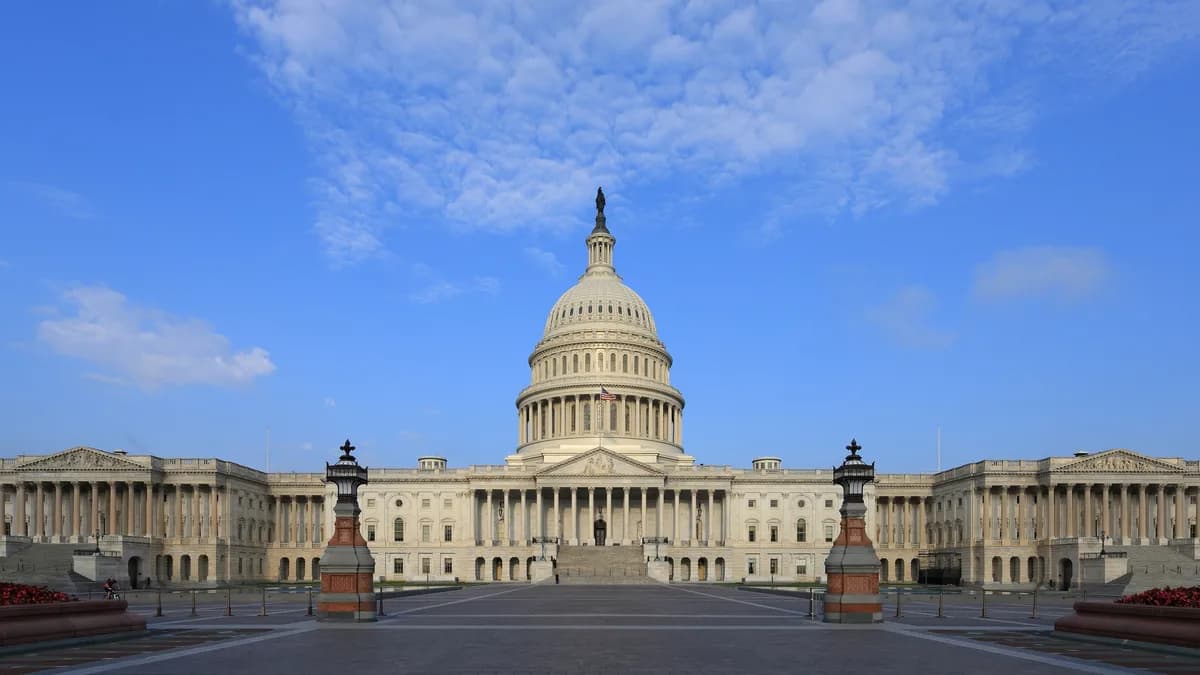
Photo: Martin Falbisoner/Wikimedia Commons (CC BY-SA 3.0)
The east side of the US Capitol stands under a blue sky in Washington, DC. Congress is weighing stalled legislative paths in the fight over a hemp THC ban.
The White House has staked out a narrower position. In its June statement on the agriculture bill, the administration said it "welcomes the opportunity to work with the Congress to, at a minimum, update the statutory definition of final hemp-derived cannabinoid products to allow Americans to benefit from access to appropriate full-spectrum CBD products."[7] Full-spectrum CBD can contain trace THC. The statement makes no such commitment for intoxicating gummies, drinks or THC vapes.
Researchers split on whether bans work
Supporters of the restrictions point to poison-center data. A peer-reviewed poison-center study recorded 4,925 delta-8 THC exposures in 2021 and 2022, an 82.1% increase in cases year over year.[11] FDA separately reported 2,362 delta-8 exposure cases from January 2021 through February 2022; 41% involved people under 18.[10]
Matthew Rossheim, an associate professor at the University of North Texas Health Science Center, argues the data support "comprehensive bans prohibiting any detectable levels of derived intoxicating cannabinoids that are well enforced, with product testing and large fines for noncompliance." His retail study found intoxicating products in 92% of sampled shops in states with little delta-8 regulation, and 90% in states with restrictive laws, a finding that points to the gap between enacting restrictions and enforcing them.[12]
Eric Leas, an assistant professor at UC San Diego's Herbert Wertheim School of Public Health, found delta-8 use was highest where marijuana remained illegal. "These findings underscore that people don't just stop using cannabis when their state bans it," he said. "They often shift to alternatives that are easier to access, even if they're less well-studied or poorly regulated."[13]
None of the exposure data establishes a Chinese origin for the products involved. That is the gap between the documented youth-safety problem and Wolf's national-security framing, and it is the gap his requested investigation would have to close.
Congress has 17 weeks. Absent new legislation, the 0.4 milligram per-container limit, cartridges included, becomes federal law on November 12, 2026.