

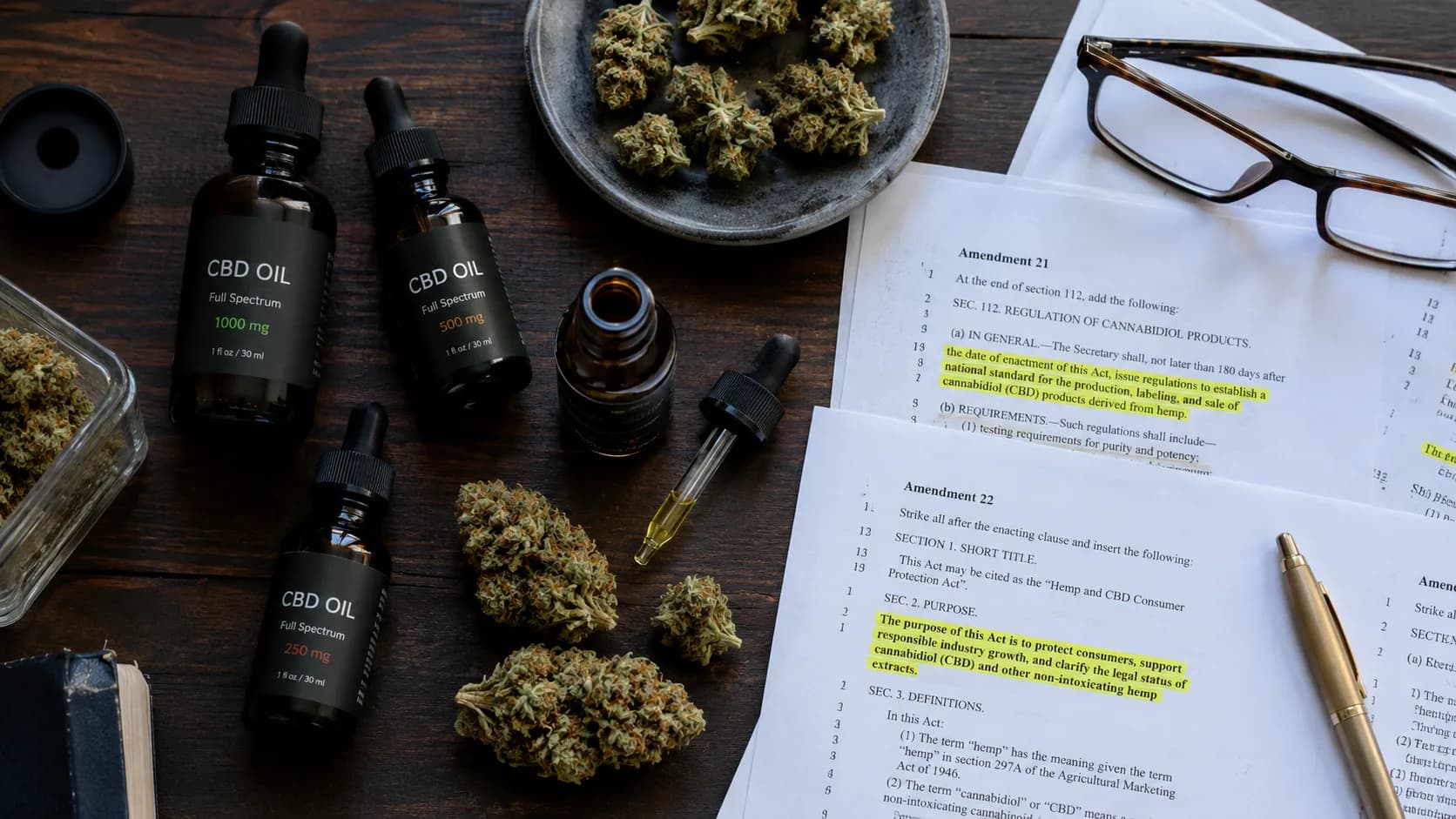
Three Republican lawmakers filed amendments this week to stop a federal ban on hemp THC products from taking effect this November. The amendments target a law that could reclassify most hemp products as illegal marijuana.
The stakes are high. Industry groups estimate the ban would wipe out 95% of hemp-derived cannabinoid products and threaten more than 300,000 jobs across the country.
The amendments race a November deadline
Reps. James Comer (R-KY), Andy Barr (R-KY), and Russell Fry (R-SC) each filed separate amendments to H.R. 8646, the FY2027 agriculture spending bill. The filing deadline was May 28.
Comer's amendment would block federal funds from being used to enforce the ban. Fry's would push the start date back two years. Barr's is a 25-page rewrite of the hemp definition.
The House Rules Committee meets Tuesday, June 2, to decide which amendments move forward.[2]
What the ban actually does
The trigger is Section 781 of a government funding law Trump signed on November 12, 2025. That law ended the longest shutdown in U.S. history at 43 days.
Buried in the package was a complete rewrite of the federal hemp definition. It replaced the 2018 Farm Bill's 0.3% delta-9 THC limit with a total THC standard covering THCA, delta-8, delta-10, and all isomers.
The new rule caps finished products at 0.4 milligrams of total THC per container. Most products on the market today contain 2.5 to 10 mg per unit.
Synthetic and converted cannabinoids like delta-8, delta-10, HHC, and THCP are banned outright. Anything over the limit gets reclassified as marijuana under the Controlled Substances Act.
The enforcement date is November 12, 2026, one year after Trump signed the law.
The Senate already rejected one rescue attempt
This is not the first try at stopping the ban. On November 11, 2025, Sen. Rand Paul (R-KY) offered an emergency amendment to strip the hemp language from the funding bill.
The Senate killed it. The motion to table passed 76 to 24, as Marijuana Moment reported.[4]
Only two Republicans, Reps. Thomas Massie (R-KY) and Greg Steube (R-FL), voted against the larger spending package the next day.
Barr's bill rewrites the rules
The Barr amendment goes furthest. His Lawful Hemp Protection Act would redefine legal hemp as up to 1% delta-9 THC on a dry-weight basis, measured on the finished product.
It builds a regulatory system around the change:
- A 21-plus age requirement for all consumable hemp products
- Civil penalties up to $1,000 per violation
- A ban on synthetic cannabinoids and non-hemp starting materials
- A 5% user fee on retail sales and 5 cents per milligram tax on hemp beverages
- A three-tier distribution system for beverages, modeled on alcohol
- American-grown hemp only
Barr framed it as leveling the field with other adult products.
"We want to create kind of a level playing field with other adult beverages so that farmers will have certainty that they can sell into a mature marketplace," Barr said at a hemp industry meeting in May.
The economic case for delay
Kentucky has driven much of the pushback. The state is a national hemp leader, a legacy of Sen. Mitch McConnell's role in legalizing the crop in 2018.
In a September 2025 letter to Speaker Johnson, Comer cited industry figures: 320,000 American jobs, $28.4 billion in regulated market activity, and $1.5 billion in state tax revenue at risk, according to Comer's office.[3]
Comer has argued for fixing the market rather than killing it.
"We must act swiftly to pass legislation that protects jobs, eliminates bad actors, standardizes labeling and requires third party testing," Comer said in January.
Trump himself weighed in. On April 23, he called on Congress to update the law so Americans can keep buying full-spectrum CBD products while restricting items that pose health risks.
The opposition
Not everyone wants the ban delayed. The Partnership to End Addiction has urged Congress to let the rules take effect on schedule, warning that delay would keep dangerous products available and increase youth exposure.
Alcohol wholesalers see it differently. Dawson Hobbs of the Wine & Spirits Wholesalers of America argued a ban would backfire.
"A ban will not remove these products from the market, it will push consumers toward unregulated, online channels with no age verification, no product standards and no accountability," Hobbs said.
What this means for you
If you buy hemp-derived THC products, gummies, beverages, or delta-8 items, most of what you use today could become illegal on November 12, 2026. Products with more than 0.4 mg of total THC per container would be reclassified as marijuana under federal law.
Nothing changes immediately. The amendments filed this week are far from law, and the path forward is uncertain.
What happens next
The fight comes back to Congress. Earlier delay efforts have stalled repeatedly, and the House Agriculture Committee passed a Farm Bill in March without the relief the industry wanted.
Sen. Ted Cruz (R-TX) called reversing the ban an "uphill path" this year.
The Rules Committee meeting on June 2 is the next test. It will show whether any of the three amendments has the support to reach the House floor, or whether the November deadline holds.