

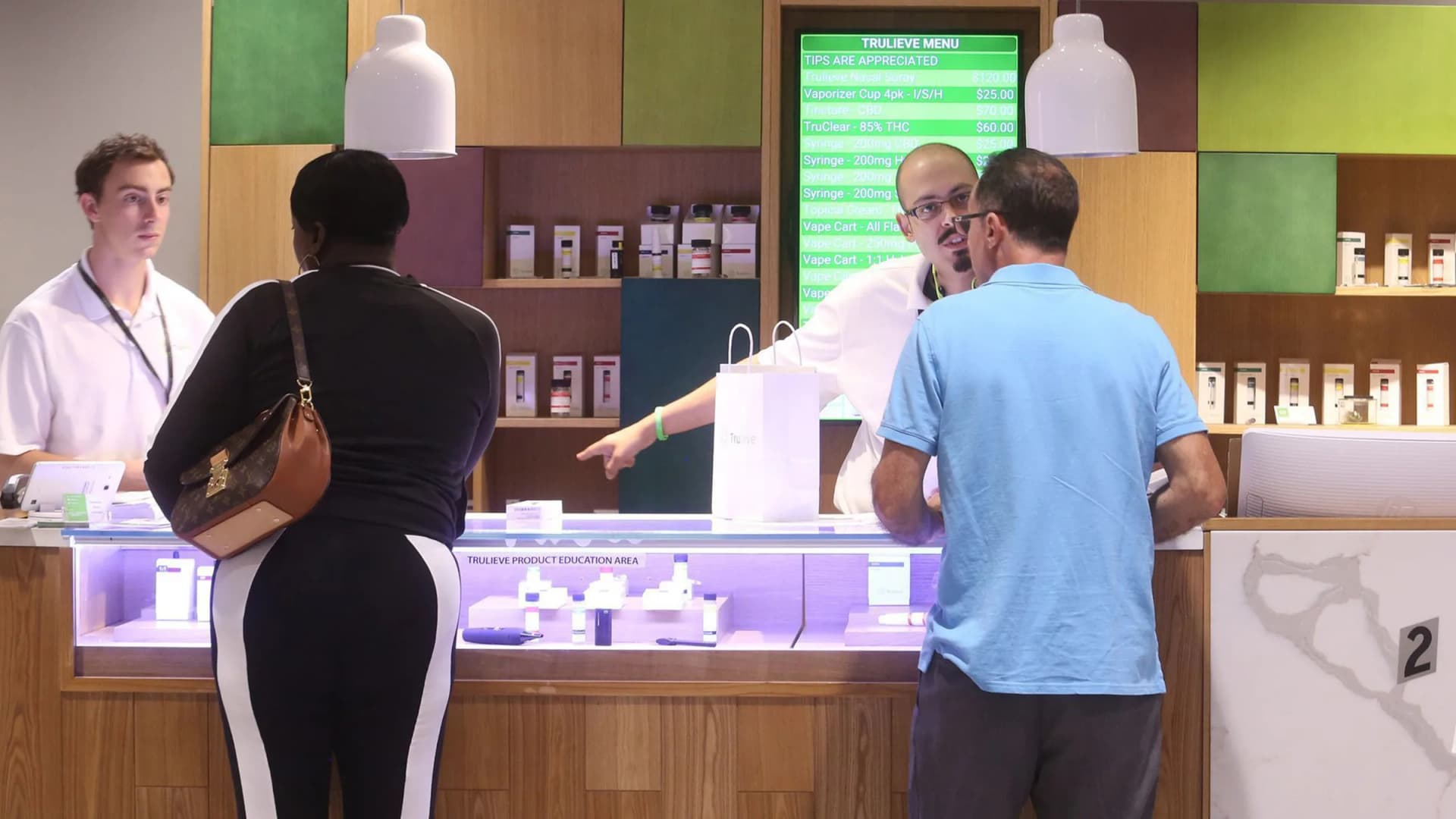
For the first time, a company that grows and sells cannabis in the United States trades on the New York Stock Exchange. One month in, the milestone has held up better than the stock price.
Trulieve Cannabis Corp. began trading as NYSE: TRLV on June 10, 2026, after announcing exchange approval on June 5.[3] Business of Cannabis reported the stock opened at $11.50. By July 9, it closed at $8.84, according to FinancialContent market data.
A first, with an asterisk
Cannabis companies have traded on U.S. senior exchanges before. Canopy Growth, a Canadian producer, reached the NYSE years earlier.[6] Trulieve's claim is narrower and, for U.S. investors, more consequential: it is the first plant-touching operator with U.S. cannabis licenses to list on a major American exchange.
Federal policy made the opening. In April 2026, the Justice Department and DEA placed FDA-approved marijuana products and marijuana products regulated by a state medical license in Schedule III of the Controlled Substances Act.[2] A broader rescheduling process for the rest of the plant continued separately.[5]
Kim Rivers, Trulieve's founder and CEO, tied the two directly together. "As the first U.S. cannabis company to list on a major U.S. exchange, we are excited for the opportunity to expand our shareholder base, increase liquidity, and raise awareness for the benefits of medical marijuana. Common sense action by President Trump to reclassify medical marijuana to Schedule III paved the way for this historic milestone," she said in the company's announcement.
The price of admission: going medical-only
The listing required surgery on the company itself. On June 3, 2026, Trulieve entered agreements to deconsolidate Harvest Enterprises, LLC and segregate its mixed medical and adult-use business from its medical business "in order to apply to list" on the NYSE.[1]
Photo: VapeExperts/AI
The split left two very different footprints, according to the company's investor presentation. The NYSE-listed medical business holds 206 dispensaries and 3.5 million square feet of DEA-registered production capacity. Harvest, which took the mixed medical and adult-use markets, holds 36 dispensaries and 0.5 million square feet. Trulieve kept a 90% economic interest in Harvest but no consolidated control. An outside buyer, Whitley Holding 05192026, LLC, paid about $14.8 million for voting units carrying a 10% economic stake.
April 28, 2026
Final rule placing FDA-approved and state-licensed medical marijuana in Schedule III is published.
June 3, 2026
Trulieve agrees to deconsolidate Harvest, splitting adult-use operations from the medical business.
June 5, 2026
Trulieve announces NYSE approval under the ticker TRLV.
June 9, 2026
CSE delisting takes effect; Trulieve authorizes a buyback of up to $50 million.
June 10, 2026
TRLV opens on the NYSE at a reported $11.50.
June 11, 2026
President Jason Pernell and the company mutually agree to end his employment.
The debut did not hold
Exchange access is not the same thing as demand. Business of Cannabis reported the stock touched $11.75 the day after its debut, then fell to $10.35 by June 14, roughly a 10% decline in four days. MarketBeat data showed closes in the high $8 range through early July.
TRLV share price after NYSE debut
Source: Business of Cannabis, MarketBeat, FinancialContent
The slide fits a sector-wide pattern we covered in our mid-year cannabis stock report. AdvisorShares data through June 30 showed its leveraged cannabis fund down 24.55% year to date, with the North American Marijuana Index down 6.57% over the same stretch.
Trulieve moved on several fronts after the debut. The company authorized share repurchases of up to $50 million or 8,495,038 shares, equal to 5% of subordinate voting shares as of June 8, expiring June 16, 2027. President Jason Pernell left the company effective June 11, one day after the listing, under a mutual separation agreement that restricts his share transfers for one year.[4] And Rivers sold 136,811 shares on June 26 at a weighted average price of $8.756, leaving 1,476,913 directly held shares, according to an SEC Form 4 filing.
The company also kept expanding its medical footprint, announcing a ceremonial first sale in Marietta, Georgia on July 1 tied to that state's medical-cannabis launch. Trulieve's investor presentation cited $1.2 billion in 2025 consolidated revenue and $273 million in cash flow from operations.
Adult-use is still locked out
The structure of the deal shows what Schedule III did not change. Adult-use cannabis remains outside the listed company. Trulieve had to move those operations into Harvest to qualify.[1]
Neil Kaufman, an attorney at Kaufman McGowan PLLC, told Forbes where the real barrier sits: "The key to unlocking U.S. capital markets will be when U.S. national securities exchanges allow direct listings by recreational plant-touching companies."[3]
Law firm Akerman made the case for why listings matter at all. Trading on Canadian exchanges and OTC markets, the firm wrote, has cut U.S. operators off from "the deeper liquidity, broader institutional participation, and analyst coverage that a major U.S. listing would provide." Kraig Fox, CEO of cannabis credit-rating firm Rekl Credit Solutions, told Forbes the listing gives Trulieve "true liquidity access to deeper, institutional shareholder base."[3]
Photo: VapeExperts/AI
What to watch
- The DEA hearing on broader marijuana rescheduling began June 29.[5] Its outcome will decide whether the medical-only carve-out stays necessary.
- Smart Approaches to Marijuana and NDASA filed a petition for review challenging the April rescheduling order in May. We are watching the docket.
- Whether other multistate operators copy the Trulieve structure, splitting medical from adult-use to reach the NYSE or Nasdaq.
- Whether Trulieve deploys its $50 million buyback authorization, which runs through June 16, 2027.
- Whether a medical-only listed company can grow fast enough to justify what it left behind in Harvest.
The listing answered one question: Schedule III can put a U.S. cannabis operator on Wall Street. The next month of trading raised another, which is what investors will pay for it.