

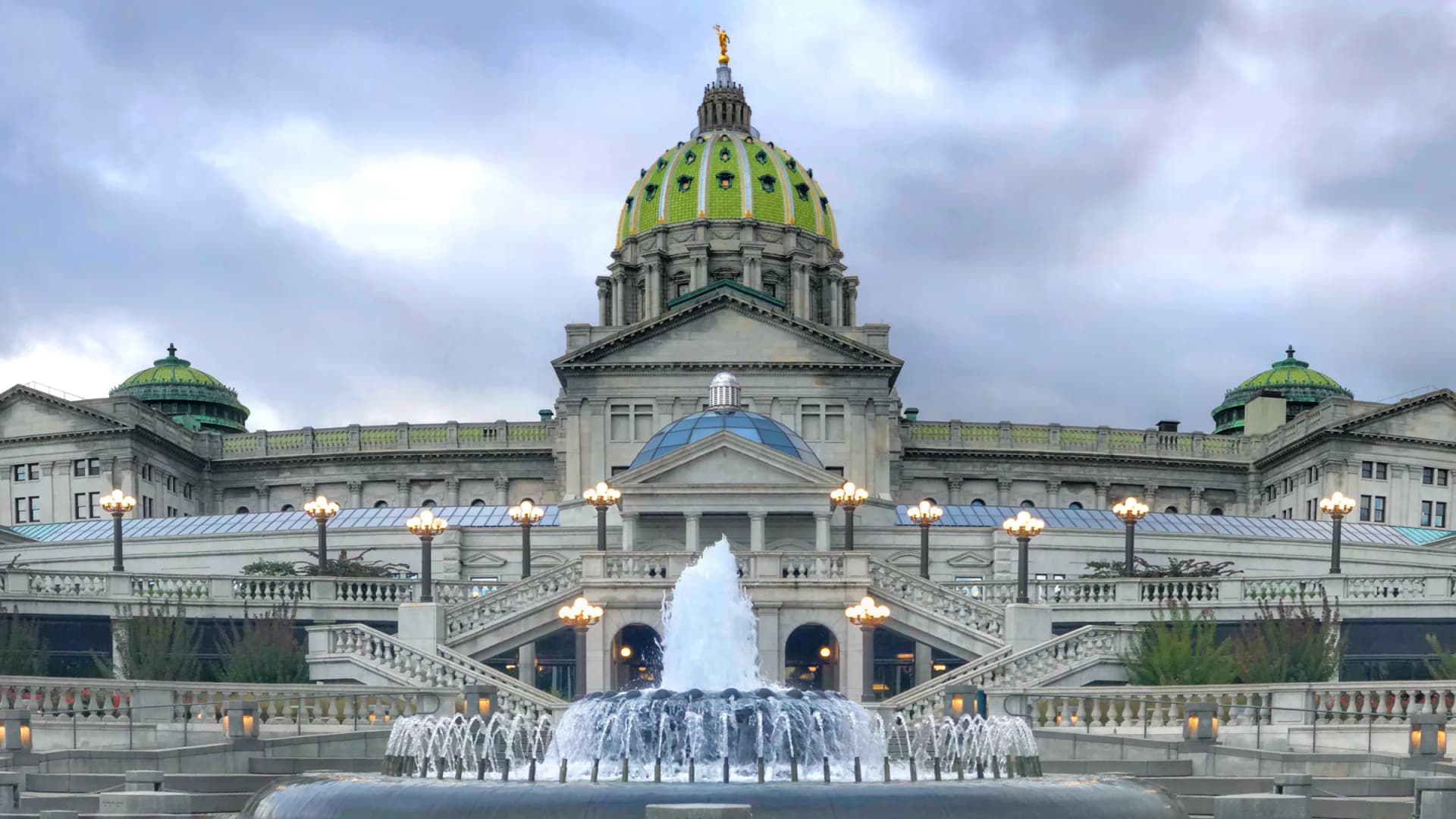
Pennsylvania will not legalize adult-use cannabis this year. Gov. Josh Shapiro signed a $50.85 billion budget on July 12, almost two weeks past the June 30 deadline, and the deal contains no legalization, no licensing system and no cannabis tax.[1] It is the fourth straight budget cycle in which Shapiro asked for legal cannabis and did not get it.
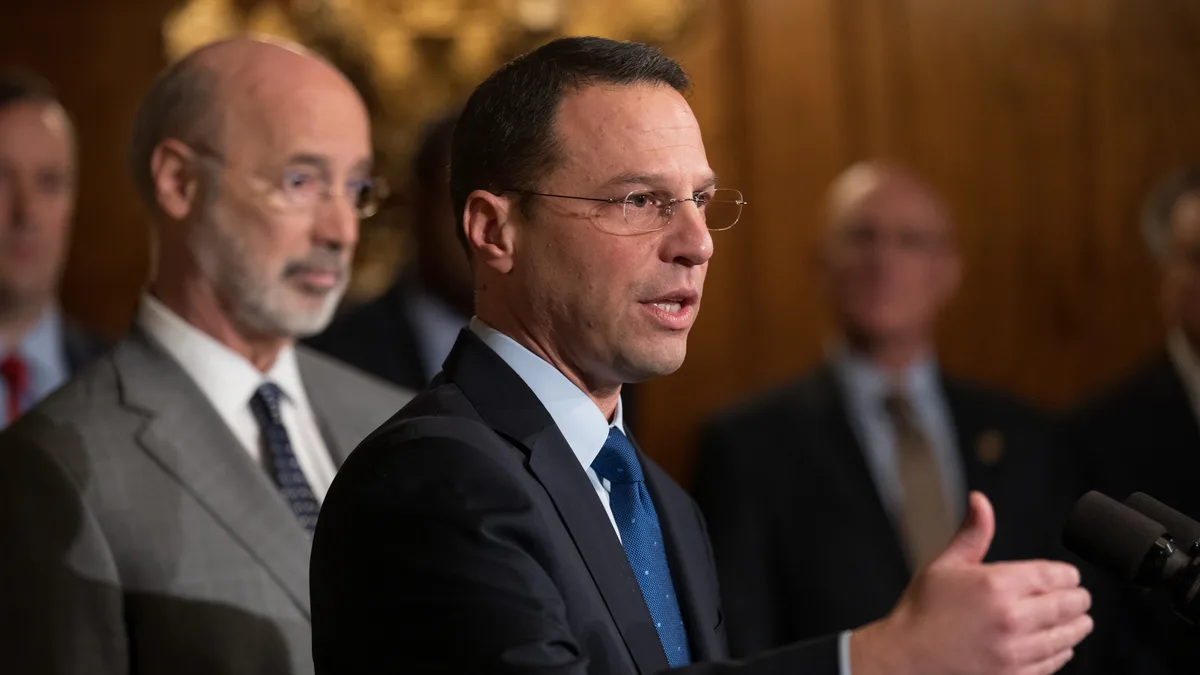
Photo: Governor Tom Wolf from Harrisburg, PA/Wikimedia Commons (CC BY 2.0)
Pennsylvania Attorney General Josh Shapiro speaks at a podium as Governor Tom Wolf stands nearby at a 2019 press event. State leaders again passed a budget without legalizing cannabis.
The main spending bill passed the Senate 44-6 and the House 167-35. A minimum-wage increase and regulation of skill games also fell out of the final agreement. Spotlight PA reported that negotiators deliberately set aside divisive issues, cannabis among them, to get a deal done.
Fourth proposal, fourth failure
Shapiro's February budget plan called for legalization effective July 1, 2026, with regulated sales starting January 1, 2027. It projected $729.4 million in first-year revenue from a 20% wholesale tax plus ordinary sales tax.[2] Roughly 90% of that figure, about $659.6 million, came from one-time licensing fees, not recurring taxes. The state projected more than $200 million annually once the market matured.
"We're putting our communities at risk and losing out on billions of dollars in revenue by doing nothing," Shapiro said in February.
The final budget came in about $2.4 billion below his roughly $53.3 billion request. Senate Appropriations Chair Scott Martin, R-Lancaster, told reporters before the vote that "this budget allows the commonwealth to fight yet another day."
Feb. 4, 2025
Shapiro proposes legalization and expungement in his FY2025-26 budget.
May 7, 2025
The House passes HB1200, a state-store legalization bill, 102-101.
May 13, 2025
The Senate Law and Justice Committee rejects HB1200, 7-3.
July 10, 2025
The bipartisan private-market bill SB120 is referred to committee. It never gets a vote.
Feb. 3, 2026
Shapiro proposes legalization a fourth time, projecting $729.4 million in first-year receipts.
June 10, 2026
SB49, a narrower Cannabis Control Board and hemp bill, fails on the Senate floor 23-27.
July 12, 2026
Shapiro signs a $50.85 billion budget with no cannabis provisions.
Two chambers, two incompatible models
The blockage is not a simple yes-or-no fight. The chambers back different market designs.
House Democrats passed HB1200 in May 2025 by a single vote, 102-101.[4] It would have put retail cannabis under the Pennsylvania Liquor Control Board, a state-store model no other state uses. The Republican-controlled Senate Law and Justice Committee killed it six days later, 7-3.
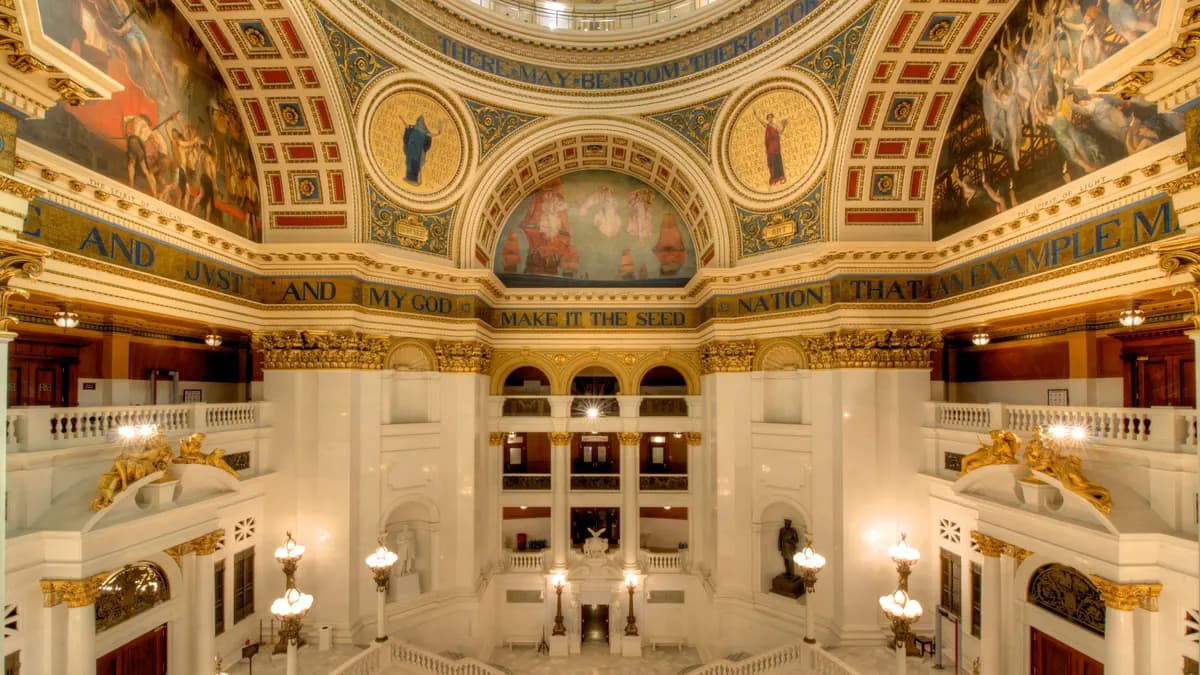
Photo: Bestbudbrian/Wikimedia Commons (CC BY-SA 3.0)
The ornate rotunda of the Pennsylvania State Capitol features murals, gilded details and grand marble staircases. Lawmakers there passed a state budget that again excluded legal cannabis.
Senate Majority Leader Joe Pittman, R-Indiana, told Spotlight PA his caucus remains divided and faulted both the House and the governor: "When the House Democrats passed recreational marijuana last year, and they came up with that crazy plan to have the state stores implemented, we heard nothing from the governor on whether or not he'd even sign the bill."
A bipartisan alternative exists on paper. SB120, from Republican Sen. Dan Laughlin and Democratic Sen. Sharif Street, would allow adults 21 and older to possess up to 30 grams of flower, five grams of concentrate or 1,000 milligrams of THC in infused products, taxed at a combined 14% through private licensed businesses. Its last recorded action is a committee referral on July 10, 2025. No hearing. No vote.
Even a narrower bill failed. SB49 would have created a seven-member Cannabis Control Board and restricted intoxicating hemp products without legalizing adult use. It lost on the Senate floor 23-27 on June 10. A 29-21 reconsideration vote keeps it procedurally alive, but inactive.
Voters say yes; the Senate math says no
Public opinion is not the obstacle. A February Quinnipiac poll found 56% of Pennsylvania voters support legalization and 37% oppose it.[3] But Republicans in the same poll opposed it 64%-32%, and Republicans hold a 27-23 Senate majority. That gap between what voters want and what law delivers is a pattern we have covered around the world.
An industry-commissioned Susquehanna Polling & Research survey of 705 likely voters put support higher, at 69%. Berwood Yost, who directs Franklin & Marshall College's Center for Opinion Research, urged caution about the sponsor, the Pennsylvania Cannabis Coalition. "You would have to examine any poll whose findings align with the organization that sponsored it," he told TribLive, while noting the broad direction matched academic polling.
Nonpatients are running out of legal options
For consumers, the failure leaves a split market. Medical dispensaries sold roughly $1.8 billion of cannabis in 2025, and the Health Department counted 438,244 active patient certifications and 192 dispensaries as of March 1.[6] Adults without a medical card have no lawful in-state option.
Pennsylvania medical cannabis sales, 2025
Source: Pennsylvania Department of Health
The gray-market alternative is closing too. Federal law H.R.5371, signed November 12, 2025, redefines hemp effective November 12, 2026. It moves to a total-THC standard, excludes many synthetic cannabinoids, and caps finished products at 0.4 milligrams of total THC per container.[5] That threshold would push most intoxicating delta-8 products, THC beverages, edibles and hemp-derived vape cartridges out of the federal hemp category. SB49 would have written matching rules into state law. Its defeat means Pennsylvania has no equivalent state provisions on the books.
Enforcement is already uneven. Northampton County authorities reported seizing 6,000 packages of THC vapes and edibles and more than $375,000 in cash from four convenience stores in May 2025. Meanwhile, arrests continue statewide: Pennsylvania police made 12,707 marijuana arrests in 2024, including 11,154 for possession, according to FBI data compiled by NORML.[7]
November 3 decides what happens in 2027
The next legalization fight now runs through the ballot. All 203 House seats and 25 of 50 Senate seats are up on November 3, along with the governorship. Shapiro backs legalization. His Republican opponent, state Treasurer Stacy Garrity, told TribLive she does not support it and has said she would veto an adult-use bill if elected.
Photo: VapeExperts/AI
Standalone bills technically stay alive until the session ends. But no hearing is scheduled, and the two chambers have not agreed on retail structure, taxes, licensing, expungement or home cultivation.
One date is already fixed. Nine days after Pennsylvanians vote, on November 12, the federal hemp definition changes. Unless lawmakers act, nonpatients could lose most of the intoxicating hemp market without a state-regulated alternative in place.