

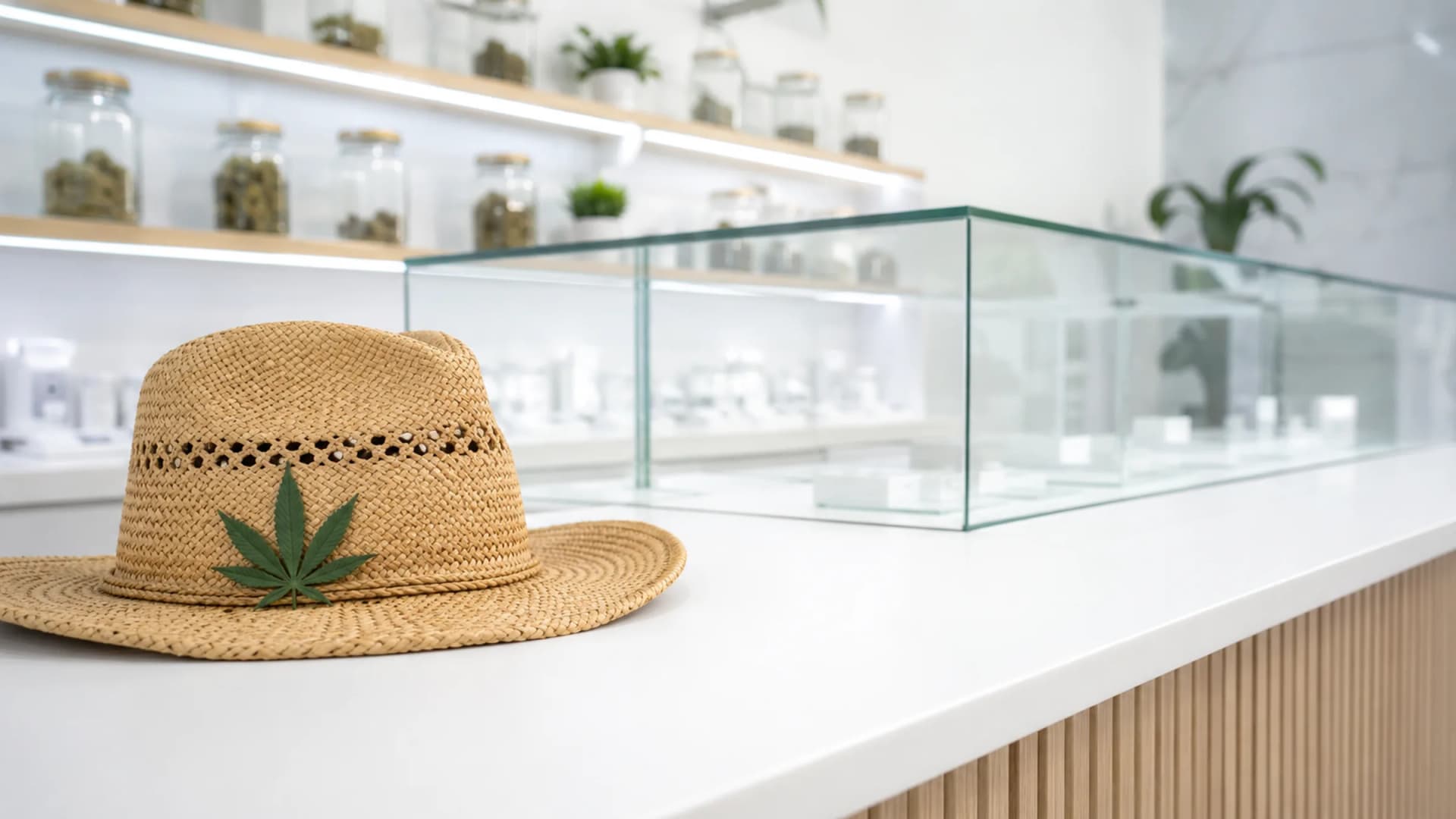
Walk down Sukhumvit in Bangkok or the beach roads of Phuket and Koh Samui in mid-2026 and you will still see cannabis dispensaries selling flower to foreigners. On paper, Thailand has been a medical-only market since June 2025. The gap between those two facts now defines cannabis tourism in the country, and the risks for visitors are not where most of them expect.
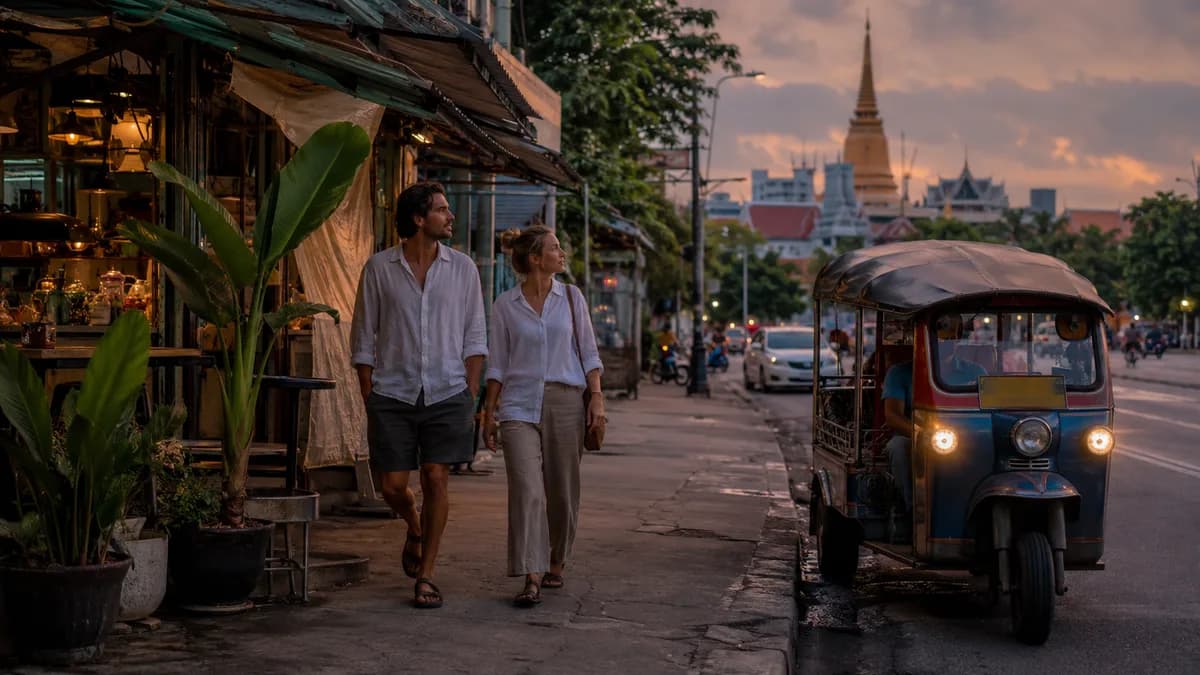
Bangkok's dispensary-lined streets still hum at dusk, but the rules of what's on offer have quietly changed.
Four years of legal whiplash
Thailand became the first Asian country with an open cannabis flower market when a Ministry of Public Health notification took effect on June 9, 2022. Cannabis and hemp plant parts came off the Category 5 narcotics list, though extracts above 0.2% THC stayed controlled.[2] Shops, cafes and delivery services multiplied fast, especially in tourist zones. No full cannabis control act was in place to govern them.
Politics has been chasing that loophole ever since.
Feb. 2022
Health Minister Anutin Charnvirakul signs the notification removing cannabis from the narcotics list.
June 2022
The delisting takes effect after a 120-day Royal Gazette delay. Retail booms.
May 2024
Prime Minister Srettha Thavisin pushes to relist cannabis as a narcotic by year end.
June 2025
Health Minister Somsak Thepsuthin signs a controlled-herb order requiring prescriptions for flower sales.
Sept. 2025
Anutin, architect of the 2022 opening, becomes prime minister.
The decisive turn came after the Bhumjaithai Party, which championed the 2022 delisting, left the ruling coalition in June 2025. Public Health Minister Somsak Thepsuthin signed a new notification classifying cannabis flower as a controlled herb, a move Reuters reported as shaking an industry it valued at about $1 billion.[2] Forbes reported in April 2026 that the medical-only framework has held.[6]
The law says medical only. The shops adapted.
Under the 2025 order, cannabis flower can only be sold to individuals with a prescription from an approved professional, capped at 30 days' use. Vending machines, online sales and commercial advertising are banned. Shops must keep source and inventory records and cannot sell near schools, temples, parks or dormitories.
Somsak was direct about who the rule covers. "Anyone wishing to purchase cannabis flowers for smoking, whether Thai or foreign, will need a doctor's prescription for medical use," he told Reuters in May 2025.[1]

These days, a quick chat with a doctor is often all that stands between you and the dispensary counter.
The key document is the PT33 prescription form, also called Phor Thor 33. A Thai public health news summary reported that 3,693 professionals had been trained to issue cannabis prescriptions by September 2025, with a fee cap of 300 baht per prescription. Those figures come from a single ministry summary and we have not seen them independently confirmed.
On the ground, dispensary websites and travel guides describe a routine that takes minutes: show a passport, fill out a health questionnaire, pick a qualifying symptom such as insomnia or chronic pain, pay a fee, and walk out with a PT33 valid for up to 30 days. Reported fees range from 100 baht at some Bangkok shops to 2,000 baht at private clinics. Flower commonly runs 200 to 800 baht per gram, according to those same tourist-facing sources. None of that pricing is official, but it is consistent across the guides we reviewed.
Enforcement pressure falls mainly on retailers, not buyers. CNN reported seller penalties of up to one year in prison or a 20,000 baht fine for violating the new rules. Shops must retain prescription copies for audit and report monthly.
The airport is where tolerance ends
The best-documented tourist arrests of 2025 and 2026 involve suitcases, not joints. In March 2025, authorities at Samui International Airport arrested 13 foreigners over four days and seized 375 kg of cannabis packed into 22 suitcases, worth about 75 million baht, roughly $2.2 million, according to reporting citing the Bangkok Post. One sub-case involved four British men caught with 131 kg in eight suitcases. Charges included Customs Act violations and controlled-herb offenses.
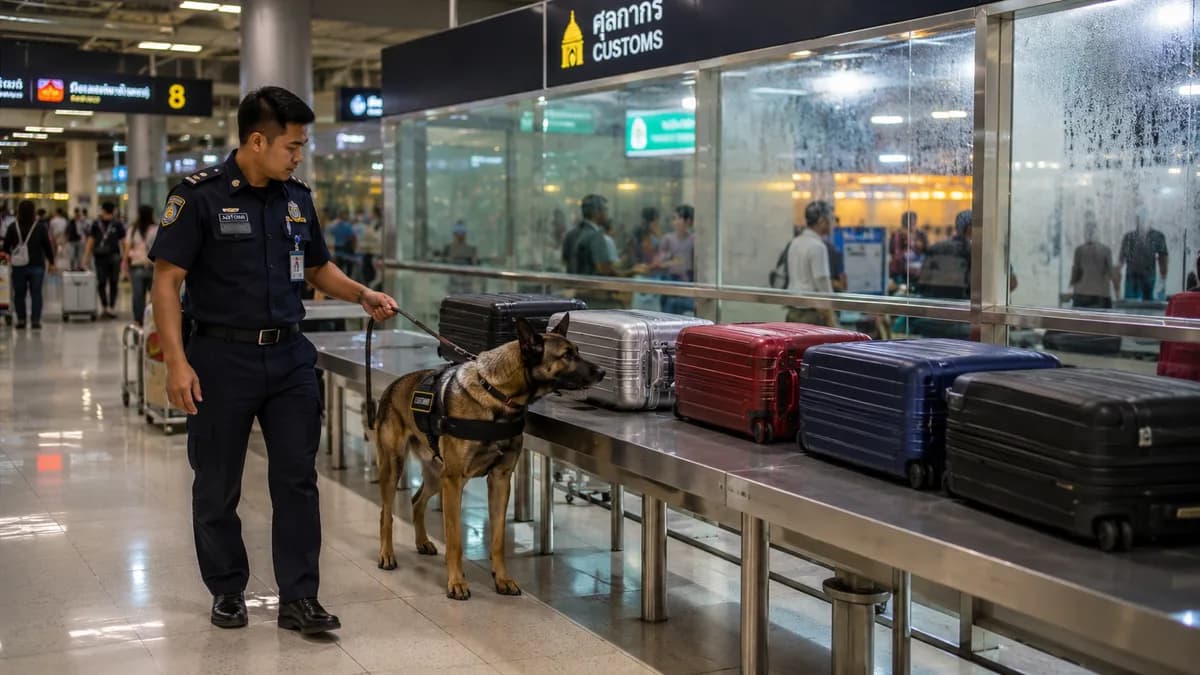
Whatever you picked up in town, leave it there: airport sniffer dogs take their job very seriously.
AP and Bloomberg both reported that the smuggling surge was a driving reason Somsak pushed the prescription rules.[3][4] Import and export of cannabis without authorization has been illegal throughout, including during the open 2022 to 2024 period.
Public smoking is the other trap. Cannabis smoke can be treated as a public nuisance under Thai public health law. Legal and travel summaries commonly cite penalties of up to 25,000 baht and three months' imprisonment, though we could not confirm those exact figures in official sources.
Vapes live under a different, harsher law
Here is the part that catches vaporizer users off guard: Thailand's cannabis rules and its vape rules are separate legal universes. Cannabis flower sits under health and traditional-medicine law. Vaping hardware sits under customs, consumer-protection and tobacco-control law, and that regime is far tougher.
Thailand's official government portal states that importing e-cigarettes can bring up to 10 years' imprisonment, a fine of five times the product price, or Customs Act penalties up to 500,000 baht. Possessing illegally imported vape products can bring up to 5 years' imprisonment. Selling carries up to three years or a 600,000 baht fine.
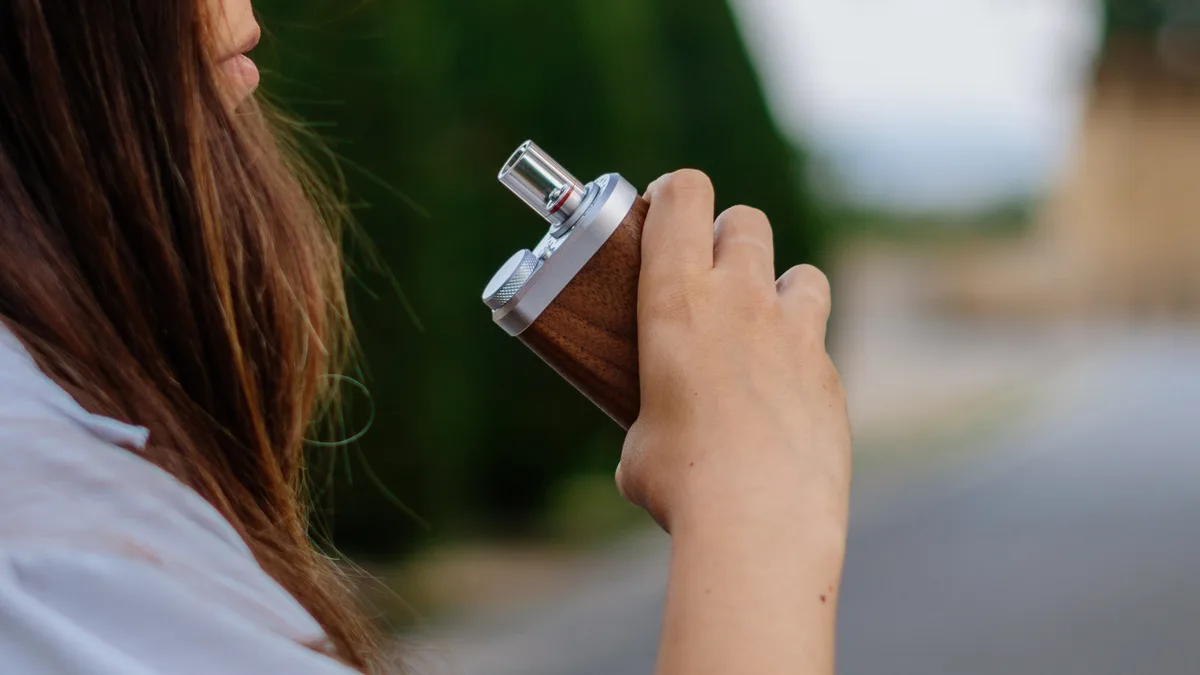
Photo: VapeExperts
A woman holds a Tinymight 2 vaporizer outdoors. Devices like this fall under Thailand's stricter vape ban even as cannabis shops remain open under the medical-only law.
The result is a strange inversion. A tourist carrying flower with PT33 paperwork has a legal defense. A tourist carrying a THC cartridge or a nicotine vape pen has none. The 2023 case of Taiwanese actress Charlene An, who was stopped at a Bangkok police checkpoint over a vape, shows how this plays out in practice. Nation Thailand reported that police later admitted officers extorted 27,000 baht from her group. "I want to apologise to everybody for some police officers' actions that have damaged the image of Thailand and Thai society," Metropolitan Police commissioner Pol Lt-General Thiti Saengsawang said afterward.
Dry herb vaporizers occupy a gray zone. Some retailers and community guides argue that a dry herb vaporizer is not an e-cigarette because it heats flower rather than liquid. Others warn that customs and police treat all vaporizers broadly. The legal distinction may exist on paper, but there is no documented case of it protecting a tourist at a checkpoint. We covered the vape side of Thai law in more detail in our earlier coverage.
The man who opened the market now governs the backlash
Anutin Charnvirakul, the health minister who signed the 2022 delisting, became prime minister in September 2025, according to AP.[5] He inherited the tightened medical-only regime his rivals built.
Anutin and Bhumjaithai have long argued their goal was medical and economic cannabis, not uncontrolled recreational use, and that they tried to pass a proper cannabis control bill but lacked coalition support. In July 2026, Thai outlet ThaiRath reported Anutin telling the Narcotics Control Board that cannabis policy should rest on government data rather than pleasing ministers or those in power. That account comes from a single Thai media report.
The Somsak camp's position was equally clear: medical only, with recreational sales stopped, and relisting cannabis as a Category 5 narcotic kept on the table.
What to watch
- Whether Anutin's government amends the controlled-herb order or finally passes a full cannabis control act, the law Thailand has lacked since 2022.
- Whether relisting cannabis as a Category 5 narcotic returns to the agenda, or stays shelved under a Bhumjaithai-led government.
- How hard regulators audit PT33 records. The paperwork system exists; the open question is whether shops that cannot prove compliant sourcing start losing licenses.
- Whether Thai courts or customs ever draw a formal line between dry herb vaporizers and banned e-cigarettes. Until one does, the practical rule for travelers is unchanged: if it looks like a vape, assume it will be treated as one.