

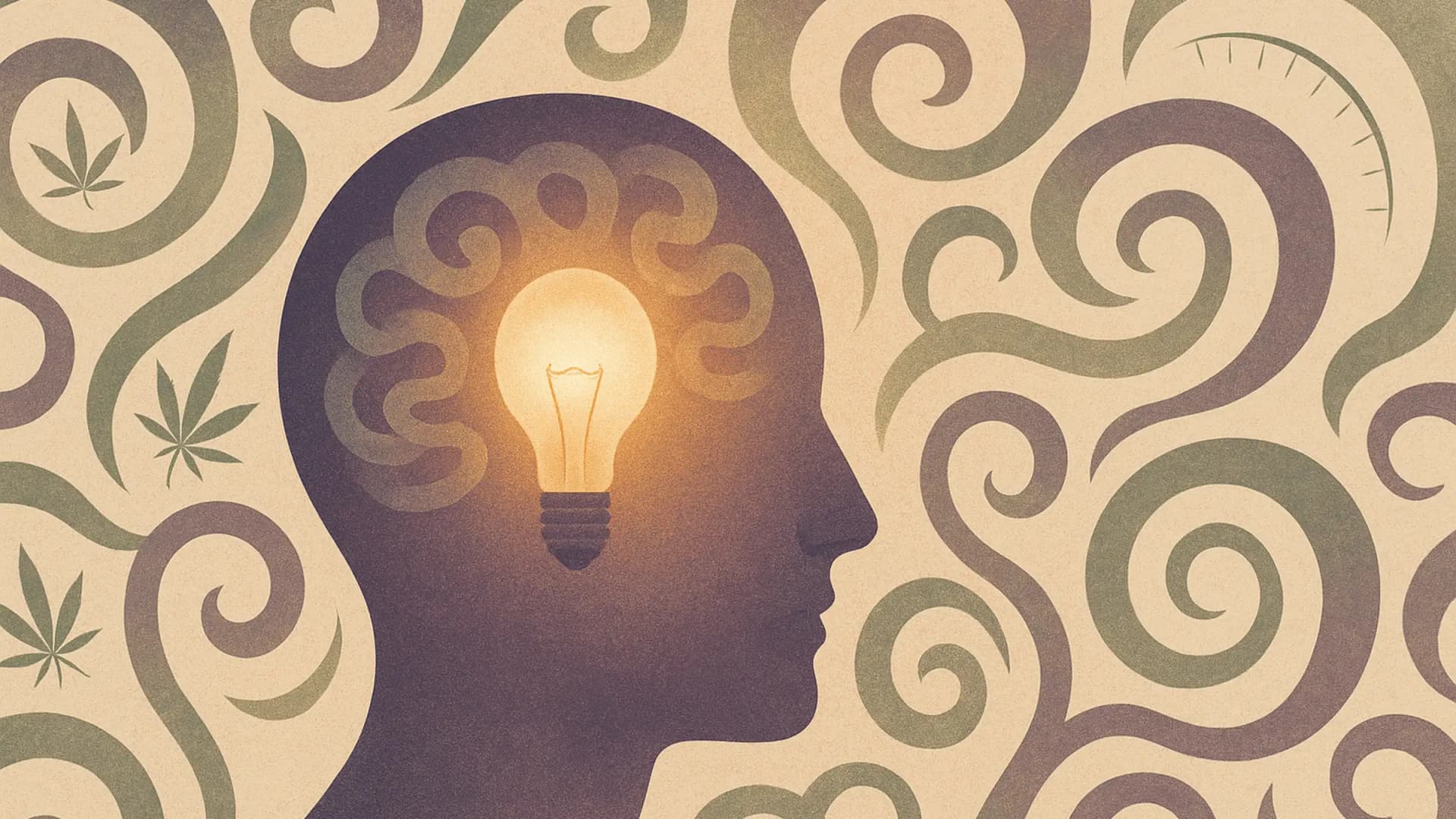
For 180 years, artists have sworn cannabis unlocks something. Victor Hugo. Louis Armstrong. Steve Jobs. The science finally caught up to the claim, and the answer is uncomfortable: cannabis makes you feel more creative without making your work better.
That gap between feeling and output is the whole story. The studies show cannabis biases your judgment of ideas, your own and other people's, while leaving the actual quality untouched.
The single most important finding
In 2022, a study in the Journal of Applied Psychology by Heng et al. tested whether cannabis improved creative work. It did not.
What it did was raise joviality, a sense of elation and good mood. High participants rated their ideas as more creative. They also rated other people's ideas as more creative.
The output itself did not change. This is the "creativity illusion." Cannabis tunes your internal critic down, so everything looks better, including work that is not.
A 2017 study in Psychopharmacology by LaFrance et al. found the same split. Users felt more creative. Their scores on objective creativity tests did not move.
The dose window is razor-thin
The clearest lab evidence comes from a 2015 Psychopharmacology study by Kowal et al., one of the few to use vaporized cannabis under controlled conditions.
Researchers gave 54 regular cannabis users vaporized Bedrocan at three doses: placebo, 5.5 mg THC, and 22 mg THC. They measured divergent thinking, the brainstorming mode that generates many ideas.
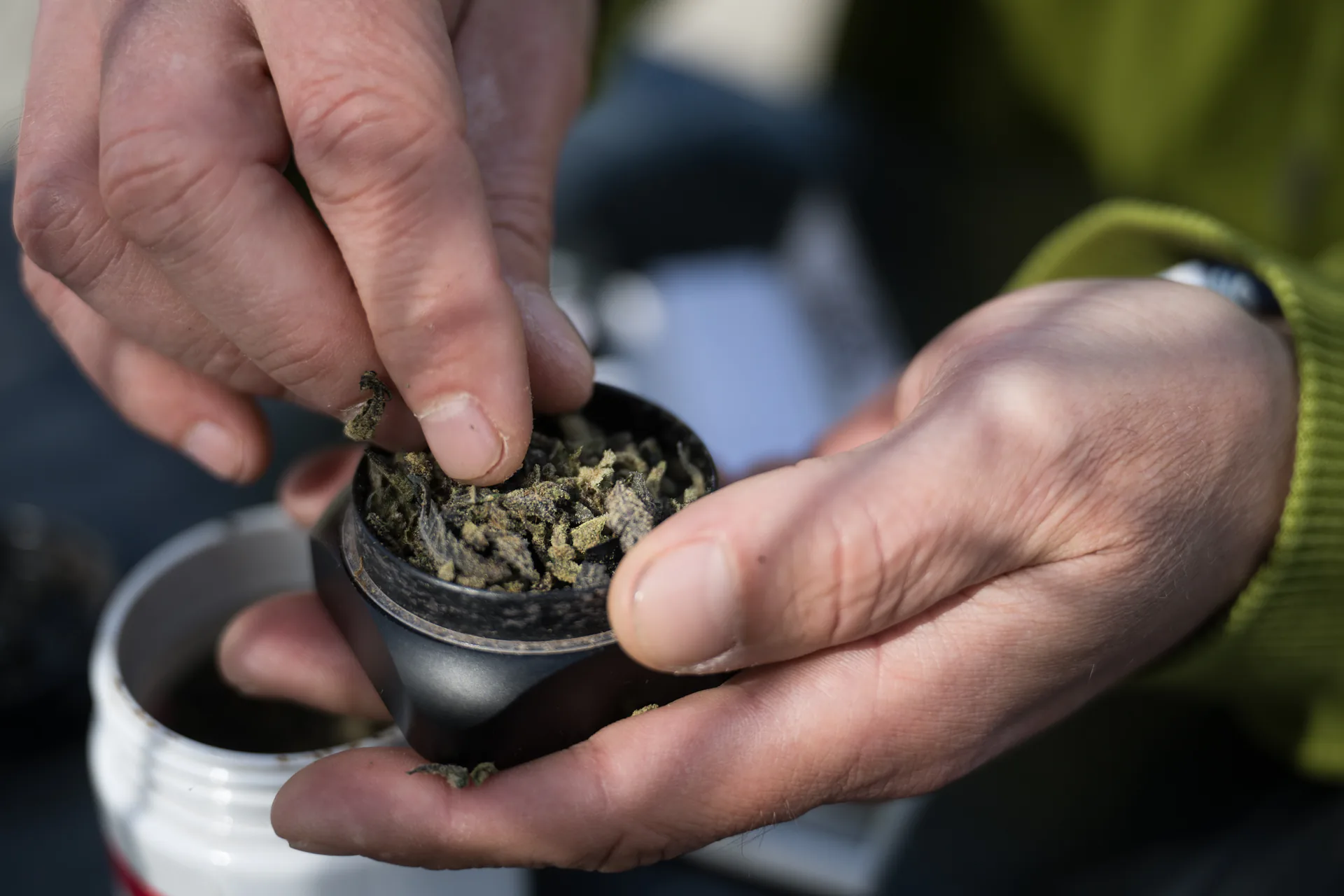
Photo: Sebastian Gollnow/dpa/picture-alliance/Newscom
A man puts marijuana into a grinder to make a joint in Berlin, Wednesday, March 27, 2024.
The 22 mg dose impaired fluency, flexibility, and originality across the board. The 5.5 mg dose showed no improvement over placebo. Convergent thinking, the editing mode, did not change at any dose.
The takeaway from the broader research: a benefit window of roughly 2 to 5 mg THC, if it exists at all. Above 10 mg, as the community puts it, "lift becomes scatter."
| Dose | Effect on creative thinking |
|---|---|
| Microdose (1-5 mg THC) | Subtle shift, possible idea fluency boost |
| Low (5-10 mg) | Possible help for "low creatives" only |
| High (10-22+ mg) | Impairs thinking, memory, attention |
Who actually benefits
A 2012 study in Consciousness and Cognition by Schafer et al. found a strange pattern. Cannabis raised divergent thinking, but only in people who scored low on creativity when sober.
Those "low creatives" reached the same verbal fluency as naturally high-creative people. The high creatives got no benefit and some impairment.
The likely mechanism is not enhancement. It is disinhibition. Cannabis loosens the mental filters in people whose default style is more rigid. If your filters were already loose, it just gets in the way.
The personality confound nobody talks about
Here is the part that complicates the whole picture. A study of 979 students found that cannabis users scored higher on objective creativity tests, even while sober.
But those same users also scored higher in openness to experience and extraversion, two traits independently linked to creativity.
So the link may run backward. Creative, open people may be more likely to seek out cannabis. The plant is not making them creative. Their personality drew them to both.
The brain wiring is real, though
The biology is not pure illusion. A 2024 study in Communications Biology by Liu and colleagues at Penn State and Southwest University mapped the neural signature of divergent thinking across more than 1,300 people.[1]
Divergent thinking engages the brain's default mode network (spontaneous idea generation) and the frontoparietal control network (filtering), while suppressing the visual network.
The creativity pattern is positively correlated with CB1 cannabinoid receptors and with dopamine-related neurotransmitters. The endocannabinoid system is, in a literal sense, wired into the creative circuit.
The same study warns that "highly potent cannabis which affects CB1 receptors may impair DT." The receptors are co-located with creativity. Flooding them backfires.
What the artists said
The cultural record is full of testimony. Steve Jobs said cannabis "would make me relaxed and creative." Alanis Morissette described "a sweet jump-starting quality. It removes veils."
That "removes veils" line maps cleanly onto the science. It is decreased inhibitory control, the same disinhibition the lab studies measure.
But the testimony cuts both ways. Elton John said "cannabis was the worst drug for me." Individual variation is real, and the plant does not work the same way for everyone.
The workflow that matches the evidence
Creative communities have arrived at a practice that lines up neatly with the data. Ideate high. Edit sober.
The pattern: take a small dose for brainstorming, capture everything without judgment, sleep on it, then review and refine clear-headed. As one musician put it, "Next morning I scrap half my beats."
This is the science in plain language. Cannabis can lower self-censorship during ideation. The critical evaluation phase belongs to sobriety.
Vaporizers fit this method because of fast onset and dose control. The Kowal study used a vaporizer precisely because it delivers measurable, consistent doses, the method most aligned with the narrow window the evidence describes. For systematic microdosing, see our guide to the best vaporizer for microdosing. One caveat: each puff varies with temperature and draw, so labeled edibles still win on precision.
Why this matters now
The research is about to get much easier. Cannabis has been Schedule I since 1970, which has been the single biggest obstacle to controlled study.
That changed on April 23, 2026, when Acting Attorney General Todd Blanche placed FDA-approved and state-licensed medical marijuana products in Schedule III,[3] effective April 28, the first shift in 56 years. It followed a December 2025 White House executive order on expanding cannabis research.[4]
A DEA hearing on rescheduling all marijuana to Schedule III begins June 29, 2026, six days from now.
NIDA Director Nora Volkow laid out a new research roadmap in January 2025, citing a 2024 National Academies report.[2] NIDA has adopted a standard 5 mg unit of THC for funded studies, almost exactly the dose window creativity research points to.
If rescheduling holds, scientists could finally study the products people actually buy, at the doses they actually use. The question the artists have asked for 180 years may soon get a real answer. For now, the honest one is this: cannabis is better at making you feel creative than making you creative.