

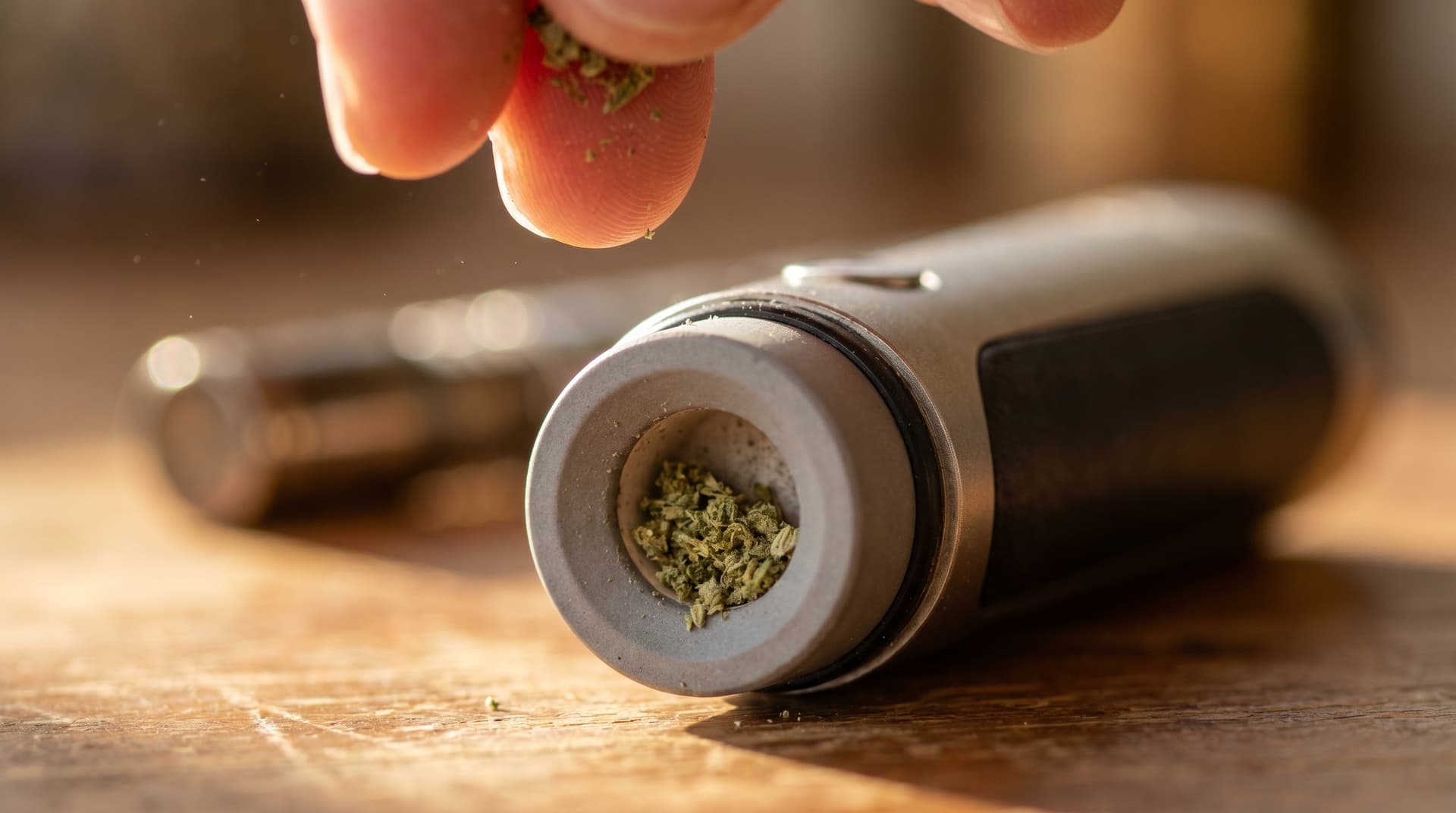
Microdosing cannabis means using a small load, about 0.025 to 0.1 g per session. The goal is a light, functional effect without getting properly high. A vaporizer makes this far easier than a joint, because you choose the temperature and can stop after a draw or two.
Our scoring methodology covers how we rate every vaporizer. For microdosing, what matters most is how a vape handles a small pinch. Some extract a 0.05 g load cleanly. Others turn the same load into thin, wispy vapor. The difference comes down to three factors: chamber size, heating style, and temperature control.
How to microdose with a vaporizer, step by step
- Weigh 0.05 g of ground cannabis on a milligram scale.
- Set your vape to 170°C and take 2 slow draws.
- Wait 10 to 30 minutes before you decide on more.
- Want more? Raise the heat 5°C and take one more draw.
- Log the strain, THC %, load, temperature and how you felt, then repeat the same setup next time.
What counts as a microdose of cannabis
A cannabis microdose is typically 0.025 to 0.1 g of flower. How much THC that holds depends on the strain. At 20% THC, a 0.05 g pinch contains about 10 mg, and only part of it ends up in the vapor you inhale. In a 2006 lab test of the Volcano, published in the Journal of Pharmaceutical Sciences, about half the THC loaded into the chamber made it into the vapor. So a 0.05 g pinch of 20% flower delivers about 5 mg at most, and the 2020 inhaler trial we cover below found pain relief at just 1 mg.
The point is to stay below the level where cannabis becomes distracting. Most people want a light buzz they can carry through the day. Strong flower can hit harder than you expect, even in a tiny load, so start smaller than you think you need.
Cannabinoids like THC and CBD, along with the terpenes that carry flavor, vaporize across a range of temperatures. A lighter simply burns the flower. A vaporizer heats it without burning and lets you choose the temperature. A small load then gives up its vapor gradually instead of all at once.
A microdose is not a green light to drive. Canada's Lower-Risk Cannabis Use Guidelines advise waiting at least 6 hours after using cannabis before you drive.
Why we prefer a vaporizer for microdosing
For microdosing, a vaporizer beats a joint because it extracts terpenes and cannabinoids progressively. You can take 2 draws, switch off, and come back to the rest later. A joint keeps burning whether you inhale or not, wasting flower every second it sits lit.
Edibles are the other common way to microdose, but they have two problems. Effects take 30 minutes to 2 hours to start and up to 4 hours to fully kick in. Adjusting on the fly is off the table. And how strongly they hit varies with your metabolism and what's in your stomach.
With a vaporizer, you feel the first effects within seconds to minutes. The full effects can take 10 to 30 minutes to arrive, so give it time before you decide on another draw.
If you use cannabis medically, our guide to vaporizers for medical cannabis covers the certified medical models. The core principle is the same either way: start low, step up slowly, and stop when you reach your target.
Small chambers extract microdoses more efficiently
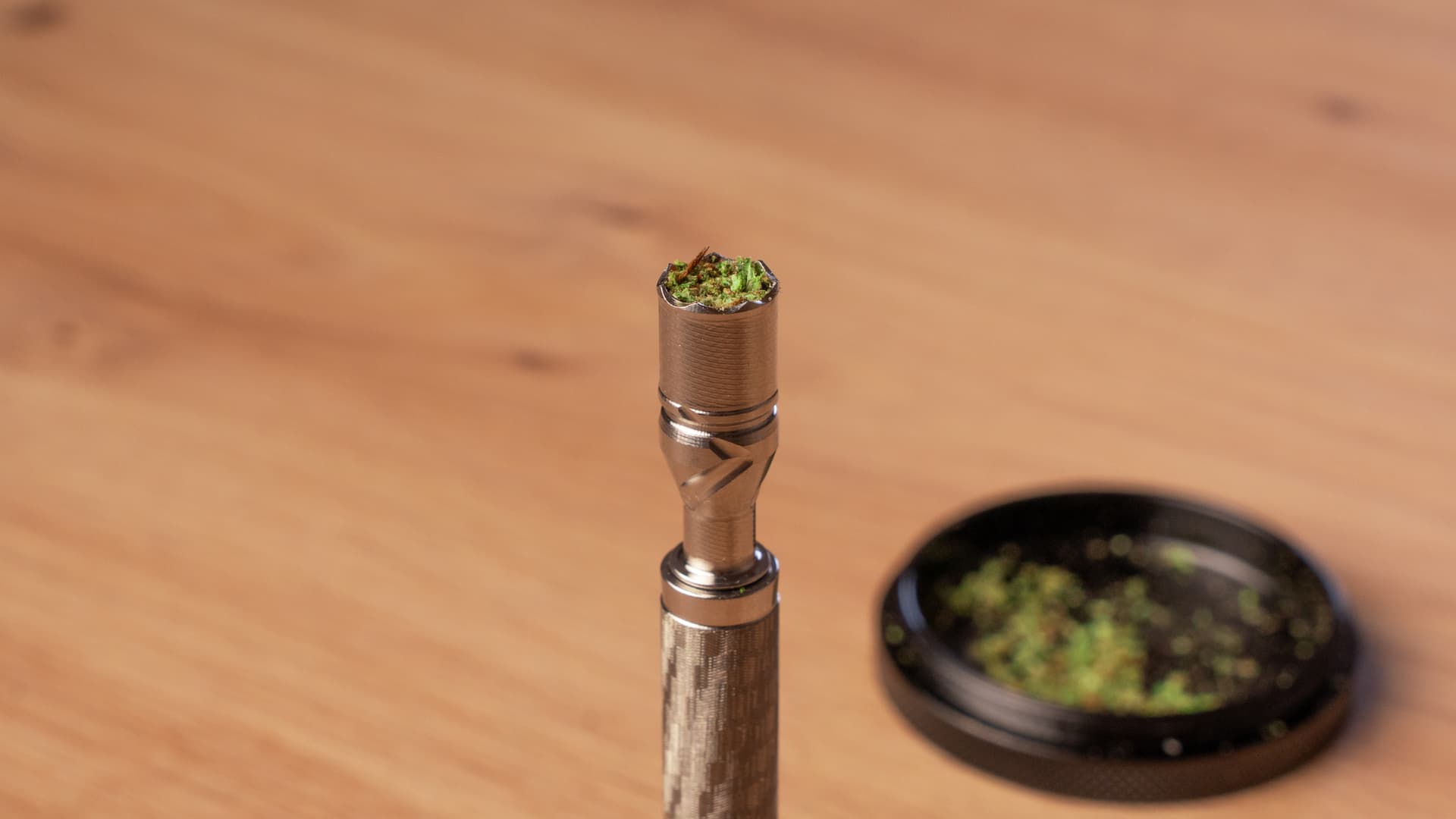
A small metal tip like the DynaVap M7's fills up with just a pinch, leaving little empty space for hot air to slip past.
In our experience, the most important feature for microdosing is a chamber that matches your load size. A 0.05 g pinch in a 0.3 g oven leaves a lot of empty space. In many designs, hot air then slips around the cannabis instead of passing through it. The result is weak, wispy vapor and wasted flower.
The Vapman 2.0 has a gold-plated copper pan built for loads from 0.03 to 0.1 g. A small load sits right on the heated pan. The DynaVap M7 is similarly compact. Its stainless steel tip holds about 0.1 g, and pushing the screen clip up gives you a half bowl of roughly 0.05 g.
Larger vapes work around this with accessories. Some ship with a spacer or an adjustable chamber floor that shrinks the space you need to fill. Several Storz & Bickel vapes take dosing capsules you can pre-fill with the same small load every time.
Most desktop vaporizers are built for bigger loads, so a pinch gets lost in the chamber. Storz & Bickel's dosing capsule adapter for the Volcano Classic is one exception, made for smaller amounts. Still, a portable handles microdoses better by design.
On-demand heating cuts waste between draws
On-demand vaporizers heat only while you press the button or touch the sensors, then stop. Apart from a little leftover warmth, your cannabis sits idle between draws. That makes them ideal for microdosing. Take one hit, set the vape down, and come back 10 to 30 minutes later for another.
Session vaporizers keep the oven hot for a set session or until you switch them off. That's fine for full loads shared among friends. With a 0.05 g microdose, though, the oven keeps cooking your cannabis whether you draw or not. Some of it goes to waste between hits.
The Tinymight 2 offers both modes. In on-demand mode, its convection heater warms up in about 5 seconds while you hold the button. It stops heating the moment you let go. Its adjustable chamber lets you shrink the space to fit a small pinch.
If you prefer a session vape for microdosing, choose one with a small chamber and short session times. Load only what you will consume in the active heating window.
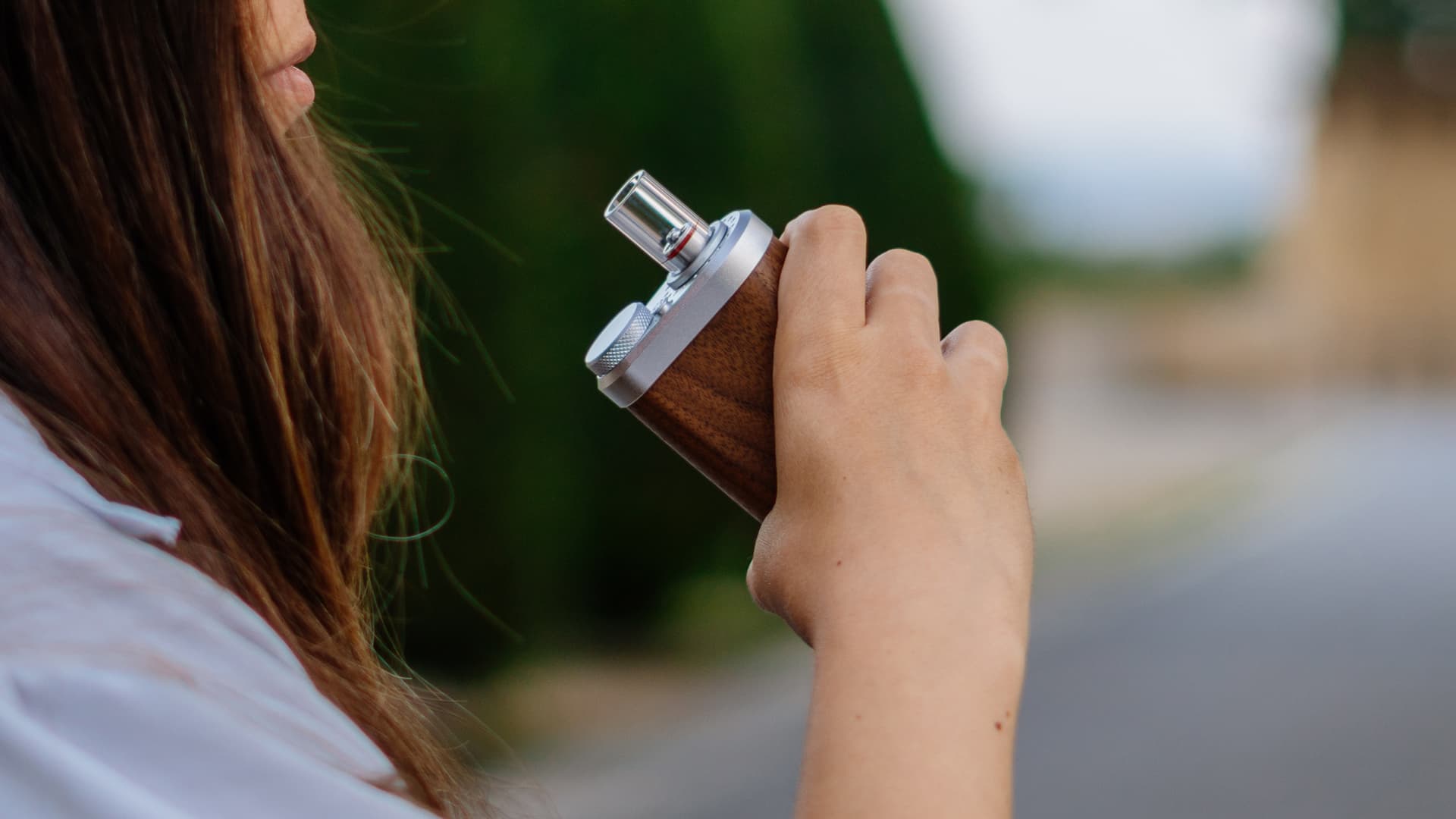
A walnut Tinymight 2 held up for a draw outdoors. It heats only while you hold the button, so one small load can stretch across a few short sessions.
Keep the temperature low: 160-185°C
Lower temperatures give you lighter, more flavorful vapor and pull less from the load with each draw. For a small pinch, we like to stay between 160°C and 185°C. Draws stay smooth, and the load lasts longer than a hit or two. Above 200°C, the vapor gets much denser and a small load runs out fast.
| Setting | What you get | When to use it |
|---|---|---|
| 160-170°C | Thin, very flavorful vapor | Your first draws |
| 175-185°C | Fuller vapor, still smooth | Most of a microdose session |
| 190°C and up | Dense vapor, the load runs out fast | Finishing off the bowl |
Our full temperature guide walks through each range and what changes as you turn the heat up.
A step-up approach gives you the fine control that makes vaporizer microdosing so useful. You adjust as you go instead of guessing a dose upfront.
Tip
Convection usually beats conduction for partial loads
Heating method matters more for microdosing than for full-oven sessions. Conduction vaporizers heat the oven walls, so cannabis touching the sides cooks faster than cannabis in the center. With a full pack, this evens out. With a half-empty oven, you get hot spots and wasted flower.
Convection vaporizers push hot air through the cannabis. As long as the air actually passes through the load, a small pinch heats more evenly. That's why most of the best microdosing vapes use convection or hybrid heating rather than pure conduction.
Pure conduction vapes can still work for microdosing, especially ones built for small loads or sold with a spacer. Use the spacer or reducer your vape came with rather than improvising. A good convection vape handles partial loads without any workarounds.
Cannabis vaporizer temperature guide
How each temperature range changes flavor and vapor, plus a simple step-up plan for your sessions.
Technique: how to microdose effectively
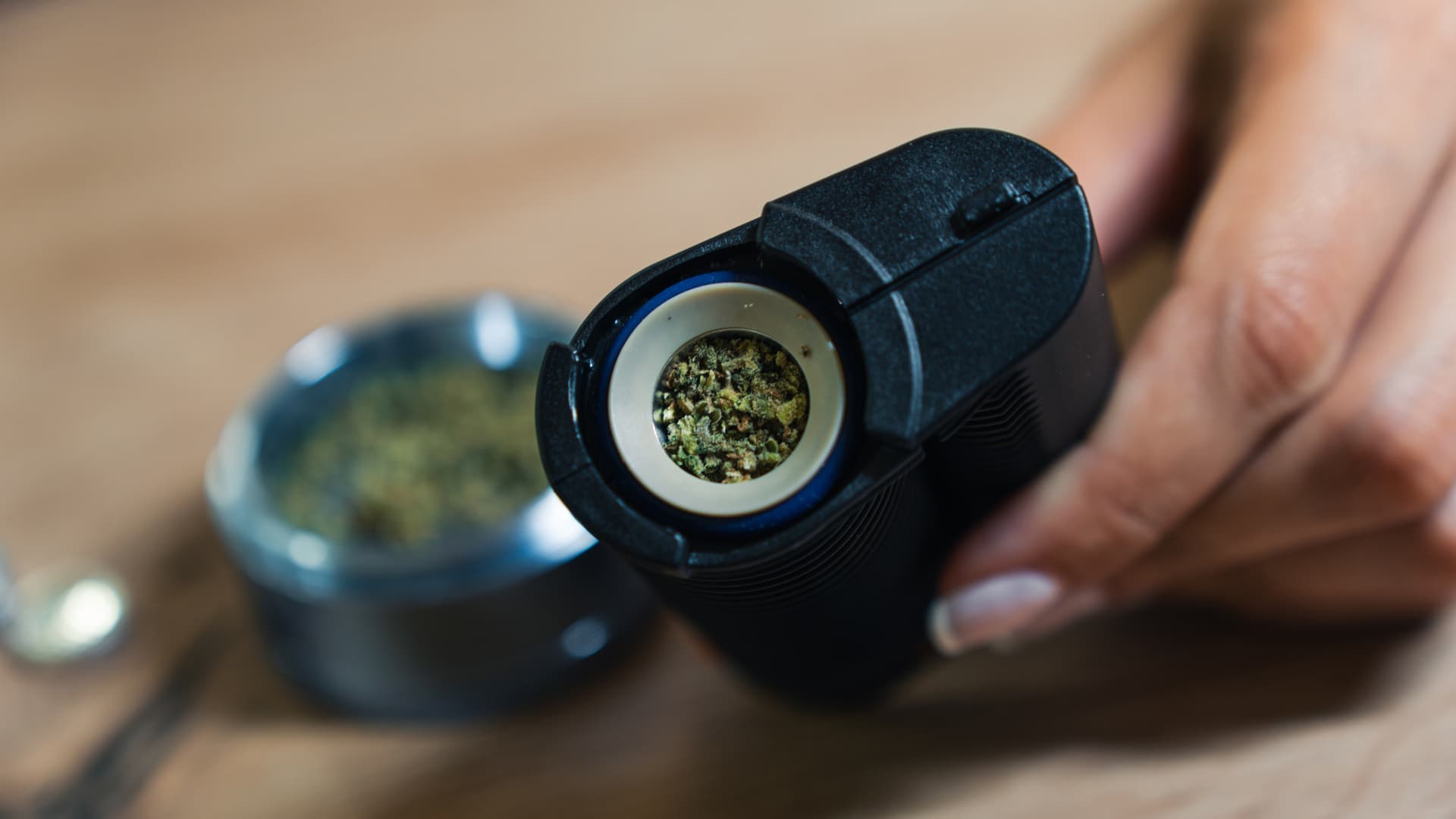
A loosely filled Crafty+ chamber beside a grinder. A light pack lets hot air flow through the cannabis, not around it.
Weigh your loads. A milligram scale turns "a small pinch" into 0.05 g, and that's what makes repetition work. Jot down the strain, load, temperature and effect after each session.
Grind fine to medium and pack lightly, unless your vape's manual says otherwise. A small load has less material for hot air to work with, and a coarse grind leaves gaps the air slips through.
Skip the tamping. You want air flowing through the material, not a compressed puck. For vapes with larger chambers, use a compatible dosing capsule or the spacer that came with it to keep the load in place.
Draw slowly and steadily. Hard pulls cool the heater and rush air through the cannabis before it picks up much vapor. A gentle draw gives the hot air time to do its work, and that matters even more with a small load. On the Tinymight 2, keep drawing for a moment after you release the button to clear the vapor path.
Skip the bubbler for microdosing. Water smooths the vapor, so it's easy to take more than you meant.
Save your already vaped bud, even from microdose sessions. Low-temperature sessions leave more behind in the flower, which makes that AVB worth cooking with later. Its strength varies a lot, so treat AVB edibles like any new edible and start small.
A well-packed 0.05 to 0.1 g load in a convection vape gives light, flavorful draws at 170-185°C.
How often to microdose
Keep it to one or two sessions a day, several hours apart, and don't stack draws inside the 10 to 30 minute wait. Daily use builds tolerance, so the same load slowly does less. A 2016 brain imaging study of heavy users found cannabinoid receptors recovering within 2 days of stopping, so a two-day break every few weeks keeps small loads working. After a break, drop back to your smallest load.
Is microdosing actually more efficient?
A 0.075 g microdose uses 75% less cannabis than a 0.3 g full oven. If you normally pack 0.3 g and switch to 0.075 g loads, the same supply lasts 4 times as many sessions. At that size, one gram gives you 13 full loads with a little left over.
The efficiency gain isn't just about using less material. Nothing burns away between hits the way it does with a joint. With on-demand heating, the flower also sits idle while you're not drawing. That adds up if you're watching what you spend.
Research on low doses is small and mixed. A 2012 trial of 360 cancer patients in The Journal of Pain tested nabiximols, a THC/CBD mouth spray. Its main result was not significant, though the low and medium doses beat placebo on some secondary measures and the high dose did not. A 2020 trial gave 27 chronic-pain patients a metered-dose inhaler set to 0.5 mg or 1 mg of THC. The 1 mg dose eased pain better than placebo.
Your vape won't meter THC that precisely, so the key is repetition: same strain, same temperature, same load size. A vaporizer makes that easy.
What is the best vaporizer for microdosing?
We recommend small-chamber portables that heat on demand for dedicated microdosing.
| Vaporizer | Chamber | Heat-up | Why it works |
|---|---|---|---|
| Tinymight 2 | Adjustable, up to 0.15 g | About 5 sec | Top pick. On-demand convection, button-release stop |
| Vapman 2.0 | 0.03 to 0.1 g | ~3 sec | Gold-plated pan built for tiny loads; torch-powered |
| DynaVap M7 | 0.1 g (0.05 g half bowl) | 5 to 7 sec | Half-bowl screen setting; needs a torch or induction heater |
If you already own a compatible session vape with a larger oven, dosing capsules are the most practical upgrade. They shrink the space you fill, keep every load the same size, and keep most of the mess out of your oven.
The Tinymight 2 also makes our best portable vaporizers list, and the Vapman 2.0 and DynaVap M7 both feature in best butane vaporizers. Torn between those two? Our DynaVap M7 vs Vapman 2.0 comparison puts them side by side.
Tinymight 2
Our top pick for microdosing. Convection heating in about 5 seconds, an adjustable chamber that holds up to 0.15 g, on-demand and session modes, and a replaceable 18650 battery. On-demand mode lets one small load stretch across several short sessions.
Key Takeaway
- Small chamber + on-demand heating. Cuts waste from partial loads
- 0.05 to 0.1 g at 170-185°C. Light, flavorful draws from a small pinch
- Slow, steady draws. A gentle pull gets the most from minimal material
- Wait 10 to 30 minutes. Inhaled effects can take that long to fully build
- 4× supply stretch. Dropping from 0.3 g to 0.075 g loads makes your stash last 4 times as many sessions