

The DEA's rescheduling hearing wrapped up on a Wednesday. Senate Democrats filed their answer on Thursday.
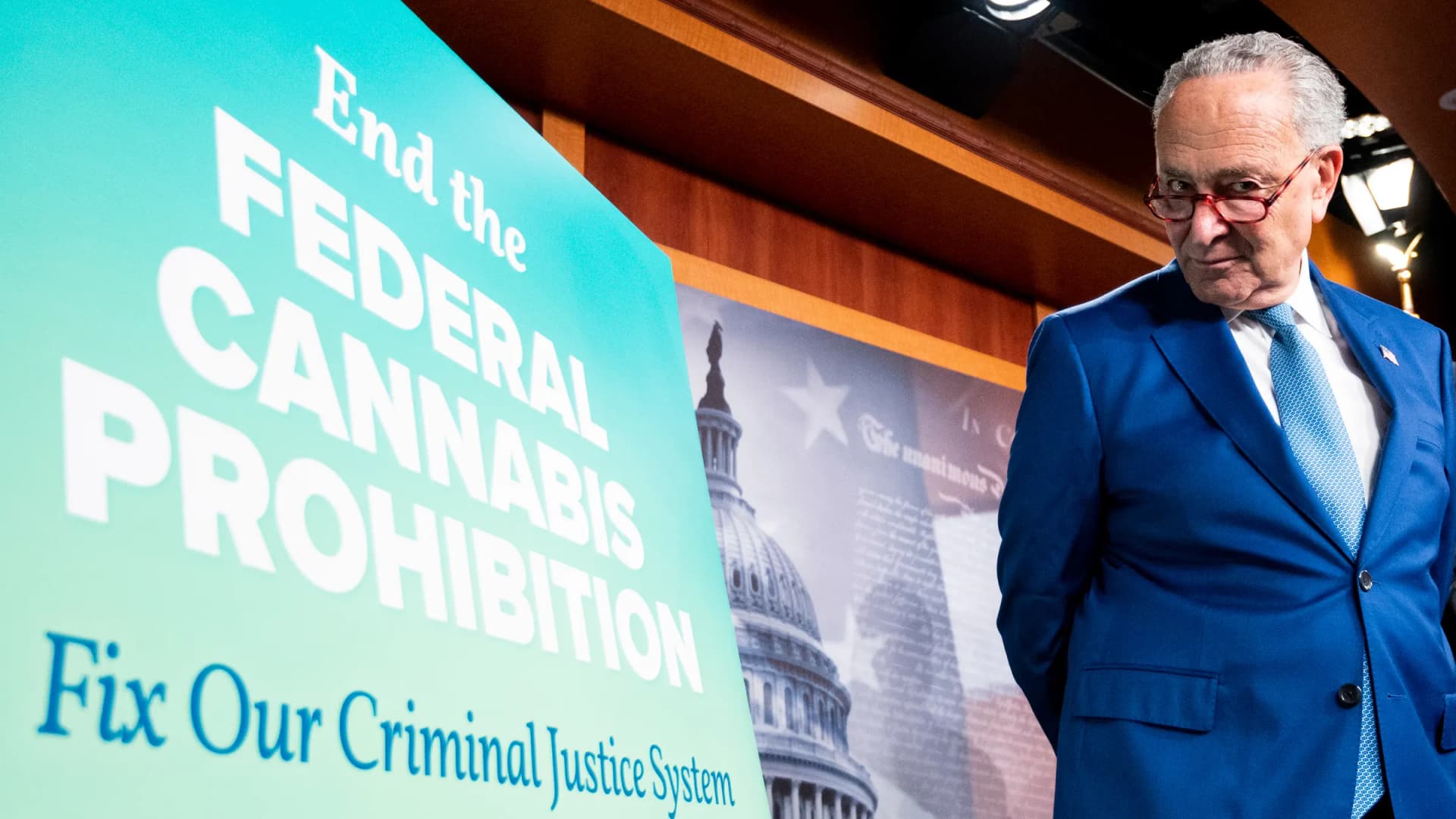
On July 16, Senate Democratic Leader Chuck Schumer, Sens. Cory Booker and Ron Wyden, and 14 Democratic colleagues reintroduced the Cannabis Administration and Opportunity Act, a bill that would remove cannabis from the Controlled Substances Act entirely.[1] The timing draws a sharp line. The Trump administration's Schedule III policy, in effect since April, reclassifies only medical cannabis. The CAOA would legalize all of it.
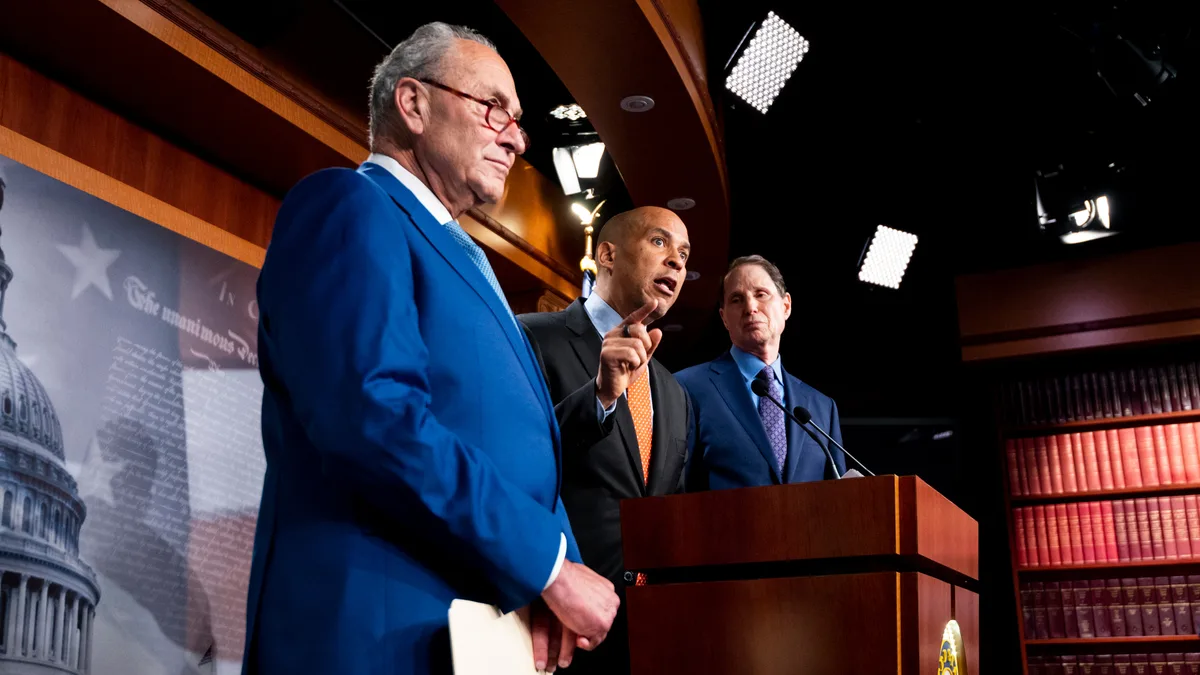
Photo: Bill Clark/CQ Roll Call/Newscom
Sen. Cory Booker, D-N.J., flanked by Senate Majority Leader Chuck Schumer, D-N.Y., and Sen. Ron Wyden, D-Ore., speaks at a Capitol news conference introducing the Cannabis Administration and Opportunity Act in July 2021.
"I am proud to reintroduce this commonsense legislation, which will dismantle the unjust and outdated federal marijuana prohibition, establish a federal regulatory framework to protect public health and safety, expunge past convictions for low-level cannabis offenses, and deliver restorative justice to the communities most harmed by decades of failed drug policy," Booker said.[1]
As of this week, the Senate release still linked to files labeled as the 2024 bill text, and a new bill number had not yet appeared on Congress.gov.
What full descheduling would change
The bill directs the attorney general to strike cannabis from federal drug schedules. Regulation would shift to the Food and Drug Administration and Treasury's Alcohol and Tobacco Tax and Trade Bureau, the agencies that oversee tobacco and alcohol.[2]
Under the sponsors' framework:
- Adults 21 and older could buy legally, with a reported cap of 10 ounces per retail transaction.
- A federal excise tax would start at 5% for small and midsize producers, rising to 12.5% over five years. Larger producers would start at 10% and rise to 25%.[2]
- Low-level federal cannabis records would be expunged automatically, and people serving federal sentences for qualifying nonviolent offenses could petition for resentencing.
- States could still ban production or sales inside their borders, but they could not block cannabis transiting through to another legal state.[1]

Photo: VapeExperts/AI
That last provision matters most for the industry. Interstate commerce between legal states would become possible for the first time, and the central banking problem, proceeds of federally illegal trafficking, would disappear for compliant businesses.
Schedule III stops at the medical market
The bill lands in the middle of the administration's own cannabis push, which we covered when the partial Schedule III order took effect. President Trump signed an executive order on December 18, 2025, directing DOJ to finish Schedule III rulemaking. Acting Attorney General Todd Blanche then issued AG Order No. 6754-2026, effective April 28, 2026, moving two categories to Schedule III: FDA-approved marijuana drugs and marijuana under a qualifying state medical license. Everything else, including the entire adult-use market, stays in Schedule I.[4]
Oct. 6, 2022
President Biden ordered HHS and DOJ to review marijuana scheduling.
Aug. 29, 2023
HHS recommended moving marijuana to Schedule III.
May 21, 2024
DOJ published the proposed rescheduling rule; nearly 43,000 comments followed.
Dec. 18, 2025
Trump directed DOJ to complete the rulemaking expeditiously.
April 28, 2026
Partial order took effect, placing medical cannabis in Schedule III.
July 15, 2026
DEA evidentiary hearing on broader rescheduling concluded in Arlington.
The administration frames the move as a research and patient-care reform. "This rescheduling action allows for research on the safety and efficacy of this substance, ultimately providing patients with better care and doctors with more reliable information," Blanche said in April.[3] DEA Administrator Terry Cole said the agency is "expeditiously moving forward with the administrative hearing process, bringing consistency and oversight to an area that has lacked both."[3]
The nonpartisan Congressional Research Service has spelled out the limits. "Moving marijuana from Schedule I to Schedule III, without other legal changes, would not bring the state-legal medical or recreational marijuana industry into compliance with federal controlled substances law," CRS concluded. It said banks would likely continue to face serious legal risk serving cannabis businesses even after rescheduling.[5] Schedule III also does not expunge convictions, and it does not authorize dispensary products to cross state lines.
Flavored cannabis vapes would not survive the bill
The CAOA is legalization, not deregulation. It creates an FDA Center for Cannabis Products with authority over manufacturing, ingredients, labeling, potency and marketing. And it bans electronic cannabis delivery systems from containing any added natural or artificial "characterizing flavor" other than cannabis.[2] Fruit, candy, mint and dessert cartridges would be shut out of the federally legal market, even in states that allow them today.

Photo: VapeExperts/AI
Shipping would stay restricted too. The PACT Act covers hardware that aerosolizes "nicotine, flavor, or any other substance," and USPS treats such products as generally nonmailable. The CAOA could open licensed business-to-business interstate distribution, but it would not restore direct-to-consumer mail shipment of cartridges or vaporizers without a separate change from Congress.
The math: 53 Republican seats
Republicans hold 53 Senate seats.[9] The CAOA has no Republican sponsor, leaving it short of both a majority and the 60 votes needed to break a filibuster. The 2022 and 2024 versions both died in the Senate Finance Committee without a vote. House appropriators, meanwhile, have advanced language that would block federal funds from being used to reschedule or deschedule marijuana at all, a sign that even Trump's narrower move faces resistance within his own party.
The sponsors point to public support. The Senate release cites a figure of 91% favoring legal medical or adult-use cannabis, a measure of support for legality in some form. Gallup's direct question on making marijuana legal tells a more mixed story: support peaked at 70% in 2023 and fell to 64% in 2025. A January 2026 Pew Research Center survey found 55% backing both medical and recreational legalization, with another 33% supporting medical use only.
U.S. adult support for making marijuana legal
Source: Gallup
"The only reefer madness I'm seeing is the continued federal prohibition of cannabis," Wyden said, calling the CAOA the most comprehensive proposal on the books to end prohibition while keeping public health front and center.[1]
Researchers call Schedule III a way station
Independent researchers largely agree the two policies are not substitutes. In a June 2026 peer-reviewed article, Brad Rowe of UCLA, Agnes Balla of the University of California and Daniele Piomelli of UC Irvine wrote that Schedule III may expand research and FDA-compliant drug development "without legalizing cannabis, approving dispensary products, authorizing interstate commerce, or resolving conflicts between federal and state law."[10]
Their recommendation: "Schedule III should be treated as a transitional status, with agencies prioritizing research access and public health surveillance while Congress addresses banking, interstate commerce, and durable criminal justice and equity reforms."[10]
For now, the nearest date on the calendar belongs to the DEA, not the Senate. Post-hearing briefs in the rescheduling proceeding are due August 17, Marijuana Moment reported, after which Chief Administrative Law Judge Derek C. Julius will send a nonbinding recommendation to Cole for a final agency decision.[7] A consolidated D.C. Circuit challenge to the April order is already pending.[8] Whichever way the agency rules, cannabis stays in federal drug law. Only Congress can take it out.