


Medical cannabis has been legal to prescribe in Great Britain since November 2018.[1] Nearly eight years on, NHS prescribing of unlicensed cannabis products is so rare that the data is suppressed because it relates to fewer than five patients. Private clinics in England, meanwhile, dispensed 659,293 items of unlicensed cannabis medicine in 2024, according to a reconstruction of NHSBSA freedom-of-information data.
That gap is the story of UK medical cannabis in 2026. The law opened a door. The NHS barely uses it. A fast-growing private sector built its own.
Two systems, one law
The NHS does prescribe licensed cannabinoid medicines such as Epidyolex, Sativex and nabilone. A parliamentary answer in March 2025 put that at 880 identifiable patients receiving 5,413 items in England's community setting over 12 months. Unlicensed whole-plant products, the flower and oils most private patients receive, are a different matter. There, NHS numbers round to almost zero.
Private dispensing has doubled or more every year since the law changed.
Private unlicensed cannabis items dispensed in England
Source: NHSBSA FOI data (reconstructed)
These figures count product lines dispensed, not patients or prescriptions. A frequently cited estimate of roughly 80,000 private patients in 2026 is modelled from item volumes, not counted; no official private-patient register exists. The General Pharmaceutical Council reported in October 2025 that more than 99.5% of cannabis-based prescribing happened in private care.
July 2018
Home Secretary Sajid Javid announced cannabis-derived medicines would move to Schedule 2.
November 2018
Specialist doctors gained the power to prescribe without case-by-case Home Office licences.
July 2019
An NHS England review found fewer than 10 NHS primary-care prescriptions since the reform.
November 2019
NICE endorsed narrow product-specific uses and declined routine prescribing for chronic pain.
June 2025
The Home Office asked the Advisory Council on the Misuse of Drugs to review supply and prescribing.
July 2026
The CQC published its annual controlled-drugs report covering 2025.
Why the NHS door barely opens
NHS England applies an "exceptional clinical need" test and says evidence for pain is not sufficiently developed, long-term harms have not been adequately studied, and the strongest paediatric-epilepsy evidence concerns purified cannabidiol rather than THC products. NICE guidance NG144 backs only narrow, product-specific uses: nabilone for chemotherapy nausea after optimised antiemetics, a trial of THC:CBD spray for MS spasticity, and licensed cannabidiol for specific severe epilepsies. It says cannabis products should generally not be offered for chronic pain outside research. NICE's economic model found chronic-pain benefits too small to justify continuing costs for the NHS.
The evidence question is genuinely unsettled. Dr Michael Lee, an Oxford pain researcher, found in brain-imaging work that THC did not act like a conventional analgesic. "We found that with THC, on average people didn't report any change in the burn, but the pain bothered them less," he said.[7]
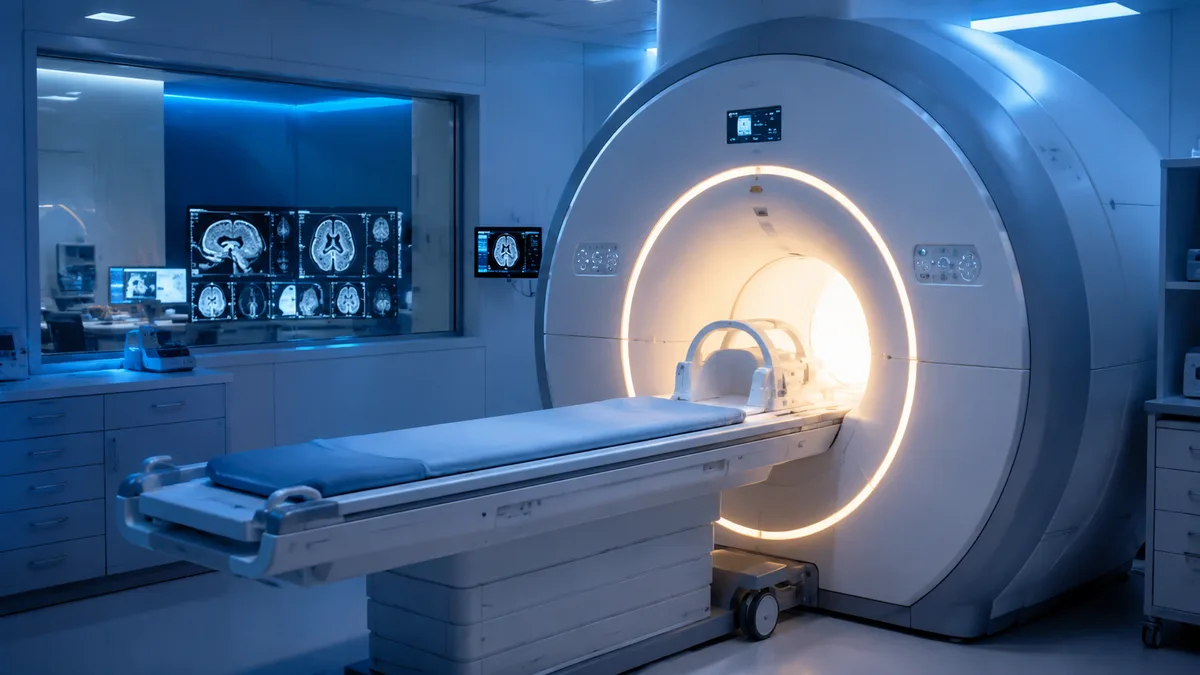
Photo: VapeExperts/AI
How the private route actually works
There is no statutory list of qualifying conditions. Clinics advertise treatment for chronic pain, anxiety, PTSD, insomnia, MS, epilepsy, gastrointestinal conditions and cancer symptoms, but a diagnosis creates no right to a prescription. A specialist must find that licensed options cannot adequately meet the patient's need.
The widely repeated "two failed treatments" rule is not in the legislation. It is an industry benchmark. The Medical Cannabis Clinicians Society calls failure of two accepted evidence-based treatments a minimum in ordinary cases, and the Care Quality Commission warns that for some patients unmet need "may well involve significantly more than 2 previous treatment options."
The pipeline runs in four steps. The patient completes an online eligibility check and releases GP records and treatment history. A doctor on the GMC Specialist Register conducts a consultation covering treatment goals, psychiatric and cardiovascular risks, drug interactions and driving responsibilities; many clinics then send the case to a multidisciplinary panel. If approved, a controlled-drug prescription, valid for 28 days, goes to a specialist pharmacy. The patient pays and receives tracked delivery. No individual Home Office application is involved; the 2018 regulations created a lawful prescription route without one.[1]

Photo: VapeExperts/AI
Turnaround times are mostly unpublished. Curaleaf says it communicates decisions within seven days and its pharmacy usually dispatches one to five working days after payment. Beyond that, patient reports of one to two weeks and a commercial guide's two-to-eight-week range are anecdotal, not guarantees.
£5 a month buys the clinic, not the medicine
Advertised entry prices have fallen hard. Curaleaf charges £5 per month ($6.50) or £30 per appointment. Alternaleaf advertises £5 per month with a 12-month minimum term. Mamedica charges a £49 one-time onboarding fee, with a £200 lifetime scheme for eligible benefits recipients, veterans and students. Releaf charges about £99.99 for an initial consultation or roughly £39.99 per month for its subscription. Integro Clinics currently shows free consultations with a £4.99 administration fee per prescription.
Every one of those prices covers the clinic relationship. Medicine is charged separately, with flower advertised between £5 and £14 per gram ($6.50 to $18). Commercial guides place many total prescriptions around £100 to £400 or more per month ($130 to $520), though no authoritative national average exists.
The rules don't end at delivery
Prescribed flower cannot legally be smoked. Regulation 16A(3) states that a person "shall not self-administer a cannabis-based product for medicinal use in humans by the smoking of the product."[2] Flower is normally directed to be heated in a dry herb vaporizer instead of burned. Patients should keep medicine in its original pharmacy-labelled packaging, store it securely and carry prescription proof with matching photo ID. A 2025 National Police Chiefs' Council guidance tells officers that no possession offence occurs where the product is lawfully prescribed, and advises checking proof and identification. A commercial "cannabis card" is not a prescription.
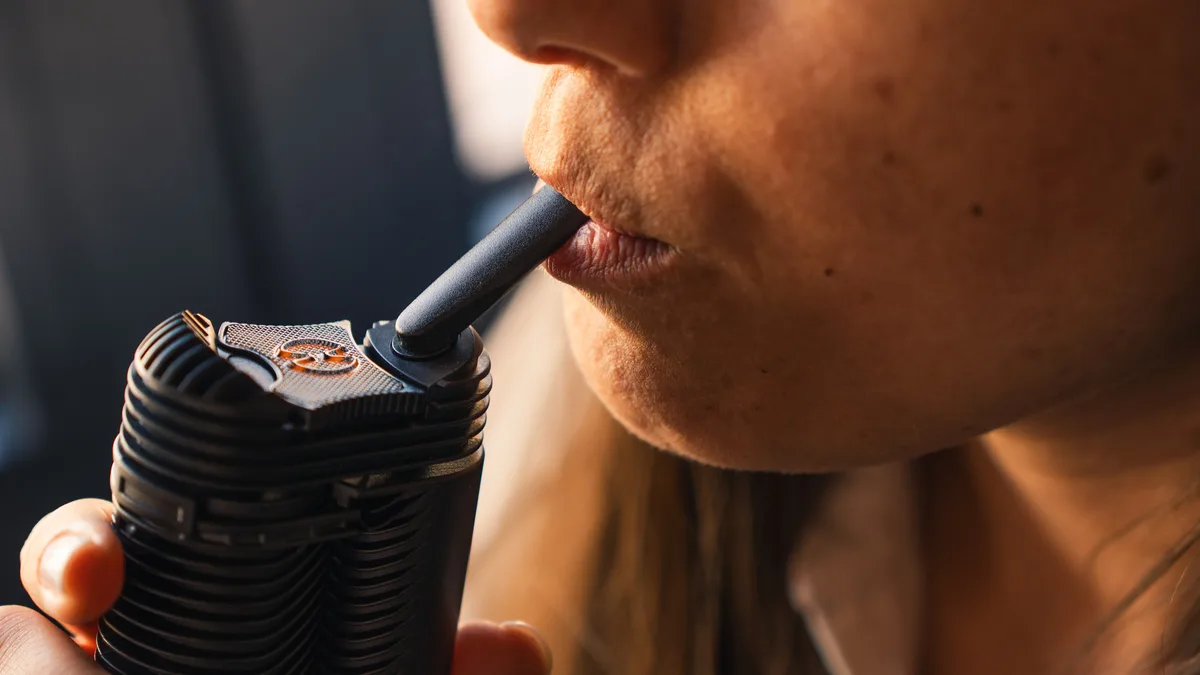
Photo: VapeExperts
A patient inhales from a Storz & Bickel Crafty+ vaporizer. Rules governing how prescribed cannabis is consumed continue to apply after private clinics deliver it to patients' doors.
Approval is not permanent. Clinics commonly review patients about a month after starting, then quarterly or twice yearly. Patients can report side effects directly through the MHRA Yellow Card system.[8]
Driving carries the sharpest legal exposure. England and Wales set a blood THC limit of 2 micrograms per litre, low enough that regularly treated patients may exceed it without feeling intoxicated. Section 5A provides a medical defence where the drug was lawfully prescribed, taken as directed and lawfully possessed.[3] It is not permission to drive impaired; a separate impairment offence still applies. A Department for Transport review found cannabis consumption generally linked to a low-to-moderate increase in collision risk, while noting medical patients may differ from recreational users.[4] Abroad, a UK prescription proves nothing. Patients must check destination law, carry a prescriber's travel letter and keep medicine in its labelled container; the UK itself permits arriving visitors up to a three-month supply of prescribed controlled medicine with proof.[5]
The regulator is uneasy
The CQC counted 35 registered English providers prescribing unlicensed products in its 2024 controlled-drugs update, and reported items dispensed rising 130% between rolling years, from 150,527 to 346,600. "We continue to hear that services are prescribing for a very wide range of medical conditions, for some of these, there is poor evidence to justify the use of CBPMs," the report said. It also flagged inadequate communication with GPs and questioned the specialist mix on some review panels. The Home Office asked the Advisory Council on the Misuse of Drugs in June 2025 to review supply, prescribing effectiveness and unintended consequences; its recommendations are pending. The CQC's next annual report, covering 2025, landed on July 9.

Photo: Charles Hutchins from London, United Kingdom/Wikimedia Commons (CC BY 2.0)
The Home Office building in London, with flags flying and a canopy of multicoloured glass panels. The department oversees drug regulation as private cannabis prescriptions boom.
Researchers who have interviewed patients see the gap between law and access as the core problem. Helen Beckett Wilson and Lindsey Metcalf McGrath of Liverpool John Moores University, who ran the first qualitative study of UK prescribed-cannabis patients, concluded: "The UK government's lack of implementation of medical cannabis legalisation, combined with their ongoing prohibition position, is producing multiple harms to people who need cannabis medicine."[6]