

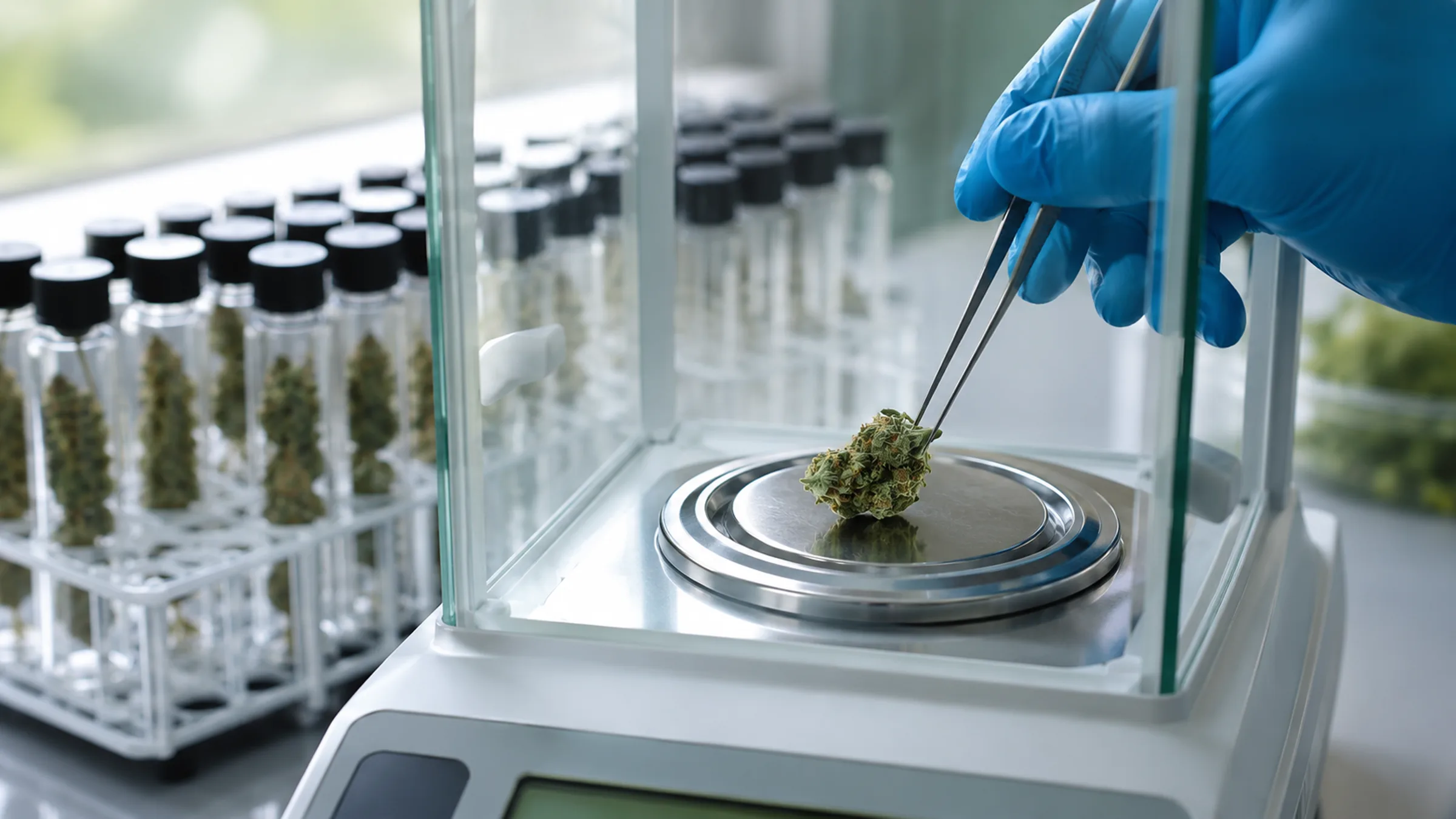
For decades, university scientists who wanted to study cannabis had to use a narrow federal supply that looked little like what patients actually buy. That is starting to change. A federal order signed in April moved state-licensed medical cannabis to Schedule III, and researchers say the shift could reshape what happens inside labs like the University of Minnesota's Cannabis Research Center.
The change is narrower than it sounds. Adult-use flower, most recreational vape cartridges and unlicensed bulk cannabis all remain Schedule I.[1]
Two categories moved, everything else stayed put
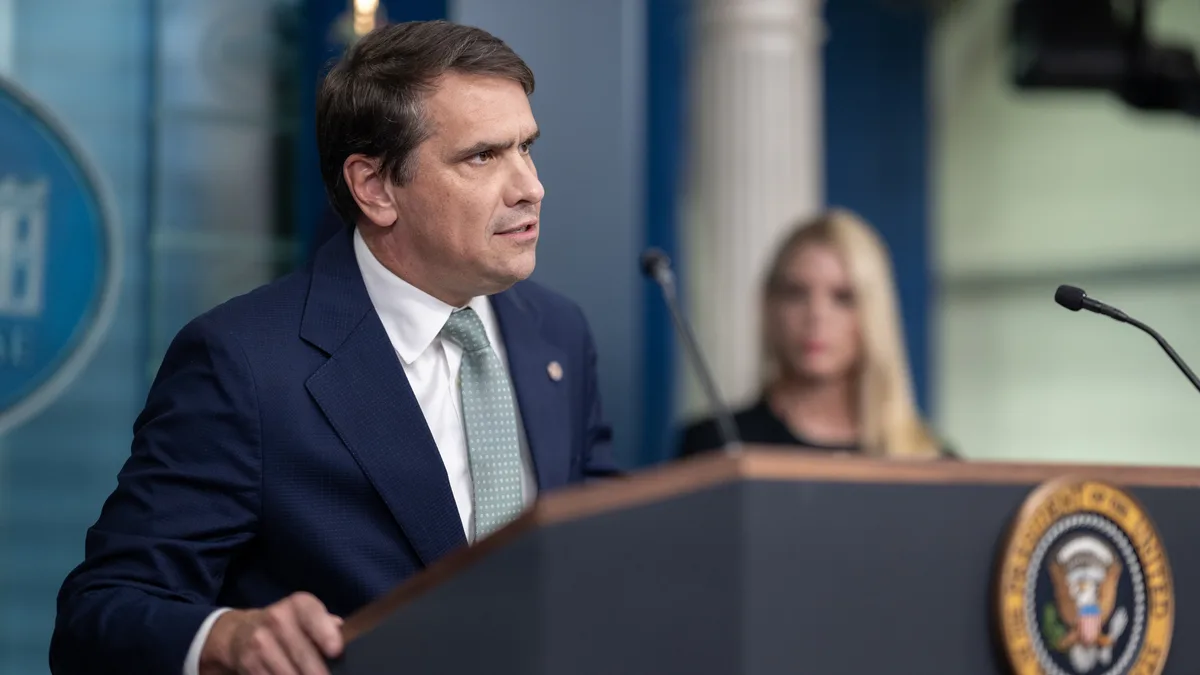
Photo: The White House/Wikimedia Commons (Public domain)
Deputy Attorney General Todd Blanche speaks from the podium in the James S. Brady Press Briefing Room at the White House. The Justice Department oversaw the Schedule III order affecting university cannabis labs.
Acting Attorney General Todd Blanche signed AG Order No. 6754-2026 on April 22. It took effect on April 28, 2026, with publication in the Federal Register at 91 Fed. Reg. 22714. The order moved two classes of cannabis to Schedule III: FDA-approved drug products containing marijuana, and marijuana covered by a qualifying state medical license. We covered the order's scope in detail in our earlier rescheduling coverage.
"This rescheduling action allows for research on the safety and efficacy of this substance, ultimately providing patients with better care and doctors with more reliable information," Blanche said in the April announcement.
A separate DEA hearing on whether the rest of federally controlled marijuana should also move to Schedule III ran from June 29 through July 15 in Arlington, Virginia.[2] As of late July, no final decision from that broader proceeding had been published.[3] We laid out the process in our hearing coverage.
August 2023
HHS recommended moving marijuana to Schedule III, citing accepted medical use.
May 2024
DOJ published its proposal to transfer marijuana from Schedule I to Schedule III.
December 2025
President Trump signed an executive order directing expedited action on Schedule III.
April 2026
The partial order covering FDA-approved and state medical cannabis took effect.
July 2026
The DEA hearing on broader rescheduling concluded with no final decision published.
Less paperwork, but not a free pass
Why does the schedule matter for science? Under Schedule I, cannabis research carries the heaviest federal controls. Schedule III research generally means shorter approval paths and fewer requirements to seek federal sign-off for every protocol change.
Robert Mikos, who holds the LaRoche Family Chair in Law at Vanderbilt University, wrote in The Hill that in Schedules II through V, approval timelines shrink and scientists do not need to inform the DEA and FDA about every change to their experimental design.

Photo: Mayur Phadtare/Wikimedia Commons (CC BY-SA 3.0)
Mechanical Engineering Building, Vanderbilt University, Nashville
There are limits. Kathryn Mallinson, an assistant professor of public policy and administration at Penn State Harrisburg, said in a July interview that rescheduling removes restrictive requirements but does not let researchers simply buy from state-legal suppliers. "The law still requires registration with the DEA of any clinical research and purchase of research material from DEA-registered manufacturers," she said. She noted the DEA has already increased the number of registered suppliers.
Minnesota's center already works, without touching a gram
The U of M School of Public Health created its Cannabis Research Center to study the health effects of Minnesota's 2023 adult-use law. Its newest output shows what the center can do without possessing cannabis at all.
A study led by Marla Eisenberg, a professor at the University of Minnesota Medical School, analyzed Minnesota Student Survey data from 2013 to 2025. Past-30-day adolescent cannabis use fell from 13% in 2013 to 5% in 2025.[4] The paper appeared in Social Science & Medicine in July.[5]
The declines were not even. American Indian and Alaska Native youth, LGBTQ+ youth and youth in poverty remained roughly three times as likely to report cannabis use as their comparison groups. Black youth went from 51% more likely than white youth to use cannabis in 2013 to 10% less likely in 2025.

Photo: VapeExperts/AI
"This is kind of a good news, bad news story," Eisenberg said. "But for LGBTQ+ youth in particular, disparities got better for a while, but then got worse again. This highlights an area we really need to focus on."
Survey work like this never needed Schedule III. The rescheduling matters most for studies that store, administer or chemically test cannabis. That is where the vaporizer questions live.
Equal doses, unequal highs: the vape data gap
A controlled Johns Hopkins trial illustrates why researchers say device studies need to catch up. Researchers gave infrequent users cannabis containing 0, 10 or 25 mg of THC, either smoked or vaporized. At equal doses, vaporization put more THC in the blood and caused stronger impairment.[6]
Blood THC after equal doses, vaporized vs. smoked
Source: Spindle et al., JAMA Network Open
At the 10 mg dose, vaping produced roughly 97% higher blood THC than smoking. At 25 mg, the gap was about 41%.
"There's a definite difference in the amount of drug making it into the blood when using a vaporizer versus smoking the drug, so considerations need to be made when dosing to ensure people are using cannabis safely," said lead author Tory Spindle of the Johns Hopkins University School of Medicine.
That single study leaves big open questions. How much THC does a given vaporizer actually deliver per puff? How do temperature, grind and airflow change the dose? Do medical product labels predict what patients inhale? A 2026 national research stakeholder meeting flagged product variability, potency inflation and scarce well-characterized study materials as ongoing barriers. Schedule III makes it more feasible for a university center to run those studies with real state medical flower, oils and vape formulations instead of a generic federal supply.
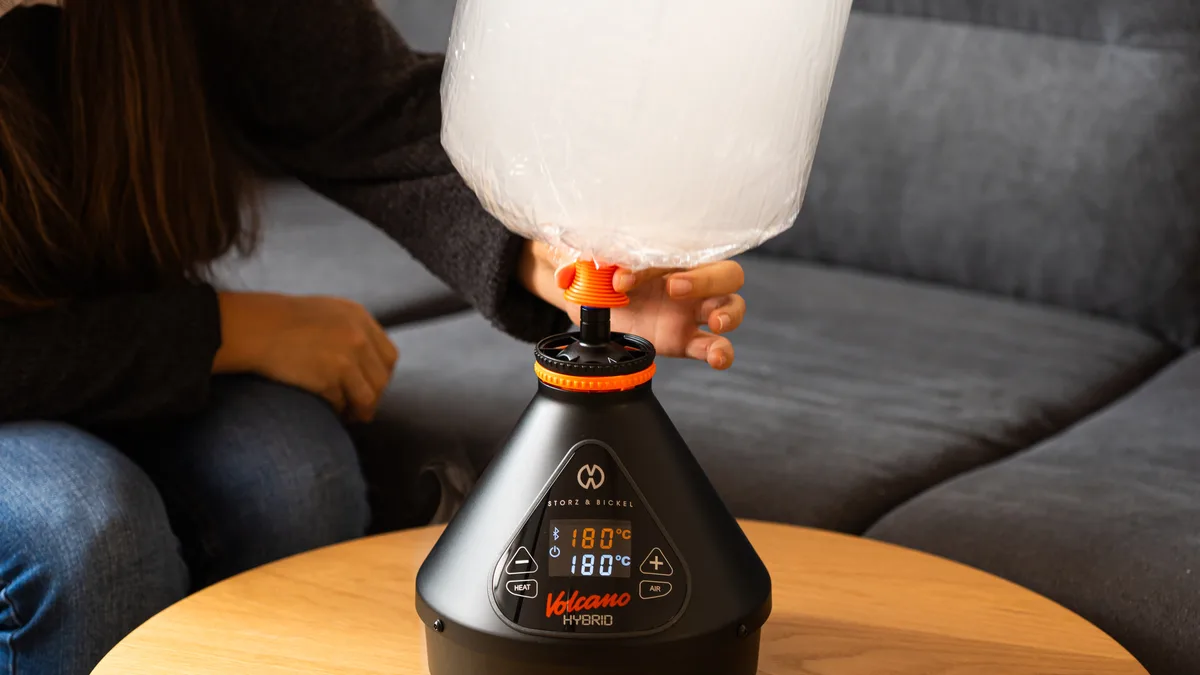
Photo: VapeExperts
A user detaches a filled balloon from a Storz & Bickel Volcano Hybrid vaporizer. Devices like this could help university labs study why equal cannabis doses produce unequal effects under the new Schedule III order.
The federal record from the June and July hearing now sits with the DEA. Whatever the agency decides on the rest of the plant, the FDA-approved and state medical categories are already in Schedule III. "Moving marijuana to Schedule III would greatly enhance scientists' ability to study it," Mikos wrote.