

Four House members from both parties want the Trump administration to answer a question no federal agency has touched: will Medicare cover medical cannabis now that some of it sits in Schedule III?
Reps. Dina Titus (D-Nev.), Dave Joyce (R-Ohio), Ilhan Omar (D-Minn.) and Greg Steube (R-Fla.) sent the letter on August 18 to President Donald Trump, Attorney General Todd Blanche, HHS Secretary Robert F. Kennedy Jr. and Treasury Secretary Scott Bessent. They asked for answers by September 30.[1]
Nine questions, one deadline
The letter asks whether the Justice Department expects to coordinate with the Centers for Medicare & Medicaid Services on Medicare coverage or reimbursement for Schedule III medical marijuana products. It also asks whether the new framework permits private health insurance to cover state-compliant cannabis treatments.
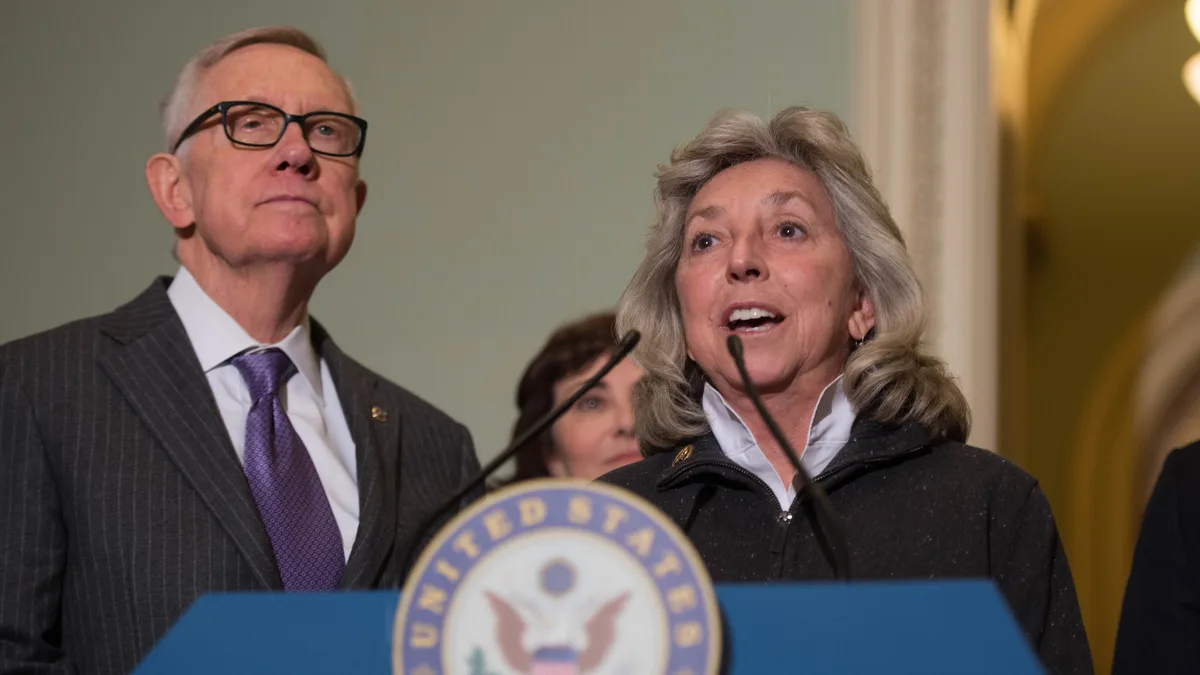
Photo: Senate Democrats/Wikimedia Commons (CC BY 2.0)
Sen. Harry Reid stands beside Rep. Dina Titus as she speaks at a U.S. Senate podium in this archive photo. Lawmakers are pressing the Trump administration on whether Medicare will cover medical cannabis.
The other questions cover home cultivation, DEA registration, patient privacy, federal enforcement, businesses that serve both medical and adult-use markets, and tax relief under Internal Revenue Code Section 280E, which denies deductions only to Schedule I and II businesses.
"As implementation moves forward, additional guidance would be helpful on several practical questions, including worker protections, patient rights, healthcare coverage, privacy safeguards, home cultivation, and the operation of the new DEA registration system," the lawmakers wrote.
Joyce, a co-chair of the Congressional Cannabis Caucus, said rescheduling "opens the door to responsible regulation, evidence-based medicine, and a safer, more transparent cannabis market."
The questions trace back to Attorney General Order 6754-2026, which took effect April 28. It moved two categories of marijuana to Schedule III: marijuana in an FDA-approved drug and marijuana under a qualifying state medical license. Everything else, including adult-use cannabis, stayed in Schedule I.[2]
Schedule III does not put cannabis on a formulary
Rescheduling removes one federal barrier. It does not make dispensary cannabis a Medicare-covered drug. Part D coverage generally requires an FDA-approved prescription drug, prescribed for a medically accepted indication and listed on a plan formulary.

Photo: VapeExperts/AI
The FDA says it "has not approved a marketing application for cannabis for the treatment of any disease or condition." The agency has approved one cannabis-derived medicine, Epidiolex, and three synthetic cannabis-related drugs: Marinol, Syndros and Cesamet. Those approvals do not extend to dispensary flower, concentrates or cartridges.[3]
That leaves a handful of routes to broad coverage: FDA approval of standardized cannabis products, a new coverage category from Congress, or a CMS demonstration outside ordinary Part D reimbursement.
The one Medicare experiment excludes vapes
CMS has already built a narrow test. Under the ACO REACH model, participating organizations can furnish up to $500 per eligible beneficiary per year in qualifying hemp-derived products, starting April 1 of this year.[4]

Photo: VapeExperts/AI
The rules matter for anyone reading this as a coverage preview. Products must meet the federal hemp definition, oral products are capped at 3 milligrams of total THC per serving, and inhalable products are excluded entirely. The organization buys the products; patients cannot submit retail receipts to Medicare.
The pilot is not a pathway for Medicare reimbursement of vape cartridges or smoked flower. Its design points toward standardized oral products, not inhalable ones, and whether any future cannabis benefit would follow the same lines is one of the questions CMS has not answered.
Seniors are the audience for the answer
The Medicare question lands on a fast-growing population. A 2025 JAMA Internal Medicine analysis of 15,689 adults 65 and older found past-month cannabis use rose from 4.8% in 2021 to 7.0% in 2023, with especially large increases among seniors with chronic conditions. The study's cross-sectional design could not establish whether cannabis caused or treated those conditions.[6] We covered the dosing questions that trend raises earlier this year.
A separate JAMA Psychiatry study of 186,823 adults, published August 19, found cannabis-use disorder climbed from 2021 through 2024, with the sharpest rise in moderate-to-severe cases among adults 50 and older.[5]
Past-year cannabis-use disorder among U.S. adults
Source: JAMA Psychiatry
The bigger rescheduling case is still moving
The letter arrived as DEA's separate proceeding on rescheduling marijuana generally entered its decision phase. On August 20, Chief Administrative Law Judge Derek C. Julius ordered 294 corrections to the roughly 2,500-page transcript from the 11-day hearing, with the corrected record scheduled for public release by August 26.[7]
In its 50-page closing brief, DOJ and DEA argued that "marijuana can no longer remain in Schedule I because it no longer satisfies two of the three criteria necessary for control in Schedule I."
Julius will now weigh the record and issue a recommendation; the DEA administrator makes the final call, on no announced deadline. The April partial order also faces consolidated challenges in the D.C. Circuit, a fight we have covered before.
April 28, 2026
Partial rescheduling order took effect at 91 Fed. Reg. 22714.
June 29, 2026
DEA opened its hearing on broader marijuana rescheduling.
July 15, 2026
The 11-day hearing concluded.
Aug. 17, 2026
Post-hearing briefs were due.
Aug. 18, 2026
Four House members sent their nine-question letter.
Aug. 20, 2026
Judge Julius ordered 294 transcript corrections.
Sept. 30, 2026
Requested deadline for the administration to respond.
The first concrete test is September 30. Whether the White House, DOJ, HHS, Treasury and CMS answer together or agency by agency will show how coordinated the implementation actually is. As of publication, no public reply has surfaced from any of them, which leaves the letter's central question, Medicare coverage for Schedule III cannabis, exactly where the lawmakers found it: unanswered.