

Most of the 169 Colorado adults over 60 in a new study chose cannabis edibles for a reason that had nothing to do with getting high. They wanted to sleep. Pain was the second most common motivation. And a separate national survey found that fewer than one in five older cannabis users had mentioned it to a doctor.[1][5]
Cannabis use among Americans 65 and older climbed from 4.8% in 2021 to 7.0% in 2023, a roughly 46% relative increase in two years, according to an analysis of more than 15,000 older adults in the National Survey on Drug Use and Health.[3] The edibles study helps explain what is pushing the trend. The doctor data help explain what is missing from it.
"They just want to feel better"
The qualitative study, published in JAMA Network Open in May 2026, was led by Rebecca Delaney at the University of Utah and Angela Bryan at the University of Colorado Boulder.[1] Researchers conducted interviews before participants bought anything. The sample had a mean age of 70.8 years, and 89 participants (54%) were women. None were regular cannabis consumers.
Photo: VapeExperts/AI
Sleep difficulty was the most common target, reported by 56.8%. Pain followed at 49.7%. Mental health concerns, including anxiety and depression, accounted for 24.9%. Participants could report more than one reason.[1]
Many said prescription drugs had failed them. They cited side effects, dependency fears, or poor results with sleep aids, opioids, and anti-anxiety medications. Others said they had tried everything: therapy, massage, acupuncture, injections.[2]
"For the most part, we found that these folks aren't really interested in getting high," Bryan said. "They just want to feel better."[2]
Word of mouth was a consistent driver. Friends and relatives who had tried cannabis tipped the balance for many participants. "They brought a lot of feedback from other people to inform their opinions," Delaney said. "Word of mouth has a really big impact."[2]
Most picked a THC/CBD blend
When choosing a product, 57.5% selected an edible containing both THC and CBD. Another 28.7% chose a CBD-dominant product, and 13.8% picked THC-dominant.[1]
Photo: VapeExperts/AI
Participants described the combined option as a middle path: some therapeutic potential without heavy intoxication. But most were uncertain about what ratio to try.[2]
The study measured motivations and expectations, not clinical outcomes. It did not test whether edibles improved sleep, pain, or mood. Because all participants had already decided they wanted edibles, the sample cannot show how older adults in general weigh edibles against other delivery methods.[1]
ER visits more than tripled after edible retail began
Photo: VapeExperts/AI
Edibles avoid smoke. But their delayed onset introduces a different hazard. The CDC says effects can take 30 minutes to two hours to appear.[7] A July review in The Washington Post reported a broader window of roughly one to three hours to onset and six to 12 hours of effects.[8]
The body converts oral THC partly into 11-hydroxy-THC, a metabolite that can produce stronger and longer-lasting effects than consumers expect. The result is dose stacking: eating more before the first serving kicks in.
An Ontario study tracked 2,322 emergency-department visits for cannabis poisoning among adults 65 and older from January 2015 through December 2022.[4] The rate climbed after legalization of dried cannabis in October 2018 and again after retail edible sales launched in January 2020.
Cannabis-poisoning ER rate, Ontario adults 65+
Source: Stall et al., JAMA Internal Medicine
The study could not determine how many cases were caused specifically by edibles, or separate intentional self-treatment from accidental ingestion. But the largest rate arrived after edible products reached store shelves. The authors cited accidental ingestion, easier access, and absent age-specific dosing guidelines as possible explanations.[4]
Nathan M. Stall, a geriatrician at Sinai Health and the University of Toronto who led the Ontario study, said he had seen the problem firsthand. "I've seen this clinically, where an older adult has confused an edible cannabis product for a non-cannabis food," he said.[4]
Fewer than one in five talked to a doctor
A nationally representative analysis published in June 2026 quantified the information gap. Only 19.18% of older adults who used cannabis in the past year had discussed it with a clinician. Just 36.83% had been screened for cannabis or drug use at all.[5]
The study, led by Pia M. Mauro at Rutgers University, examined survey data from more than 14,000 adults 65 and older collected between 2021 and 2023. Discussions were more likely among people with at least two chronic conditions. Hispanic and Latine older adults were far less likely to report one.[5]
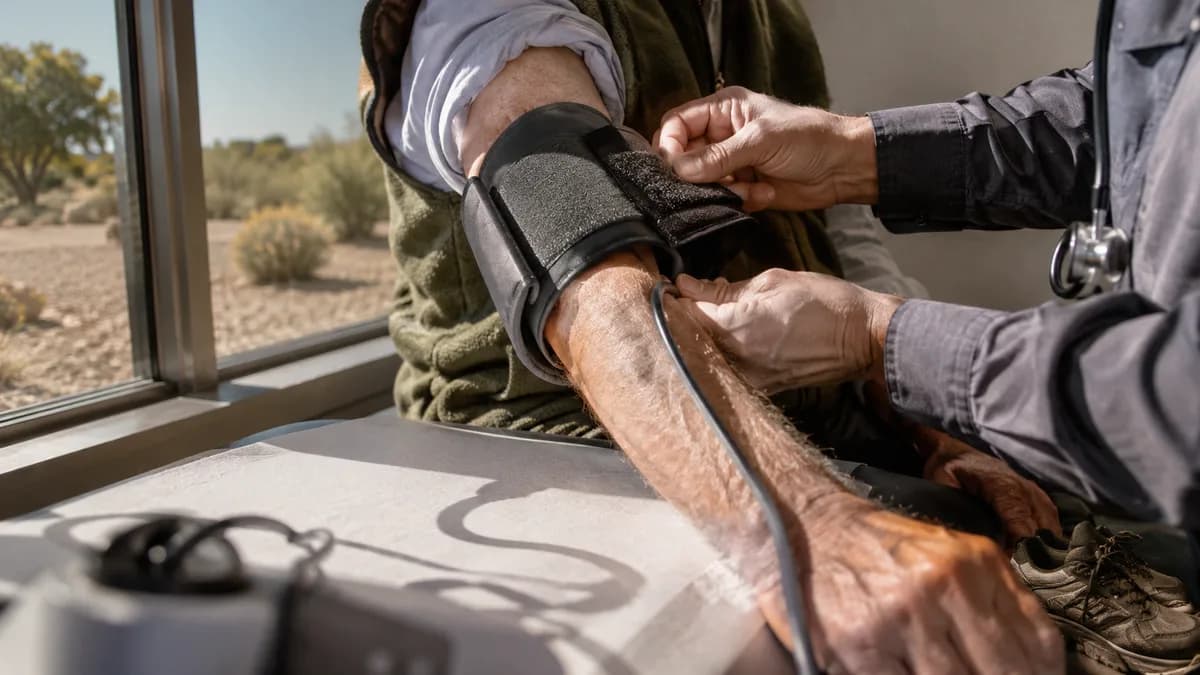
Photo: VapeExperts/AI
"Cannabis use is on the rise; therefore it's crucial for physicians to facilitate important conversations about the potential consequences of cannabis, especially for older adults and those with chronic diseases," Mauro said.[5]
Benjamin H. Han, an associate professor of geriatrics at the University of California San Diego, said the clinical stakes are real. "Cannabis can complicate the management of chronic diseases and be potentially harmful if patients are not educated on its use and potential risks," he said.[3]
Vaping's trade-off: less smoke, more THC
Dry-herb vaporizers heat cannabis flower below combustion temperature, producing vapor instead of smoke. For an older adult who insists on inhalation, research suggests vaping is a step down from smoking. But the evidence does not show it is a step up from a properly dosed edible.
A controlled crossover study found that the Volcano vaporizer produced THC blood levels similar to smoking but with lower exhaled carbon monoxide and no adverse events during controlled sessions.[9] Reviews have concluded that vaporization reduces several combustion toxicants and respiratory symptoms compared with smoking.[9]
Efficiency cuts both ways, though. A Johns Hopkins study of 17 infrequent users found that vaporized cannabis produced higher blood THC concentrations and greater drug effects than the same nominal smoked dose. Both 10 mg and 25 mg THC impaired cognition and motor performance; the 25 mg dose triggered more adverse reactions.[6]
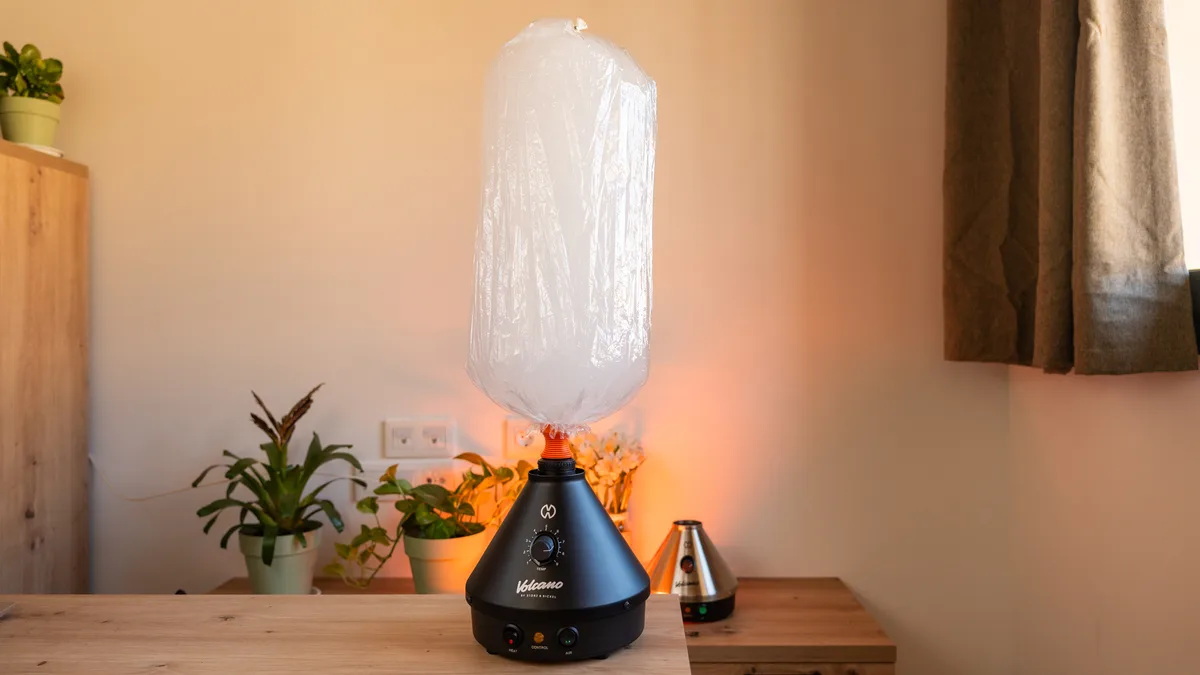
Photo: VapeExperts
A Storz & Bickel Volcano Classic vaporizer with an inflated balloon bag sits on a table. Devices like these deliver cannabis with less smoke but often higher THC concentrations than other methods.
That finding matters for the population in the JAMA edibles study: people who are not regular cannabis users. A vape that extracts THC efficiently could increase the risk of acute intoxication if the user loads too much flower or uses a high-THC cultivar.
Vaporization's practical edge is speed. Effects arrive in minutes, giving users real-time feedback to stop before they overshoot. Edibles offer no such feedback. But inhalation still carries cardiovascular and pulmonary exposure. A 2026 review found that smoking and vaping can produce similar acute increases in heart rate and blood pressure, and long-term data remain limited.[11]
Cannabis inhalation policy continues to evolve, but for older adults the more pressing gap may be simpler: route-specific medical guidance that most of them are not getting.
The trial that could settle the question
A Yale and VA crossover trial is designed to compare 5 mg and 10 mg oral THC with placebo and, in a separate phase, 2 mg and 4 mg vaporized THC with placebo in adults 65 and older.[10] It is one of the first studies to pit oral and inhaled cannabis head to head in this age group while measuring cognition, balance, blood pressure, and pain.
Until results like those arrive, four out of five older cannabis consumers are making the choice on their own.