


Medical cannabis has been a Schedule III drug for 104 days. Whether it stays there now rests with three judges who have said nothing since briefing closed on July 17.
The D.C. Circuit is weighing a motion to stay the April order that moved state-licensed medical marijuana out of Schedule I, along with a motion by two medical-cannabis operators to join the case in the government's defense. As of August 10, neither motion had been decided. The consolidated cases carry docket numbers 26-1106, 26-1130 and 26-1136.
The stakes reach past the courtroom. Federal tax treatment, DEA registrations, research access and the legal status of medical vape products all turn on how the court rules.
Two categories moved, everything else stayed put
Acting Attorney General Todd Blanche signed AG Order No. 6754-2026 in April. Published at 91 Fed. Reg. 22,714 on April 28, it took effect immediately and moved exactly two categories to Schedule III: marijuana in an FDA-approved drug product, and marijuana handled under a qualifying state medical license.[1] Adult-use cannabis and everything else stayed in Schedule I.
The order built an expedited DEA-registration pathway for state-licensed growers, distributors and dispensaries. State credentials can serve as evidence of authorization, though DEA may still deny registration under the public-interest factors in 21 U.S.C. §823.
The order's stated logic leans on the state systems themselves. It says incorporating state licensing into federal registration is "the most effective and efficient means" of meeting the Controlled Substances Act's goals "while promoting the medical benefits of marijuana and causing the least disruption for patients and existing state systems."[2]
Blanche framed the move around science. "This rescheduling action allows for research on the safety and efficacy of this substance, ultimately providing patients with better care and doctors with more reliable information," he wrote.
Three lawsuits, one consolidated fight
Three petitions arrived within a month of the order. Smart Approaches to Marijuana and the National Drug and Alcohol Screening Association petitioned on May 4, arguing the move will increase marijuana abuse and disrupt their drug-testing members' businesses.[3]
Nebraska and Indiana followed on May 22, initially joined by Louisiana, which later withdrew. A third petition from treatment groups and pharmaceutical developer MMJ International Holdings arrived May 28. The D.C. Circuit consolidated all three on May 29.

Photo: AgnosticPreachersKid/Wikimedia Commons (Public domain)
The E. Barrett Prettyman United States Court House stands in Washington, D.C. under a blue sky. The D.C. Circuit, based here, is weighing the consolidated challenges over the Schedule III cannabis order.
Their shared legal theory: the government used the treaty-implementation shortcut in 21 U.S.C. §811(d)(1) to skip notice-and-comment rulemaking and a pre-order hearing, then built a "hybrid" regime of quotas, import controls and state-license recognition that no statute authorizes. Both sides invoke the 1977 D.C. Circuit precedent NORML v. DEA and read it in opposite directions.
DOJ answers that §811(d)(1) permits scheduling by order when the 1961 Single Convention on Narcotic Drugs requires it, that a 2024 Office of Legal Counsel analysis supports its reading, and that petitioners have shown no concrete injury. It also argues any flawed provisions can be severed while Schedule III placement survives.
Two state-licensed operators, MedPharm Iowa, doing business as Bud & Mary's, and Tri-Mountain Pure, moved on June 29 to intervene on DOJ's side. They told the court that vacatur would directly injure their businesses and their federal registration applications.
Apr. 28, 2026
AG Order 6754-2026 takes effect, moving medical cannabis to Schedule III.
May 4, 2026
SAM and NDASA file the first petition for review.
May 22, 2026
Nebraska and Indiana file the state petition.
May 28, 2026
Treatment groups and MMJ International file the third petition.
May 29, 2026
The D.C. Circuit consolidates all three cases.
June 9, 2026
NDASA and MMJ move to stay the order pending review.
June 29, 2026
Bud and Marys and Tri-Mountain Pure move to intervene for DOJ.
July 2, 2026
DOJ files its opposition to the stay.
July 17, 2026
Briefing on the stay and intervention motions concludes.
Before the merits, the court must find an injured party
The first question is not whether the order is legal. It is whether anyone suing has Article III standing to complain about it.
NDASA says its drug-testing members face immediate compliance costs. DOJ calls those injuries speculative predictions about how employers might react. MMJ claims competitor standing, arguing Schedule III benefits state operators, naming products from Trulieve, Cresco Labs, Verano, Green Thumb Industries and TerrAscend, that compete with its FDA drug-development pipeline.
Photo: VapeExperts/AI
Bertha K. Madras, a Harvard Medical School psychobiology professor and former White House drug-policy official, submitted a declaration for the challengers calling the public-health risks "substantial" and "unacceptably high," particularly for adolescents and unborn children.
If the court finds no standing, the petitions die without any ruling on the Attorney General's legal theory, and Schedule III stands. A dismissal on those grounds would not shield a future broader rule from a challenger with a clearer injury.
A stay would reopen the 280E tax question
The stay motion carries the most immediate money. IRC §280E disallows ordinary business deductions for Schedule I and II trafficking, but not Schedule III. Qualifying medical operators have been outside that penalty since April.
A stay could revive §280E prospectively and trigger disputes over deductions already taken in 2026. It could also suspend the registration pathway, though whether it would restore Schedule I outright or only pause parts of the order would depend on the court's wording.
Jason Adelstone, an attorney at Harris Sliwoski tracking the case, summarized the challengers' stay argument this way: "Marijuana has remained prohibited for more than 50 years. Preserving the status quo for a few additional months while the court reviews the Final Order's legality is hardly an extraordinary burden."
Patients keep their programs either way, mostly
Photo: VapeExperts/AI
The April order did not create a national medical-cannabis market. State rules still decide qualifying conditions, eligible patients and available products, and rescheduling did not generally bring insurance coverage or interstate shipment.
"State medical marijuana regulations still rule the day," said Daniel J. Mallinson, associate professor of public policy and administration at Penn State Harrisburg.[4]
If the order is stayed or vacated, state programs are unlikely to vanish automatically. They ran for decades while cannabis sat in Schedule I. What patients would lose is the order's limited federal recognition, and the practical fallout would depend on federal enforcement policy.
Research is where the change bites hardest. Schedule III removes Schedule I-specific restrictions on researchers, though Mallinson notes they still need DEA registration and must buy study material from DEA-registered manufacturers.
Photo: VapeExperts/AI
Katherine E. Galluzzi, professor and chair of geriatric and palliative medicine at the Philadelphia College of Osteopathic Medicine, said Schedule I status had confined her field to observational work. "What we need to study, and what I hope this rescheduling will finally allow us to do, is determine which treatments are most effective, what safe use looks like, and where the threshold for unacceptable side effects lies," she said.[5]
What a ruling means for vapes
The order schedules cannabis, not hardware. A vaporizer, battery or heating element is not a controlled substance. But a cartridge handled under a qualifying state medical license may now be Schedule III, while an otherwise identical adult-use cartridge remains Schedule I. That split matters to a lot of people: 24.2 million Americans, or 39.2% of past-year marijuana users, vaped cannabis in 2025, federal survey data show.[6]
Schedule III is not FDA approval. Rescheduling does not establish that any dispensary vape product is safe or effective for inhalation, and federal drug approval remains product-specific.
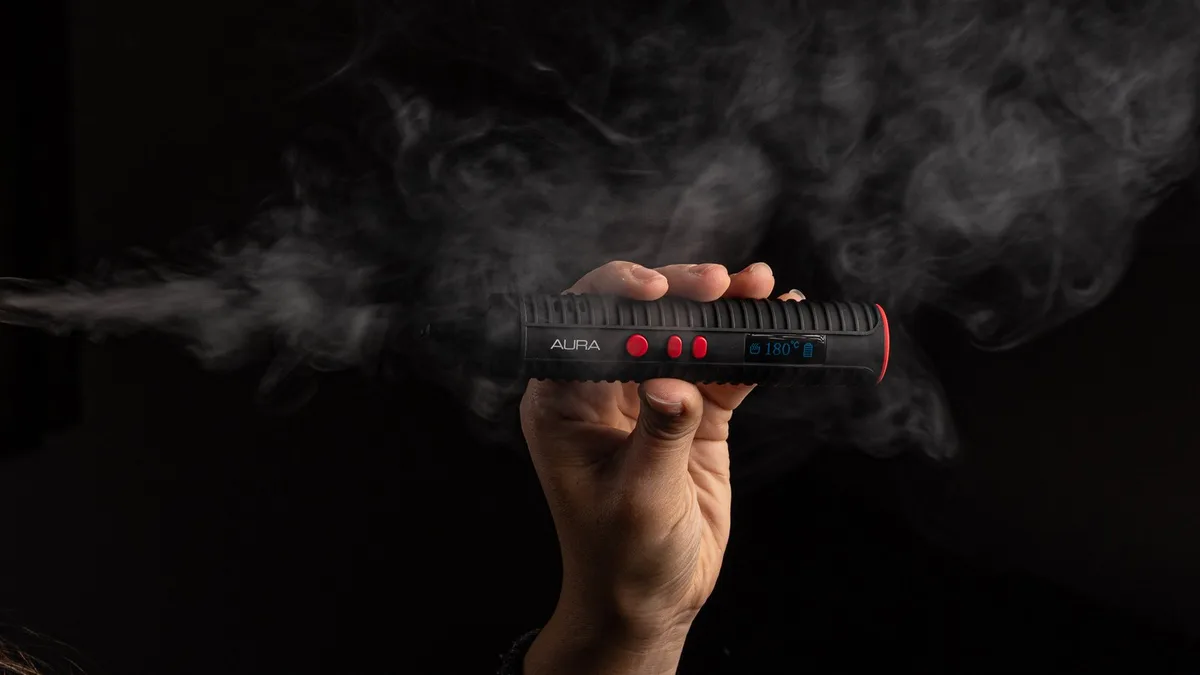
Photo: VapeExperts
A user holds a Flowermate Aura vaporizer amid a cloud of vapor. The regulatory status of cannabis vaporizers could shift depending on how the D.C. Circuit rules on the Schedule III order.
The tax split follows the license, not the product. Medical vape manufacturers and retailers outside §280E can potentially deduct payroll, rent and marketing. Adult-use vape operations cannot, even when the hardware and formulation are identical, and mixed-license businesses must separate the two activities.
The durable vape-specific stake may be research. A stay or vacatur could restore Schedule I paperwork and supply restrictions just as investigators begin studying real state-market formulations, including concentrates and cartridges, for dosing, contaminants and emissions.
The DEA is running a parallel track
Separately from the litigation, DEA's administrative hearing on moving the rest of marijuana, including adult-use products, to Schedule III concluded July 15. We covered what comes after that hearing as it wrapped.
Chief Administrative Law Judge Derek C. Julius set August 17 as the deadline for optional post-hearing briefs, capped at 50 pages per party. No deadline exists for his nonbinding recommendation or for the DEA administrator's final decision.
Neither track has a fixed end date. The D.C. Circuit can rule on the stay at any time, and its answer will shape both the April order and the legal ground under any broader rule that follows.
Adelstone has identified the signal to watch. "If the court grants both standing and a stay," he wrote, "I believe that will signal the end of state-legal medical marijuana in Schedule III." Until the three judges speak, the April order remains in force, and medical cannabis stays in Schedule III one ruling at a time.