


The court fight over federal cannabis rescheduling has a new set of players. Two state-licensed medical cannabis companies filed a June 29, 2026 motion asking the D.C. Circuit to let them join the government's side and defend Schedule III against the lawsuits trying to undo it.[1]
MedPharm Iowa, LLC, which does business as Bud & Mary's, and Tri-Mountain Pure, LLC want to intervene as party respondents supporting the Justice Department. Their motion says they would suffer "direct economic, regulatory and operational harm" if the challengers succeed in staying, vacating, or delaying the order, according to Marijuana Moment.
Two companies say DOJ cannot speak for them
The intervenors argue the government will defend the legality of its own order but cannot fully represent their commercial stake in it. "Unlike DOJ, Intervenors have a specific, focused interest in the transfer of their products to schedule III and the opportunity to register with DEA to ensure their operations do not violate the Controlled Substances Act," the motion says, as quoted by Marijuana Moment.
The filing adds that the companies "have invested substantial resources in reliance on DOJ's final order" and "have applied for DEA registration in the wake of that final order."
Photo: VapeExperts/AI
What the April order actually did
The challenged action is DOJ's order placing two categories of cannabis in Schedule III: FDA-approved drug products containing marijuana, and marijuana products regulated under qualifying state medical licenses. DOJ announced the move on April 23, 2026, and the actions ran in the Federal Register on April 28, 2026.[2][8]
The order is limited. Adult-use cannabis, including flower and vape products sold in recreational markets, sits outside its scope unless covered by a qualifying state medical license or a future broader rule.[7]
Acting Attorney General Todd Blanche framed the order as a research and patient-access move. "This rescheduling action allows for research on the safety and efficacy of this substance, ultimately providing patients with better care and doctors with more reliable information," he said.
Photo: VapeExperts/AI
Opponents want the order frozen
Several petitions challenging the order were filed in the D.C. Circuit and consolidated. The petitioners include Smart Approaches to Marijuana, the National Drug and Alcohol Screening Association, and state attorneys general. We covered the state lawsuit when it landed: states sue to block marijuana rescheduling.
On June 9, 2026, NDASA and MMJ International Holdings entities asked the court to stay the order while the litigation plays out.[5] DOJ filed its opposition on July 2, 2026, criticizing the challengers' "pocketbook interests" and arguing Congress "did not enact the CSA to provide drug screeners with a permanent source of income for testing marijuana."[4]
MMJ responded to the intervention filing in a press release. Duane Boise, the company's president and CEO, said: "The intervention motion confirms what MMJ has consistently argued. The companies seeking to intervene openly acknowledge the substantial financial and regulatory benefits they expect to receive if DOJ's Final Order remains in place. Those are legitimate business interests, and the Court should have a complete record regarding those interests."
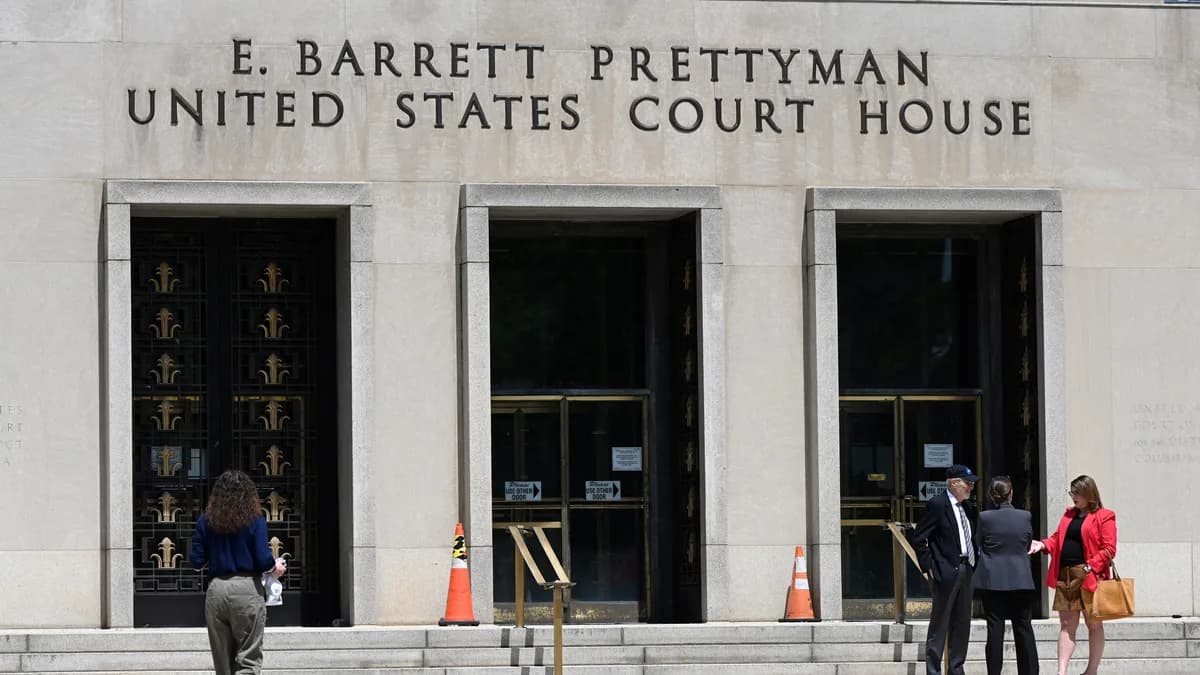
Photo: Douliery Olivier/ABACA/Newscom
Members of the media gather outside the E. Barrett Prettyman United States Courthouse in Washington in April 2026.
May 21, 2024
DEA published a proposed rule to move marijuana from Schedule I to Schedule III.
Dec. 18, 2025
President Trump issued an executive order directing expedited rescheduling activity.
April 23, 2026
DOJ announced its order placing two categories of medical cannabis in Schedule III.
April 28, 2026
The final rule and related actions were published in the Federal Register.
June 9, 2026
NDASA and MMJ entities filed a motion to stay the order pending review.
June 29, 2026
MedPharm Iowa and Tri-Mountain Pure filed their motion to intervene in support of DOJ.
July 2, 2026
DOJ filed its opposition urging the court to deny the stay.
The Section 280E tax question
The intervenors' claimed economic interest runs through the federal tax code. Treasury says Section 280E generally disallows deductions and credits for businesses trafficking in Schedule I or II controlled substances. Rescheduling generally removes that bar for activity that is no longer Schedule I or II because of the final order.[6]
The intervenors say they have invested substantial resources in reliance on the order, and their motion argues a stay or vacatur would put those plans in question. Reuters has noted the order arrives with limits and does not cover cannabis activity outside the two categories.

Photo: VapeExperts/AI
DEA's broader rescheduling hearing has a deadline
Separate from the litigation, the DEA opened a new administrative hearing on broader marijuana rescheduling on June 29, 2026. The agency selected 7 participants, including NDASA, Smart Approaches to Marijuana, and the states of Nebraska, Idaho, Indiana, and Louisiana. DEA says the hearing must conclude no later than July 15, 2026.[3] That process could eventually produce a broader Schedule III rule covering cannabis more generally, but only after administrative findings and final agency action.
What to watch
- Will the D.C. Circuit let MedPharm Iowa and Tri-Mountain Pure into the case? As of July 6, no ruling had been reported on the intervention motion.
- Will the court grant the stay? If it does, the April order could be frozen during the litigation. If it does not, Schedule III stays in effect while the merits are argued.
- Does DEA's broader rescheduling hearing, which must end by July 15, 2026, move toward a rule that reaches beyond medical products?
- How will the court handle the core merits questions, including whether DOJ had authority to act by order and whether the two-category approach holds up?
We will report the court's rulings on both motions when they come down.