

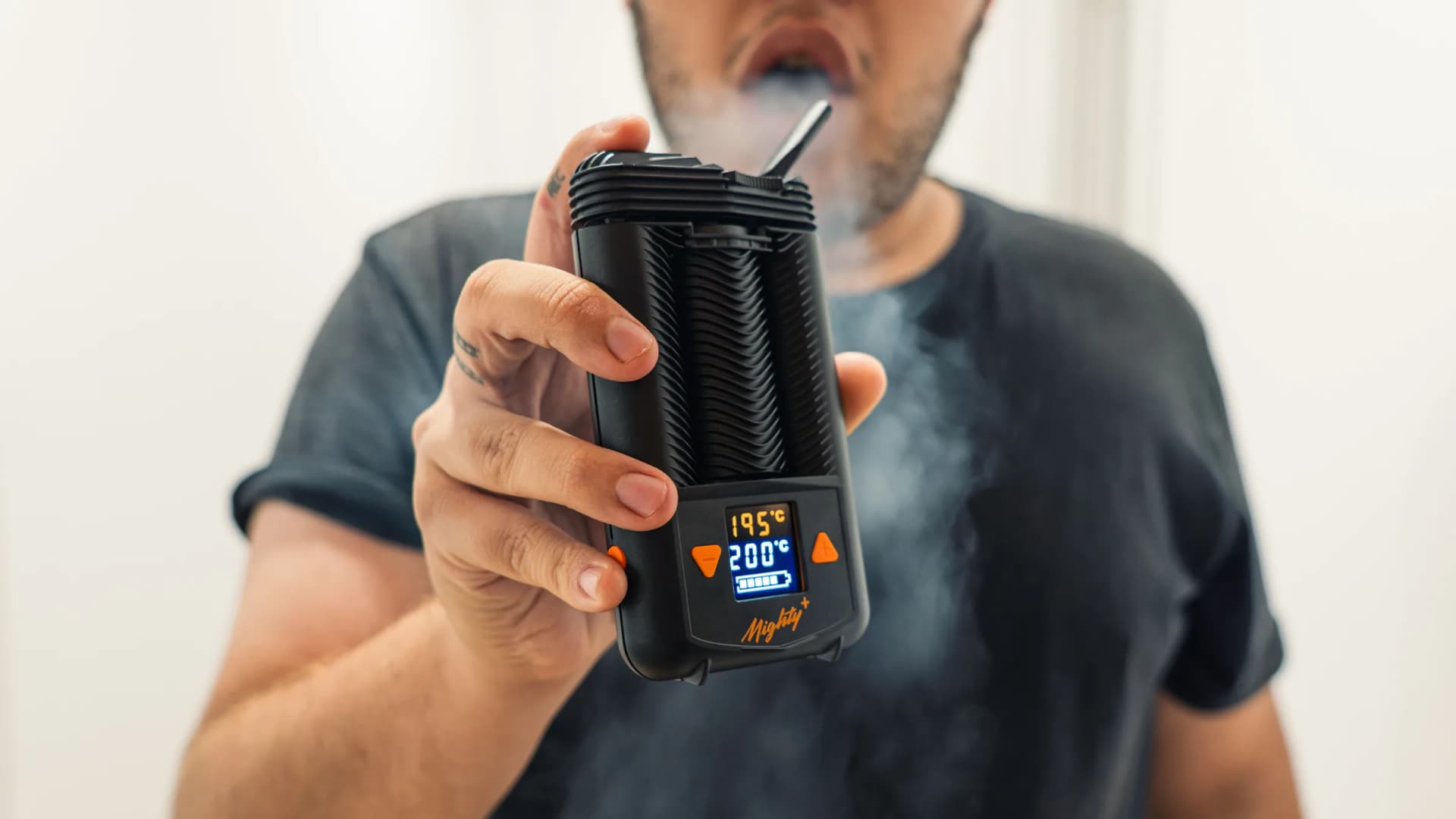
Seventeen adults who rarely used cannabis inhaled 25 mg of THC through a vaporizer. The exhale was thin. Peak blood THC averaged 14.4 ng/mL, roughly 41% higher than when the same people smoked the same dose. Subjective drug effects scored 78 out of 100 vaporized versus 66 out of 100 smoked.[1]
The thinner aerosol hit harder. That result, from a randomized crossover trial by Tory Spindle and Ryan Vandrey at Johns Hopkins, runs counter to one of the most durable assumptions in cannabis vaping: a fat cloud means a strong hit, and a wispy one means your vaporizer is broken.
We think the assumption is wrong. Here is what the data say.
E-cigarettes built the cloud expectation
E-liquid clouds are not gas. They are suspended droplets of propylene glycol (PG) and vegetable glycerin (VG) that scatter visible light as they cool in the air. VG-based aerosol particles had count-median diameters of 182 ± 9 nm versus 145 ± 8 nm for PG.[3] Ambient conditions shift the picture: moving from 20°C and 30% relative humidity to 37°C and 95% humidity increased measured particle diameter by 4% to 44%, depending on the liquid.[3]
Cannabis flower has no glycerin tank. It supplies cannabinoids, terpenes, moisture and other plant compounds, but the total condensable mass per draw is a fraction of what an e-liquid coil aerosolizes. Flower vapes produce thinner exhales by default. Not by defect.
The modern cloud ideal came from second- and third-generation e-cigarettes. Cloud competitions appeared in vape shops shortly after sales began around 2011. Open-system mods became popular by roughly 2013. Al-Hamdani and colleagues found that cloud-trick culture peaked around 2015, that high-VG liquids and greater power drove the aesthetic, and that cloud chasing contributed to e-cigarette appeal among young people.[2] Instagram, Reddit and YouTube turned an aerosol production side effect into a performance standard.
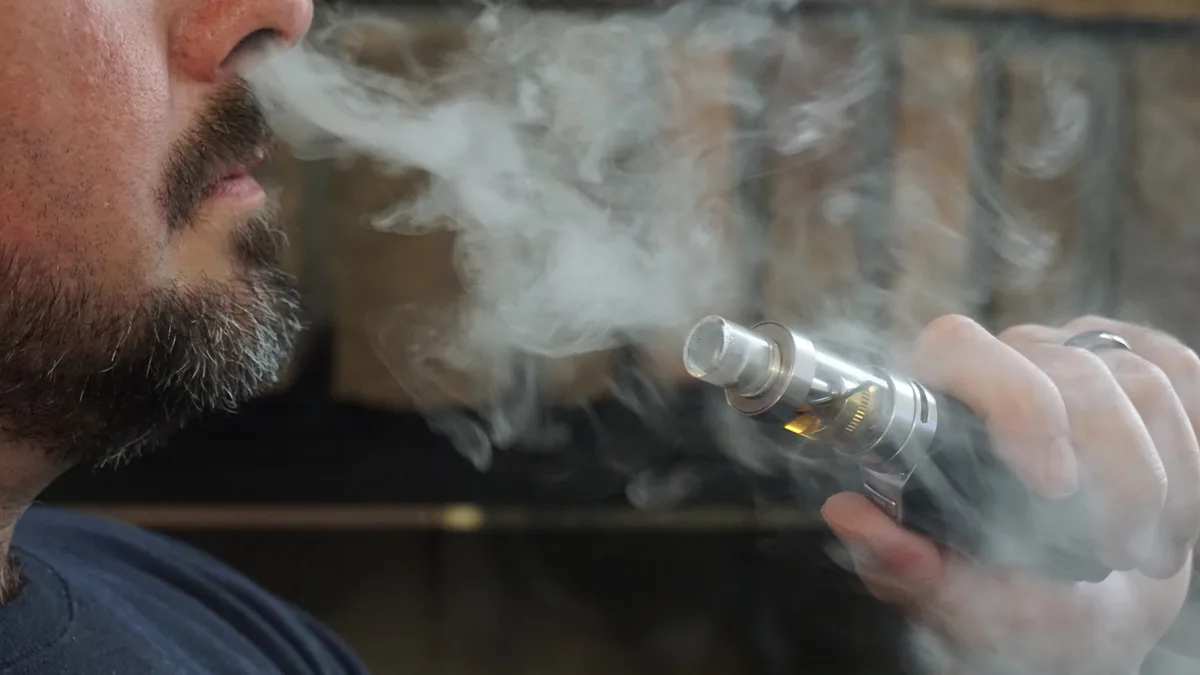
Photo: Vaper City/Wikimedia Commons (CC BY-SA 4.0)
A man exhales a large cloud of vapor while holding an e-cigarette device. Such devices built the cloud expectations that can mislead dry herb vape users.
When users switch from e-cigarettes to dry herb vapes, many carry that standard with them. The chemistry is different. The comparison does not transfer.
That temperature chart is wrong
Most cannabis temperature guides repeat the same numbers: THC boils at roughly 157°C, CBD at 160 to 180°C. Both figures are misleading.
Meehan-Atrash and colleagues traced the 157°C figure to distillation data collected under a deep vacuum of about 0.05 torr. A dry herb vape operates near 760 torr, normal atmospheric pressure. The authors estimated normal boiling points of approximately 425°C for THC and 463.9°C for CBD, while noting that cannabinoids decompose before reaching those temperatures.[4]
A December 2025 thermogravimetric study in the Journal of Cannabis Research arrived at a different estimate: 245 ± 6°C for THC at one atmosphere.[5] The two papers disagree on exact figures. Both confirm that 157°C is not the temperature at which THC activates in your vape.
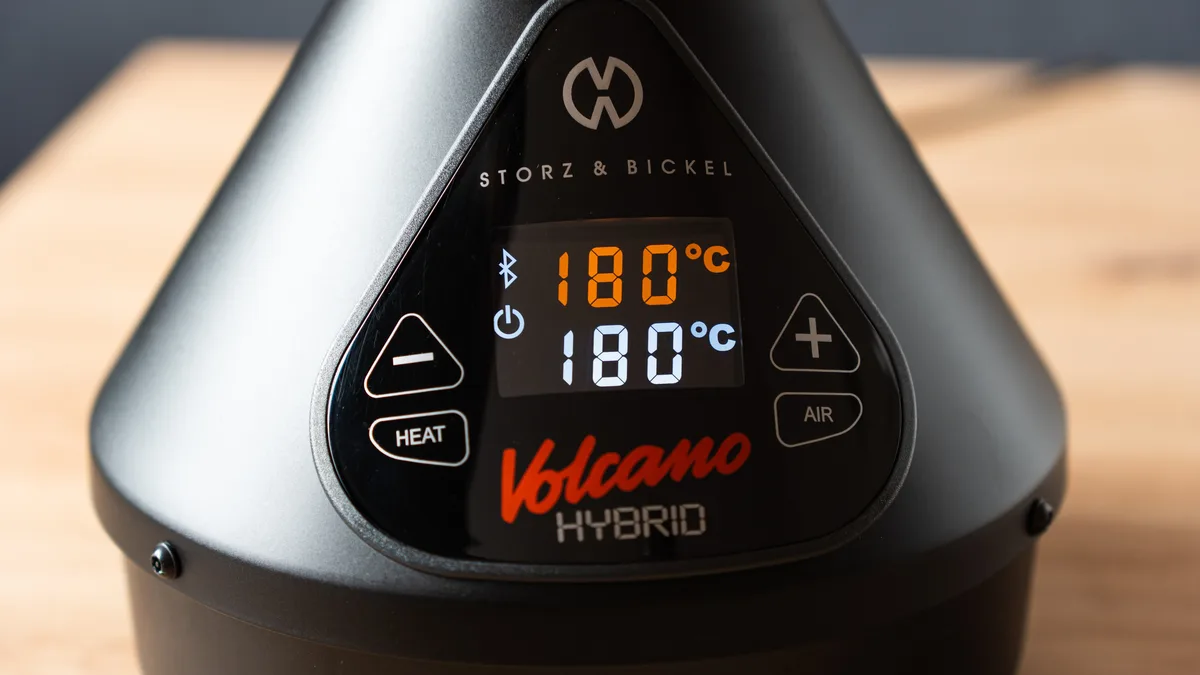
Photo: VapeExperts
A Storz & Bickel Volcano Hybrid vaporizer sits on a wooden table set to 180 degrees Celsius. Users often judge potency by vapor cloud size, but common temperature charts can be misleading.
What actually happens is continuous evaporation. THC has nonzero vapor pressure well below its boiling point. As the chamber heats up, cannabinoids evaporate, THCA converts to THC, and hot gases condense into aerosol droplets as they cool. Terpenes generally leave the plant earlier than cannabinoids. This is why a 180°C draw can deliver active THC while looking almost invisible.
Users who set their vaporizer to 157°C and see nothing may assume the temperature is too low. The temperature may be fine. The chart was wrong.
Same temperature, wildly different extraction
If cloud size measured extraction, vaporizers set to the same temperature should produce similar results. They do not.
Christian Lanz and colleagues tested four electric vaporizers at 210°C and measured the share of total cannabinoids recovered in vapor.[6]
THC recovered in vapor at 210°C
Source: Lanz et al., PLOS ONE, 2016
The Arizer Solo recovered 82.7% of THC. The DaVinci recovered 54.6%. Same displayed temperature. A 28-percentage-point gap. THC decarboxylation exceeded 97.3% in all four electric units. A fifth, gas-powered model visibly combusted the flower while recovering just 55.9%.[6]
Separate laboratory work by Micalizzi and colleagues compared the Mighty Medic and DaVinci at 210°C with 150 mg of flower and 10 standardized puffs. The Mighty collected 84 ± 4% of THC in its aerosol filter. The DaVinci collected 42 ± 6%. But the Mighty also deposited 24 ± 1% of loaded THC inside its mouthpiece and cooling unit, cannabinoids that never reached the user.
Chamber design, heat transfer and airflow created those gaps. Cloud appearance did not predict them. And as of this writing, no peer-reviewed study has directly correlated optically measured cloud density with cannabinoid recovery for the Mighty+ 8.7 , Venty 9.2 or TinyMight 2.
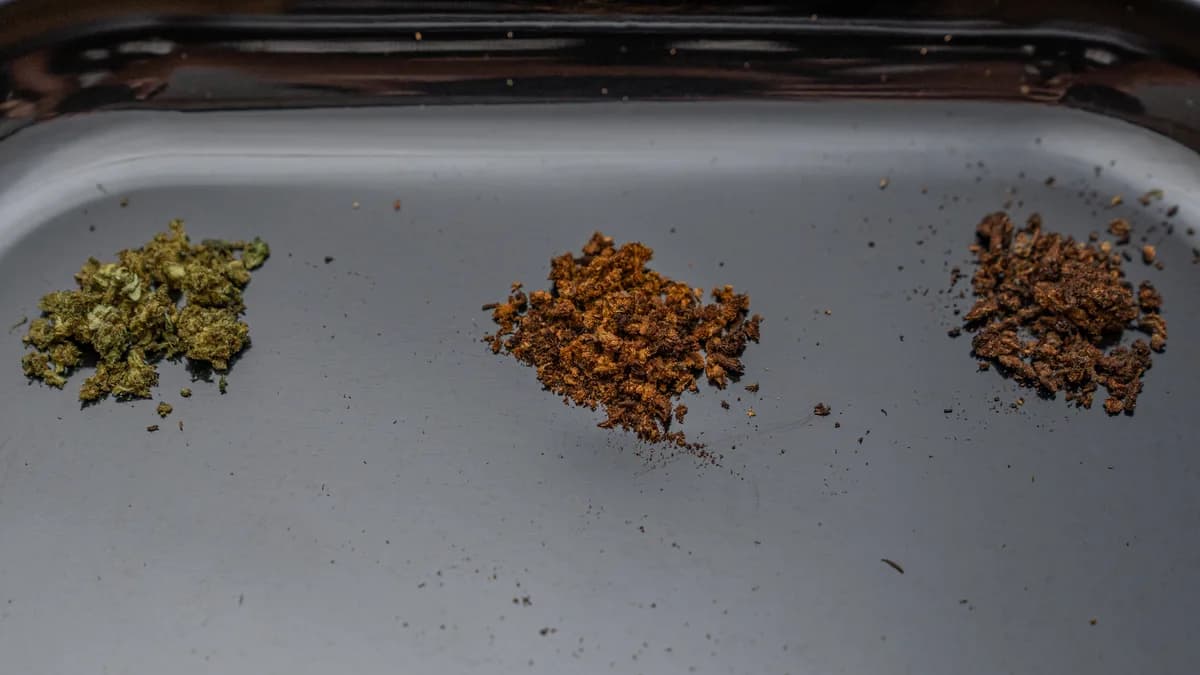
Photo: VapeExperts
Cannabis vaporized in a DynaVap UniDyn shows a range of colors from green to dark brown. Even at the same temperature, extraction levels can vary widely, making vapor cloud size a poor guide.
Higher temperatures do generally help. Pomahacova and colleagues compared Volcano vapor at 170°C, 200°C and 230°C with smoke. The cannabinoid-to-byproduct ratio was best at the two higher temperatures. At 170°C, it was worst because cannabinoid delivery was low.[7] But higher temperatures also deplete the load faster, produce harsher aerosol, and narrow the safety margin before pyrolysis begins. A cloudier high-temperature draw may contain more cannabinoid than a low-temperature draw from the same bowl. It still does not establish better whole-session efficiency.
An impressive exhale can mean wasted cannabinoids
Research by Arno Hazekamp found that a Volcano transferred about 54% of loaded THC into its balloon under optimized conditions. During human use, roughly 35% of inhaled THC was directly exhaled.
That creates a paradox. A dramatic cloud may partly display cannabinoids that deposited nowhere useful. A longer breath hold produces a thinner exhale because more particles settled in the lungs, not because the vaporizer generated less. (This does not mean holding your breath until you feel faint. It means the exhale is an unreliable report card.)
The common claim that visible vapor is "just terpenes" is also wrong. Research on THC and terpene mixtures estimated essentially complete THC partitioning into aerosol particulate matter.[8] A 2025 chamber study from the U.S. Department of Energy found that terpene-only mixtures produced much less particulate matter than mixtures containing THC or CBD.[9] Adding cannabinoids to the aerosol made it denser, not thinner. Peak particle-number concentrations in the chamber ranged from 0.7 million to 13 million particles per cubic centimeter, depending on composition.[9]
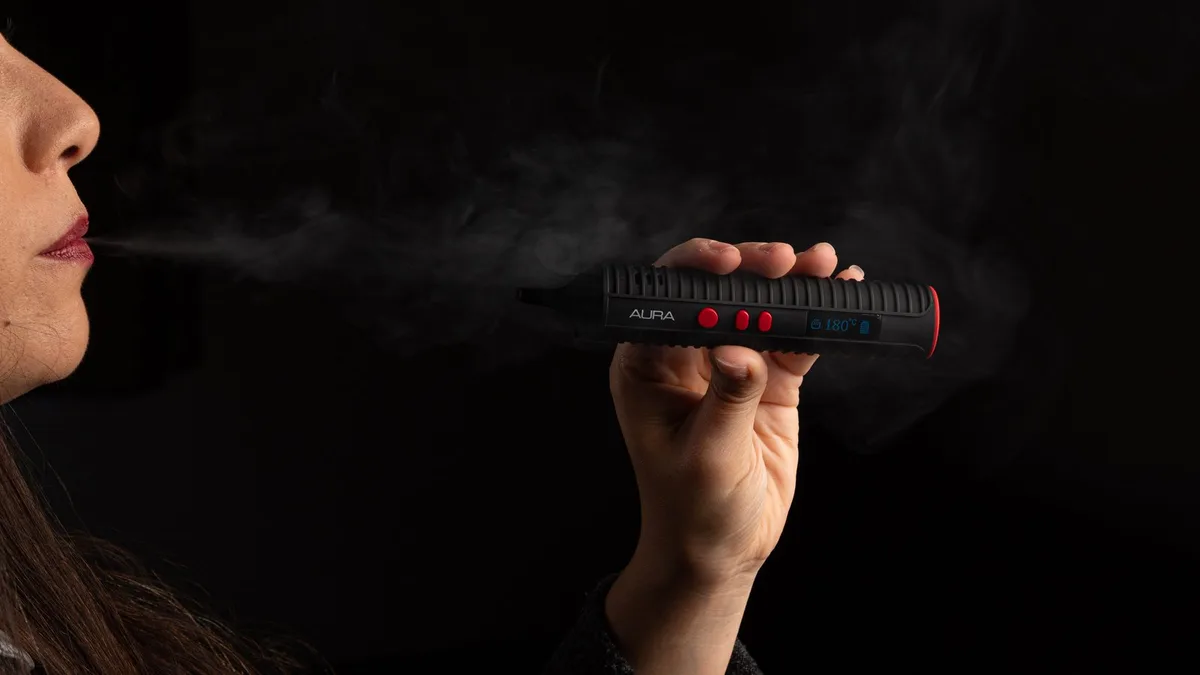
Photo: VapeExperts
A user exhales vapor after drawing from a Flowermate Aura vaporizer. Large clouds like this can signal wasted cannabinoids rather than an efficient session, experts say.
Cannabinoids are in the cloud. So are terpenes, water and other plant volatiles. Visibility alone cannot sort them.
When clouds tell you something real
None of this means visibility is useless. Within a single session on one vape with the same flower, watching the exhale provides real information. It can tell you whether the chamber has reached operating temperature, whether airflow is passing through the load, when production is declining, and when the bowl is nearly done.
Storz & Bickel recommends starting the Mighty+ Medic around 180°C, increasing temperature progressively as vapor fades, and treating a capsule as depleted when no visible vapor remains at 210°C. The Venty defaults to 180°C with boost steps to 195°C and 210°C. That is a manufacturer using visibility as a pacing cue within a controlled protocol, not as a universal potency gauge.
Cloud-focused users also have a reasonable argument about ritual. The sensory feedback of exhaling something visible matters for satisfaction and, for some people, for staying away from combustion. The strongest version of that argument is not "bigger always means stronger." It is "some feedback is better than none."
What actually tells you your vape works
Cloud size is a dashboard light, not a dynamometer. Better indicators:
- Measured effects at a consistent dose. Weigh the same amount of the same flower. Allow time before increasing.
- Flavor and aroma. A terpene-rich first draw can be effective while barely visible.
- Even browning. Properly extracted flower turns evenly tan to brown. Black spots or ash indicate overheating.
- Progressive output. Production that builds as the chamber heats, then gradually diminishes.
- Free airflow. Overpacking, clogged screens and resin in the cooling path can reduce output even when the heater works.
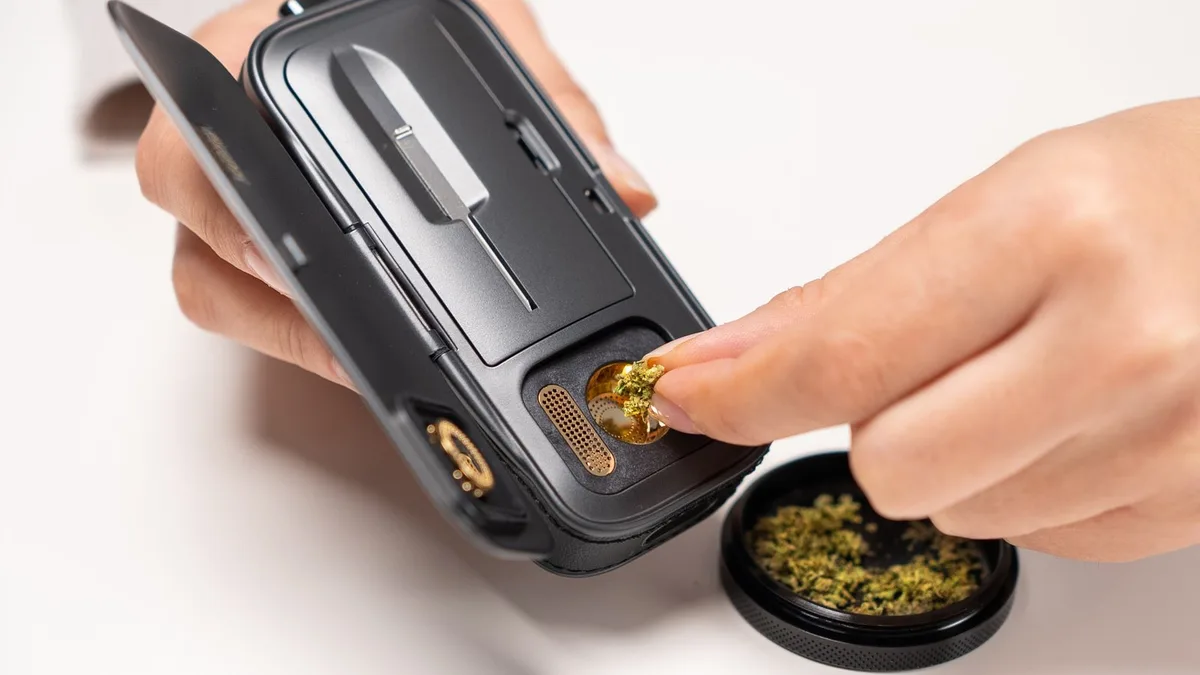
Photo: VapeExperts
A user loads ground herb into the chamber of an AirVape Legacy Pro 2. Experts say proper loading and heating, not vapor cloud size, indicate whether a dry herb vaporizer is working well.
Signs worth troubleshooting: no flavor, effect or browning after several full draws at a confirmed medium-to-high temperature. Completely green material after a full session. Unusually cool air from a convection vape. One black hot spot with the rest still green.
Temperature stepping beats either extreme. Start around 180°C for flavor, raise in increments as production fades, stop before the load tastes burnt. Not every draw needs to fill a room.
In a peer-reviewed survey of 557 people with cannabis vaping experience, 81% preferred dry herb, and the top three reasons for choosing vaporization were perceived health advantages (77.7%), discretion (53.6%) and better taste (48.4%).[10] Cloud size did not make the list.