

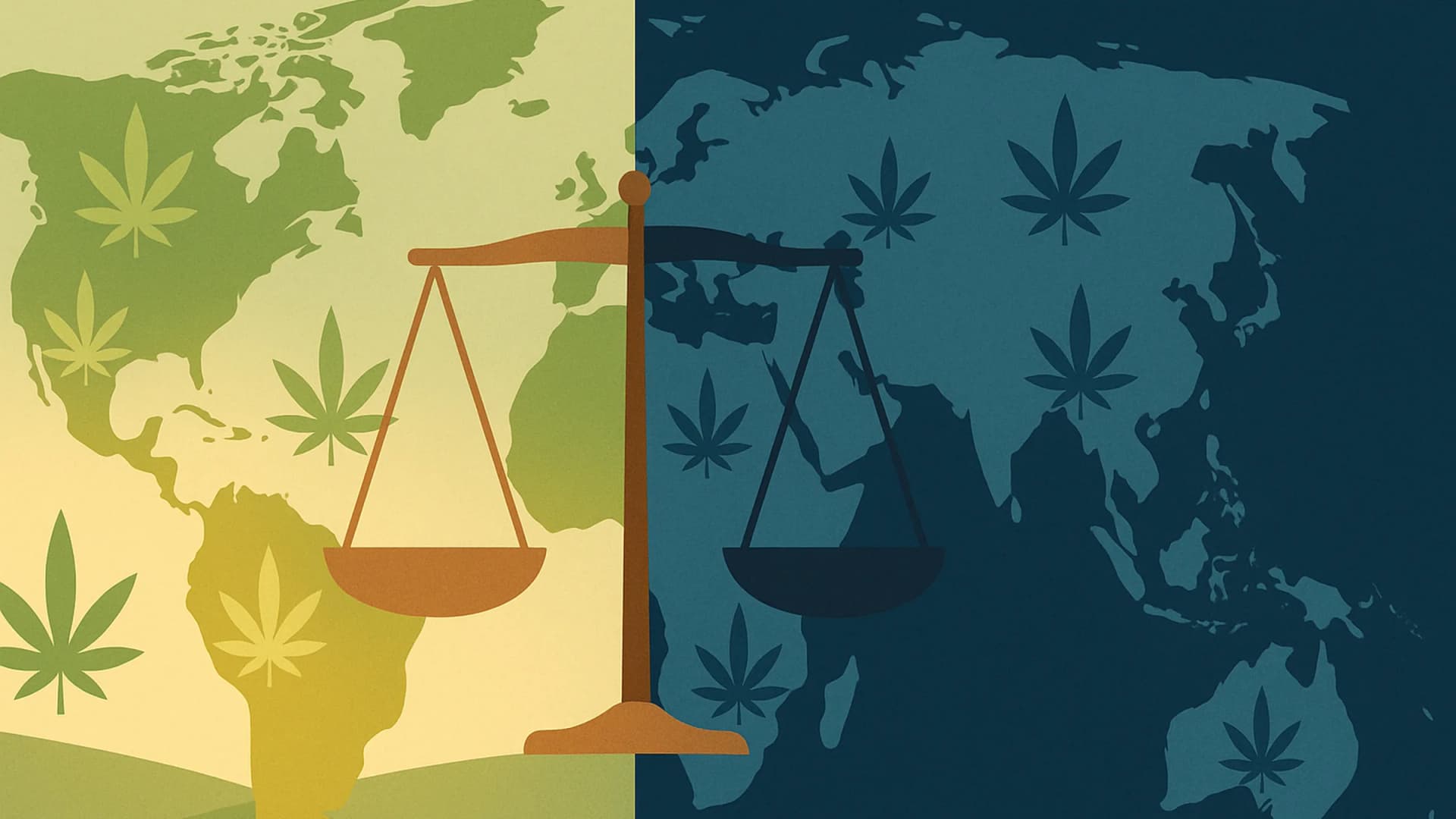
Here is a fun fact about cannabis weight.
In an Amsterdam coffeeshop, 500 grams is the maximum stock a shop can legally keep on the premises.[2] In Singapore, 500 grams of cannabis is the threshold for a mandatory death penalty.[3]
Same plant. Same weight. One is a Tuesday in the Dam. The other ends at the gallows. The world cannot agree on cannabis, and the laws still on the books in 2026 prove it.
The Dutch sold weed for 50 years but made growing it a crime
The Netherlands invented the most famous legal paradox in cannabis history. For nearly 50 years, you could legally walk into a coffeeshop and buy 5 grams. But every gram came in through the "back door" as criminal contraband, because growing and supplying it stayed completely illegal.
The Dutch call this the tolerance policy, or gedoogbeleid. The official definition: "to allow, under certain circumstances, what is legally prohibited."[1]
Translation: every coffeeshop in the country was, by definition, buying from criminals. For half a century.
Shops follow the AHOJ-G rules: no advertising, no hard drugs, no public nuisance, no sales to anyone under 18, and no more than 5 grams per sale.[4]
The fix finally arrived. On April 7, 2025, the four-year Wietexperiment launched, with about 75 coffeeshops in 10 municipalities now selling only regulated, government-licensed cannabis. One catch: the ban on illegal hashish was not enforced until September 1, 2025, because the legal growers could not make enough hash in time.
Japan let you get high legally for 76 years, as long as you owned nothing
Japan's old law had a loophole that sounds invented. For 76 years (1948 to 2024), cannabis use was not a crime in Japan. Only possession was.[5]
The drafters of the 1948 Cannabis Control Act left out a "use" offense on purpose. They wanted to protect hemp farmers who might accidentally breathe in psychoactive material while working their fields.
So in theory, you could be completely high and face zero consequences, provided you were not holding any cannabis.
Japanese slang even captured it. Synthetic cannabinoids that exploited the gap became known as dappo habu (loophole herb).
That window closed on December 12, 2024. Cannabis use is now punishable by up to 7 years in prison. The same reforms cracked open a narrow door for medical cannabis pharmaceuticals.
South Korea follows its citizens through customs
Most countries stop caring about your habits at the border. Not South Korea.
Under the Narcotics Control Act, Korean citizens can be prosecuted for using cannabis even in countries where it is legal, like Canada, Germany, or Colorado. The penalty when they return home: up to 5 years in prison.[6]
In May 2024, the Ministry of Justice issued a public warning. "There have been cases in which Korean citizens mistakenly believe that smoking marijuana is alright in countries where it has been legalized," the ministry said. "Korean citizens, however, could face a heavy penalty under our domestic laws for using illicit drugs in those countries after they return."
What happens in Vegas, in other words, follows you home through Incheon.
Thailand legalized, then un-legalized, in three years flat
Thailand holds the record for fastest cannabis whiplash.
On June 9, 2022, it became the first country in Asia to decriminalize cannabis. Dispensaries and cafes exploded across the country almost overnight.[7]
Then, on June 26, 2025, Thailand re-criminalized recreational cannabis, effective immediately, with no transition period. Cannabis buds were reclassified as a "controlled herb."
Recreational use is now banned outright, with penalties up to 1 year in prison and a fine of 20,000 baht (about $560). You now need a valid medical prescription, capped at 30 days, to buy.
The whole legal-to-illegal swing took roughly three years. That is about how long it takes to grow a few good harvests.
Bhutan feeds cannabis to its pigs
In Bhutan, cannabis grows wild and enormous, with stalks towering over people from the midlands to the southern border. The local name for it is "Phakpa Nam," which translates to "pig feed."[8]
That is exactly what it was used for: fattening pigs, plus making rope, textiles, and bowstrings.
Here is the wild part. According to local accounts, nobody in Bhutan knew about cannabis's recreational use until 1999, the year television was legalized and tourism opened up.
Possession and sale are illegal now. Selling more than 50 grams can mean 5 to 9 years in prison. But the plant still grows everywhere, and according to one account, nobody pays it any attention.
Bhutan's pigs may be the most relaxed livestock on Earth.
Germany legalized weed and then made it nearly impossible to buy
Germany legalized adult-use cannabis on April 1, 2024, becoming the third EU country to do so. Adults can possess 25 grams in public, keep 50 grams at home, and grow up to 3 plants.[9]
Then comes the very German part.
There is no commercial retail. The only legal source beyond home-grow is a non-profit Cannabis Social Club. As of May 2025, only about 237 permits had been granted out of roughly 660 applications.
So you can legally grow three plants and legally possess weed, but you may have no legal way to actually buy any. The coalition government later committed to an ergebnisoffene Evaluierung (open-ended evaluation), with results expected in 2026.
In Spain your couch is protected, the beach is not
Spain runs on a sharp line between private and public.
Under the 1978 constitution, personal cannabis use in private spaces has never been criminalized, thanks to principles of personal autonomy and privacy.[10]
Step outside, though, and the math changes fast. Public possession or use carries administrative fines of 601 to 30,000 euros under the Citizens' Security Law.
So your living room joint is constitutionally protected. The same joint on the beach next door could cost you up to 30,000 euros.
The Czech Republic quietly joined the club
On January 1, 2026, the Czech Republic added itself to Europe's short list of reformers. Adults 21 and over can now grow up to 3 plants and keep up to 100 grams at home or 25 grams in public without penalty.[11]
There is no commercial retail. The law covers personal growing and possession only, the result of three decades of slow reform.
A century of disagreement, and it only got weirder
The year 2025 marked 100 years since cannabis first came under international drug control, starting with the 1925 International Opium Convention.
For decades, cannabis sat in the most restrictive Schedule IV of the 1961 Single Convention, right alongside heroin. It stayed there for 59 years.
That changed on December 2, 2020, when the UN Commission on Narcotic Drugs voted to remove cannabis from Schedule IV. The margin was razor thin: 27 in favor, 25 against, 1 abstention.[12]
Today, Canada, Uruguay, Malta, Luxembourg, and Germany have fully legalized recreational cannabis, and the Czech Republic now allows home growing.[13] In the United States, 39 states and D.C. allow recreational marijuana, while it stays Schedule I federally. Germany even set a roadside THC limit of 3.5 micrograms per litre of blood serum.[14]
A hundred years in, the world has not gotten any closer to agreement on this one plant. It has only gotten stranger. Somewhere in Bhutan, a very content pig has no idea what all the fuss is about."