

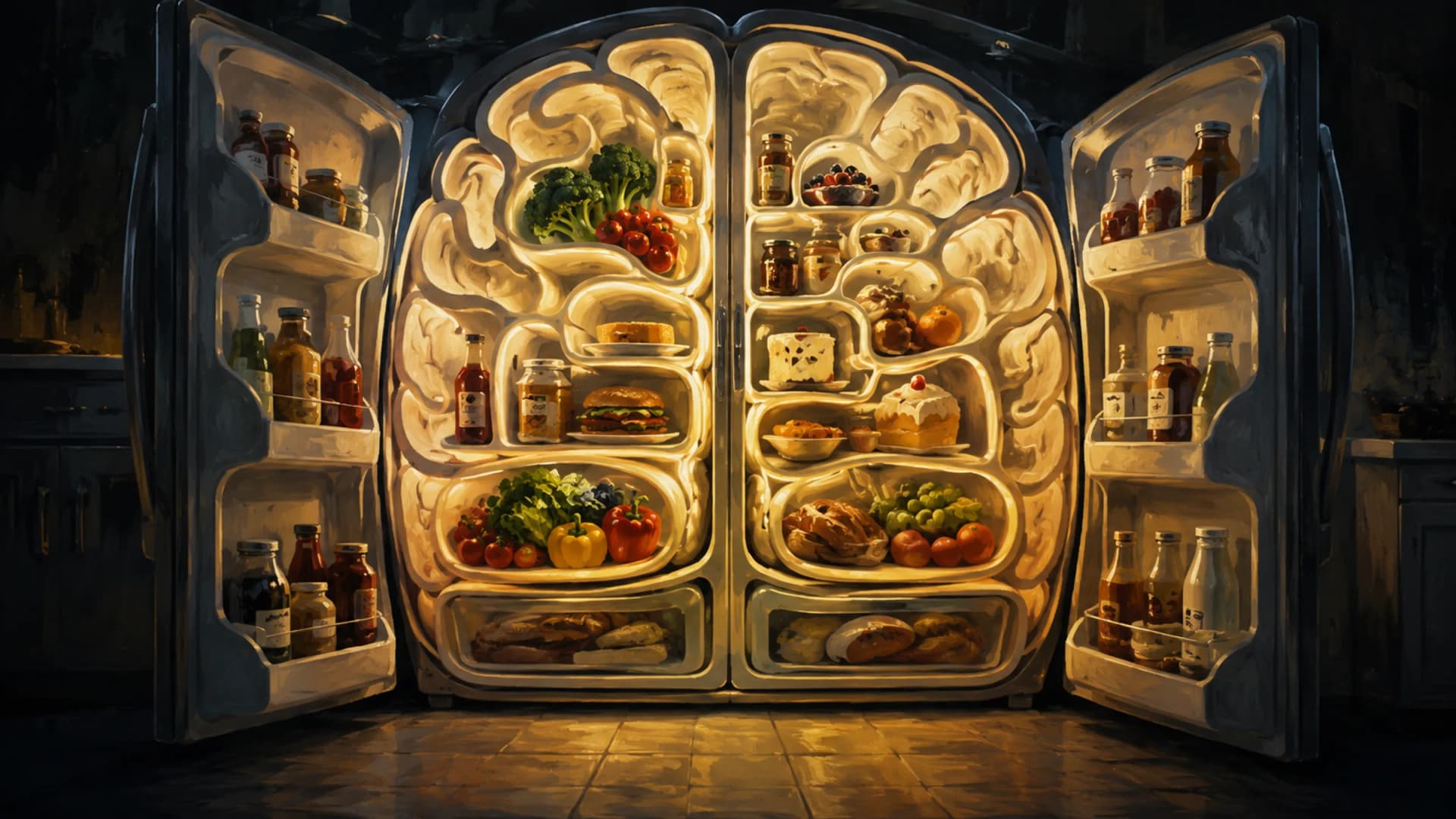
The brain cells that tell you to stop eating can, under the influence of THC, switch sides and start promoting hunger. That reversal, documented in mice over a decade ago, is just the opening act. The full picture of why one plant makes some people raid the fridge, locks others to the couch, and leaves a third group wide awake and indifferent to snacks involves hijacked neurons, amplified smells, temperature physics, and a pile of overconfident strain labels.
The "full" neurons flip to hungry
In a 2015 study published in Nature, Marco Koch, Tamas Horvath and colleagues at Yale University examined a group of hypothalamic neurons called POMC cells in mice. These neurons normally help signal satiety. When the researchers activated CB1 cannabinoid receptors on them, the neurons became more active, and feeding increased. [1]
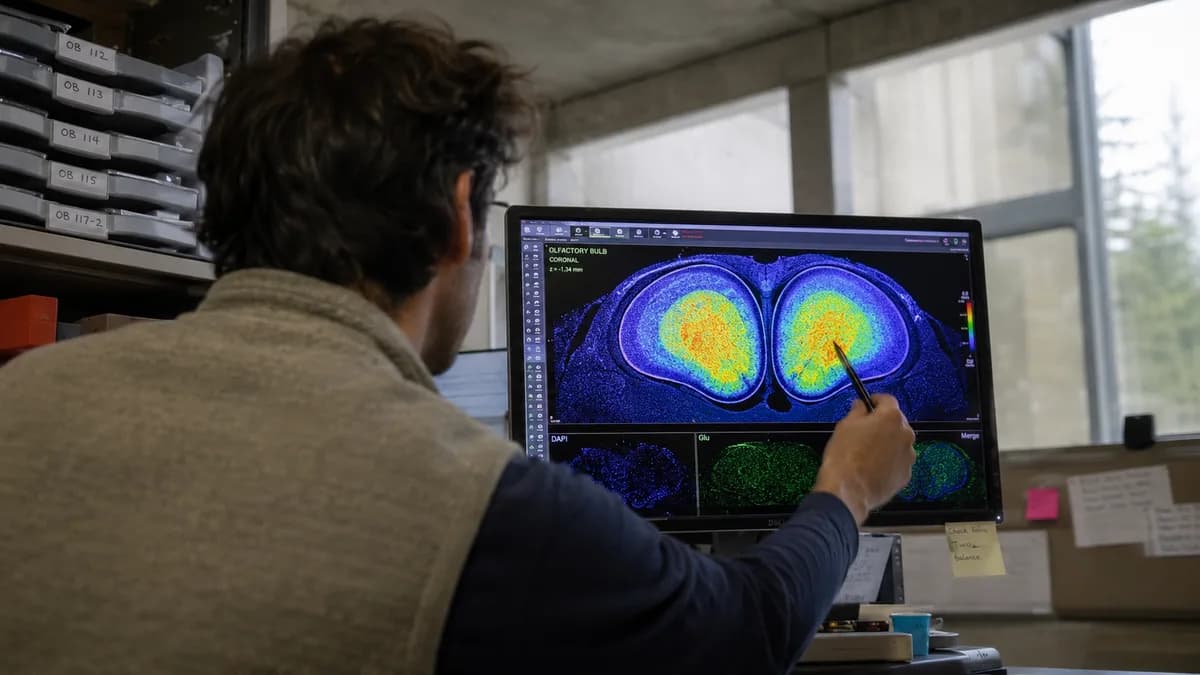
The reversal happened at the molecular level. CB1 activation boosted appetite-promoting beta-endorphin while leaving appetite-suppressing alpha-MSH alone. Blocking opioid receptors with naloxone shut down the feeding response. Mitochondrial changes involving uncoupling protein 2 were also required. [2]
Horvath compared the result to "pressing a car's brakes and accelerating instead."
A separate 2014 mouse study, published in Nature Neuroscience, added another layer. CB1 receptors on projections to the main olfactory bulb increased odor detection and food intake. Fasting naturally raised endocannabinoid signaling in the same circuit. THC may not merely signal "you need calories" but also amplify the sensory announcement of nearby food.
Both findings come from rodent experiments. They identify plausible mechanisms, not proof that every human brain responds the same way.
The munchies don't care what you ate
A 2025 study published in the Proceedings of the National Academy of Sciences by Catherine Hume, Carrie Cuttler and colleagues tested whether the munchies survive controlled conditions. In the human arm, 82 adults aged 21 to 62 received vaporized cannabis. Energy intake rose during the first 30 minutes of food access, regardless of dose or sex. In rats, intake rose during the first 60 minutes, even when animals were already satiated, because they began eating sooner and initiated more feeding bouts. [3]
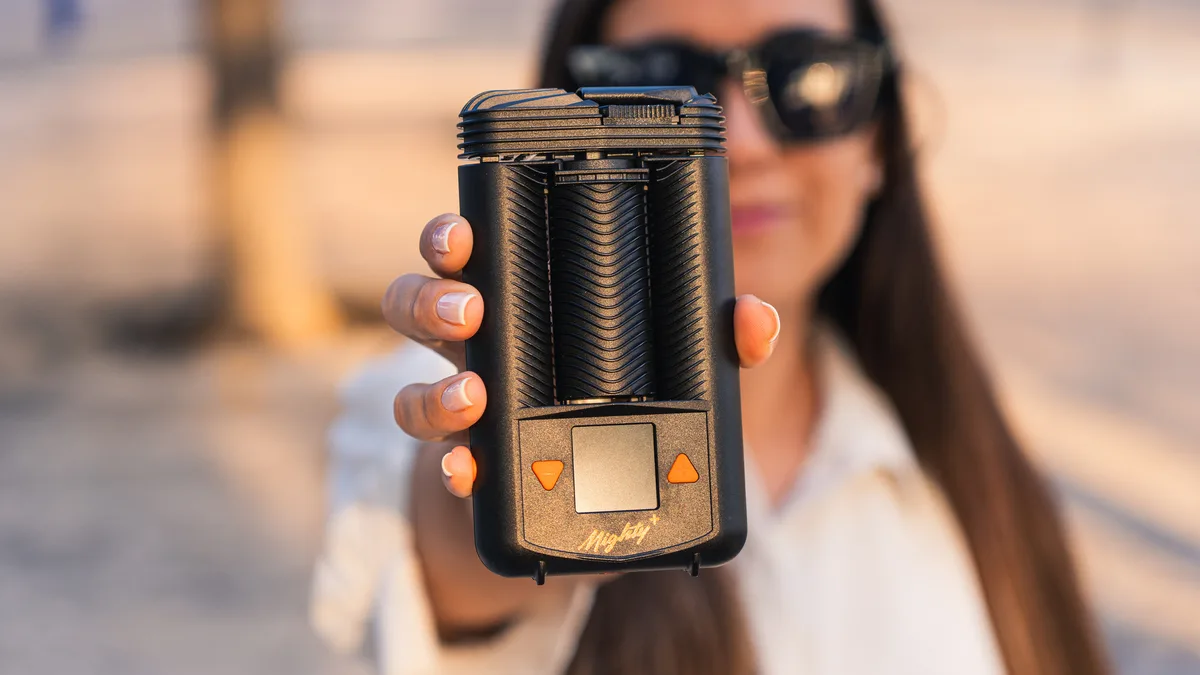
Photo: VapeExperts
A woman holds up a Storz & Bickel Mighty+ vaporizer. New research suggests THC can flip 'full' brain cells into hunger signals, helping explain why the munchies strike regardless of a recent meal.
Senior author Ryan McLaughlin of Washington State University reported that increased eating was observed regardless of BMI, sex, time since the last meal, or cannabis dose. [4]
One surprise: a larger dose did not necessarily produce proportionally larger munchies, suggesting a ceiling or nonlinear response.
The vaporized cannabis also did not change the proportion of carbohydrate, fat, and protein consumed. The munchies, in this study, were a general push to eat sooner and eat more, not a craving for any particular food type.
Ghrelin does not tell the whole story
Ghrelin is often called the "hunger hormone," but cannabis studies do not produce a universal hormone signature. In a placebo-controlled pilot involving HIV-positive men, smoked cannabis increased ghrelin and leptin. In a randomized crossover study comparing oral, smoked, and vaporized cannabis, total ghrelin was higher during the oral session than during smoked or vaporized sessions, showing that route matters. In a third experiment, THC actually lowered a form of ghrelin before a milkshake test while still increasing food wanting and oral intake.
"THC causes munchies by raising ghrelin" is too simple. Appetite can rise even when a particular ghrelin measure does not.
CBD and THCV have not earned "diet weed" status
CBD shows a suggestive signal for appetite suppression. A 2022 systematic review examined 11 randomized, placebo-controlled human trials reporting appetite or body-weight outcomes. Most found either reduced appetite, increased fullness, or lower weight in at least some CBD-treated participants. A separate safety meta-analysis found decreased appetite more frequently with pharmaceutical CBD than with placebo, with an odds ratio of 3.56. [5]
The catch: most of those trials used oral, purified CBD at medical doses. They do not prove that a few milligrams of CBD in flower will cancel the appetite effect of inhaled THC.
THCV has attracted bolder marketing. In a 13-week randomized study of 62 people with type 2 diabetes, 5 mg oral THCV twice daily improved fasting glucose and some pancreatic-function measures. It did not produce an appetite or body-weight change. In a separate fMRI study of 20 healthy volunteers, 10 mg oral THCV altered brain responses to chocolate and aversive food stimuli but did not change subjective pleasantness or wanting ratings.
THCV is an interesting research lead, not a proven appetite suppressant. Its "diet weed" reputation outruns the clinical data.
Falling asleep is not sleeping well
THC's reputation as a sleep aid rests on uncertain ground. The most recent systematic review and meta-analysis, published in Sleep in 2025, located 18 polysomnography studies. Only nine could be meta-analyzed. The conclusion: cannabis did not consistently change sleep duration, latency, efficiency, waking, or sleep stages. Older high-dose studies suggested REM suppression, but newer lower-dose studies produced mixed or null results. [6]
A 2025 pilot crossover trial made the problem concrete. Twenty people with diagnosed insomnia received a single oral dose containing 10 mg THC plus 200 mg CBD, or a placebo. The cannabinoid dose reduced total sleep time by 24.5 minutes, cut REM sleep by 33.9 minutes, and delayed the first REM period by 65.6 minutes. It did not improve subjective sleep quality.

Falling asleep faster is little comfort if the clock keeps greeting you at 3 a.m.
That was a small, oral trial combining THC with a large CBD dose, one data point rather than a universal rule. But it shows that "THC equals better sleep" is not automatic.
Tolerance complicates things further. The 2025 meta-analysis found that withdrawal effects (longer sleep latency, reduced sleep time, REM rebound) were more consistent across studies than any benefit from administration.
CBN's sleepy reputation is ahead of its evidence
A 2021 review titled "Cannabinol and Sleep: Separating Fact from Fiction" concluded that there was insufficient published evidence to support sleep claims for CBN. [7]
Newer data is more encouraging but not conclusive. A double-blind, randomized, placebo-controlled study of 293 participants found that nightly 20 mg CBN did not reach the primary sleep-quality endpoint at the conventional threshold. It did reduce nighttime awakenings and overall sleep disturbance. It did not change sleep-onset latency, wake after sleep onset, or daytime fatigue. Adding CBD did not improve the CBN result. [8]
CBN has preliminary human evidence for fewer awakenings. "CBN reliably knocks you out" remains an overstatement, and evidence that the trace CBN content of ordinary fresh flower causes couch-lock is especially weak.
Terpenes are clues, not commands
The popular terpene chart (myrcene for sleep, limonene for energy, pinene for focus) is more confident than the human evidence permits.
Myrcene's sedative reputation rests on animal experiments. In one mouse study, injected doses of 100 to 200 mg per kilogram reduced movement. The 200 mg/kg dose prolonged barbiturate sleep about 2.6-fold. Those exposures are far beyond what a person receives from a vape session with even the most myrcene-rich flower.

Sometimes the munchies hit before you even make it to the bike rack.
Linalool, the terpene associated with lavender, prolonged barbiturate sleep and reduced locomotion in mice at inhaled concentrations of 1% and 3%. Direct trials demonstrating that naturally occurring linalool in cannabis flower improves human sleep do not exist.
Limonene has the best new human result, but it concerns anxiety rather than wakefulness. In a double-blind crossover study at Johns Hopkins, 20 intermittent cannabis users received 30 mg vaporized THC plus 15 mg D-limonene, or THC alone. The limonene group reported lower ratings of anxiety and paranoia. Limonene did not broadly reverse THC's other effects. [9]
A laboratory study found that six common terpenes neither activated CB1 or CB2 receptors nor modified THC signaling at those receptors. [10] If terpene-cannabinoid interactions exist, they may not work through the endocannabinoid system at all.
Myrcene-rich flower may still be a reasonable personal experiment for someone seeking relaxation. But "more than 0.5% myrcene guarantees couch-lock" is not a clinically validated threshold.
Your vaporizer is a dose dial, not a molecule selector
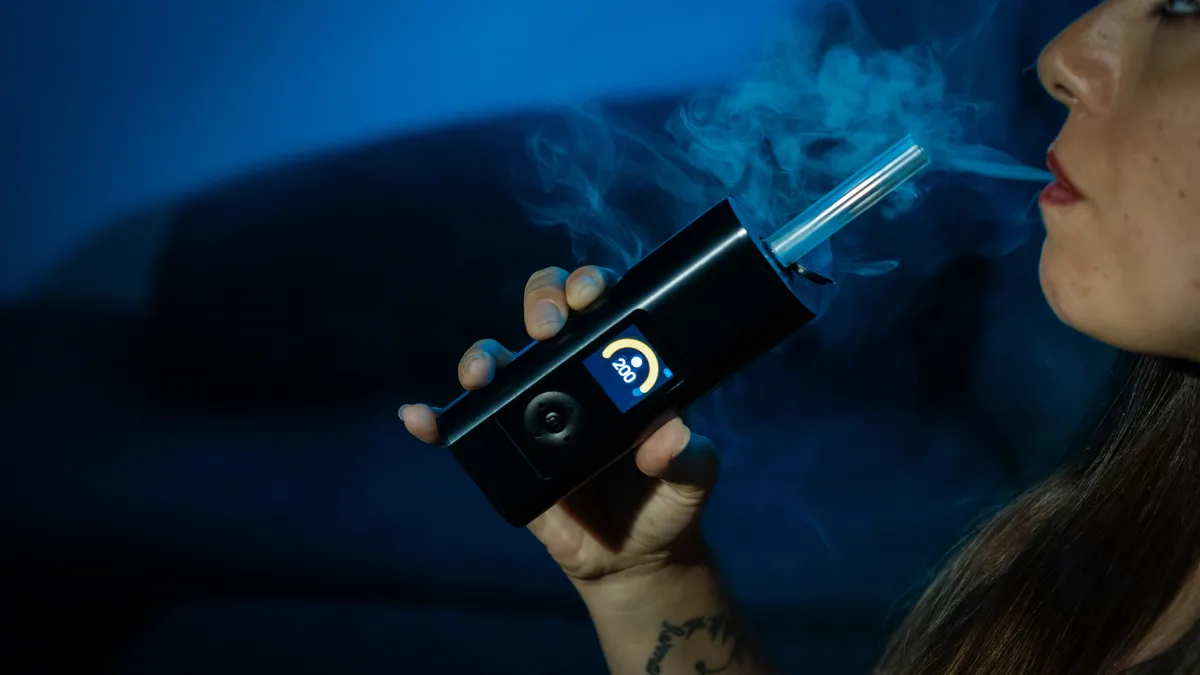
Photo: VapeExperts
A woman exhales vapor while using an Arizer Solo 3 vaporizer. Devices like this control the dose of THC delivered, but not which brain circuits the molecule flips into hunger signals.
Many cannabis guides list boiling points (THC at 157 degrees Celsius, myrcene at 167, limonene at 176, linalool at 198) and imply you can isolate one molecule by choosing its number. A physical-chemistry review in Cannabis and Cannabinoid Research found this approach misleading. The often-quoted THC and CBD "boiling points" were based on reduced-pressure measurements or misinterpretation. Cannabinoids evaporate over ranges and can leave the plant below their atmospheric boiling point. Monoterpenes tend to enter the vapor earlier than cannabinoids regardless of set temperature.
A dry-herb vape is not a mixing board where 176 degrees Celsius mutes THC and solos limonene.
What temperature reliably controls is how much total cannabinoid you extract and how fast. In a 2016 laboratory comparison of four vaporizers, all set to 210 degrees Celsius, THC recovery ranged from 54.6% to 82.7% and CBD recovery from 51.4% to 70.0%. THC decarboxylation was at least 97.3% across the electric models. [11]
Cannabinoid recovered in vapor at 210°C
Source: PLOS ONE, 2016
The wide device-to-device range shows that a displayed temperature does not by itself define the dose you receive. Utah's medical-cannabis guidance notes that higher set points around 210 to 230 degrees Celsius can produce faster and more complete cannabinoid release, but also greater intoxication, sedation, and risk of pre-combustion or pyrolysis products. [12]
What temperature zones actually do
These are starting points, not prescriptions:
- About 160 to 180 degrees Celsius: Lighter, more terpene-forward vapor. Less total cannabinoid delivered per draw. Will not exclude THC.
- About 180 to 200 degrees Celsius: More complete extraction and denser vapor. A useful middle ground for comparing batches.
- About 200 to 210 degrees Celsius: Faster, heavier extraction. More likely to feel sedating because more THC is delivered quickly, not because a specific "couch-lock molecule" switches on at 200 degrees.
- Above roughly 210 degrees Celsius: Diminishing flavor and increasing potential for thermal degradation.
A step-up session (starting low, increasing temperature) changes chemistry over time. Early draws tend to be more aromatic. Later high-temperature draws deliver a denser cannabinoid load. By the final draw, fatigue may simply reflect cumulative THC.
Why the same hit lands differently every time
In a crossover trial of 17 infrequent cannabis users, vaporizing cannabis containing 10 mg THC produced a mean "drug effect" rating of 69 out of 100, versus 46 after smoking the same nominal dose. At 25 mg, the corresponding averages were 78 and 66. Cognitive and psychomotor effects sometimes persisted for up to six hours. [13]
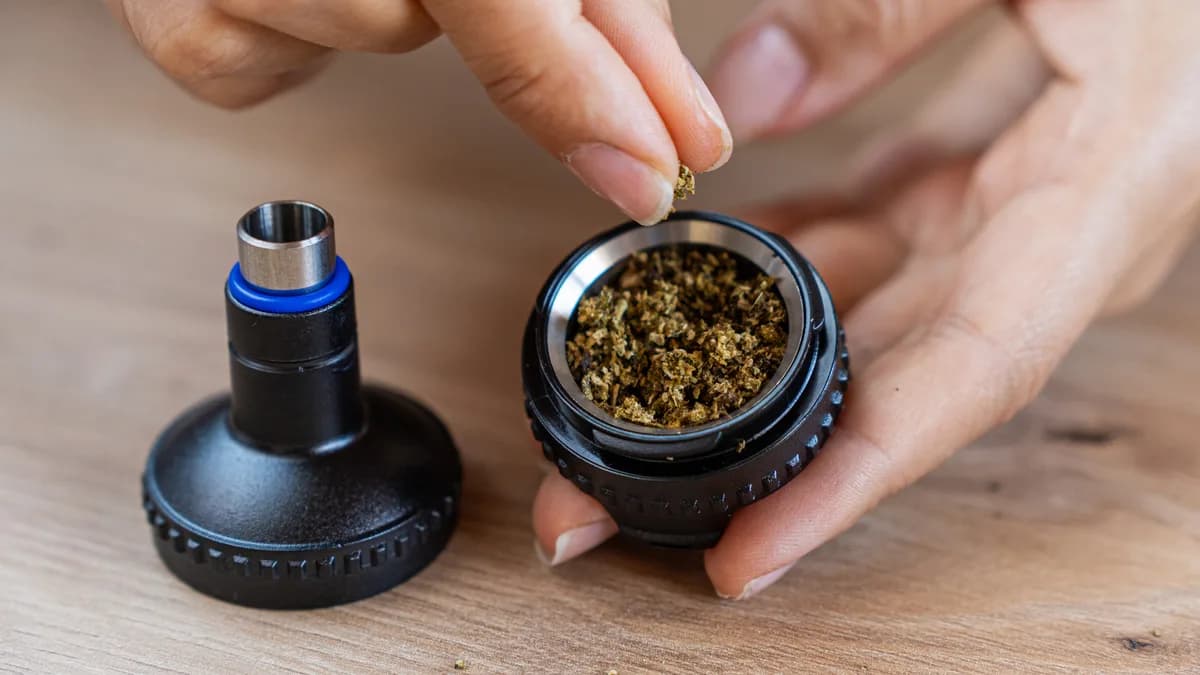
Photo: VapeExperts
A user loads ground cannabis into the filling chamber of a Storz & Bickel Volcano Classic vaporizer. New research suggests THC flips 'full' brain cells into hunger signals, helping explain why each hit can land differently.
Vaporization delivers THC efficiently enough that one long draw from a well-heated bowl is not equivalent to one shallow draw from a cooler or less efficient setup. Beyond the vaporizer, these variables shape every session: recent food intake, sleep debt, time of day, prior cannabis exposure and CB1 tolerance, anxiety and expectations, puff volume, breath holding, grind, moisture, and airflow.
The strain label is the weakest predictor
A genomic and chemical study of more than 100 samples found that indica- and sativa-labeled products were genetically indistinguishable across the genome. "Indica" labeling correlated most strongly with myrcene, but myrcene explained only 21.2% of label variation. [14]
A separate analysis of almost 90,000 commercial samples from six U.S. states concluded that indica, sativa, and hybrid labels did not consistently track underlying chemical diversity. [15]
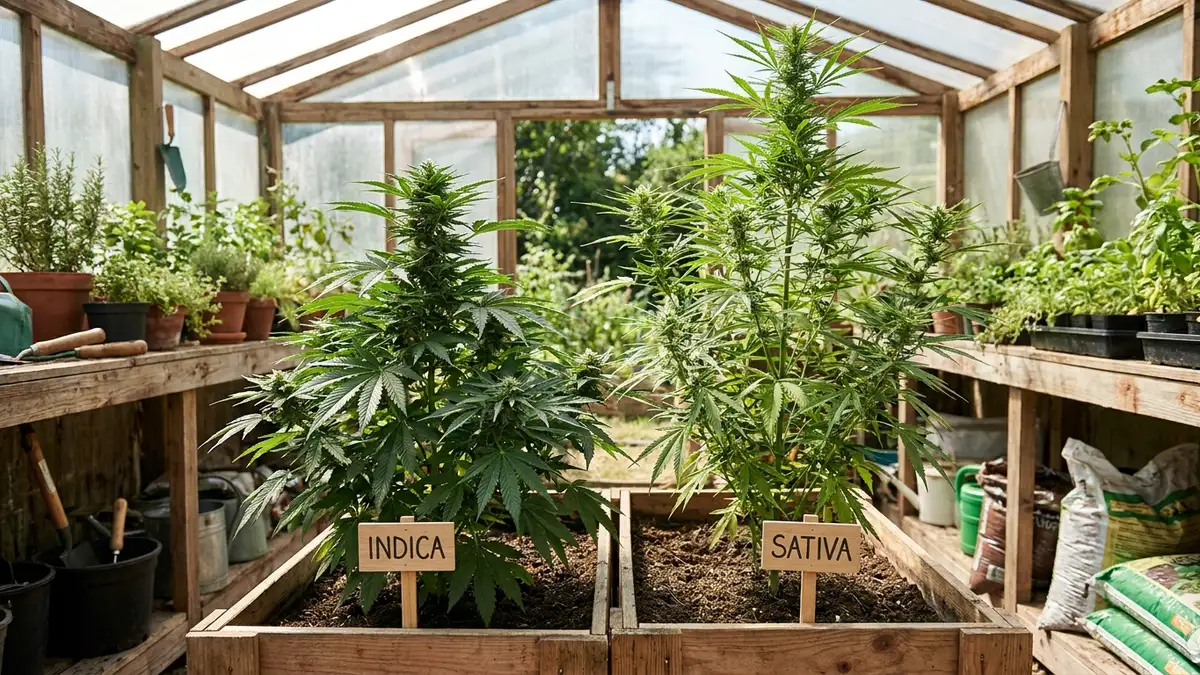
The labels sound definitive, but the chemistry inside tells a messier story.
For predicting hunger or sedation, THC dose, CBD and THCV content, and the actual terpene lab results on the certificate of analysis are more informative than the cultivar name on the jar, though still not perfectly predictive.
Four things you can actually control
- Control THC dose first. A smaller bowl, shorter draw, or lower starting temperature is more reliable for avoiding heavy sedation or intense munchies than chasing a particular strain name.
- Read the certificate of analysis. Compare total THC, CBD, THCV, and dominant terpenes batch by batch.
- Change one variable at a time. Use the same vaporizer, load, temperature, and draw style when testing whether a particular flower triggers hunger or sleepiness.
- Expect higher temperatures to increase delivered dose. Do not assume they selectively unlock a single compound.
The FDA approved Marinol, a synthetic form of THC, for anorexia associated with AIDS-related weight loss on December 22, 1992. The pivotal trial enrolled 139 patients. [16] For those patients, the munchies were the therapeutic endpoint, not a side effect.