

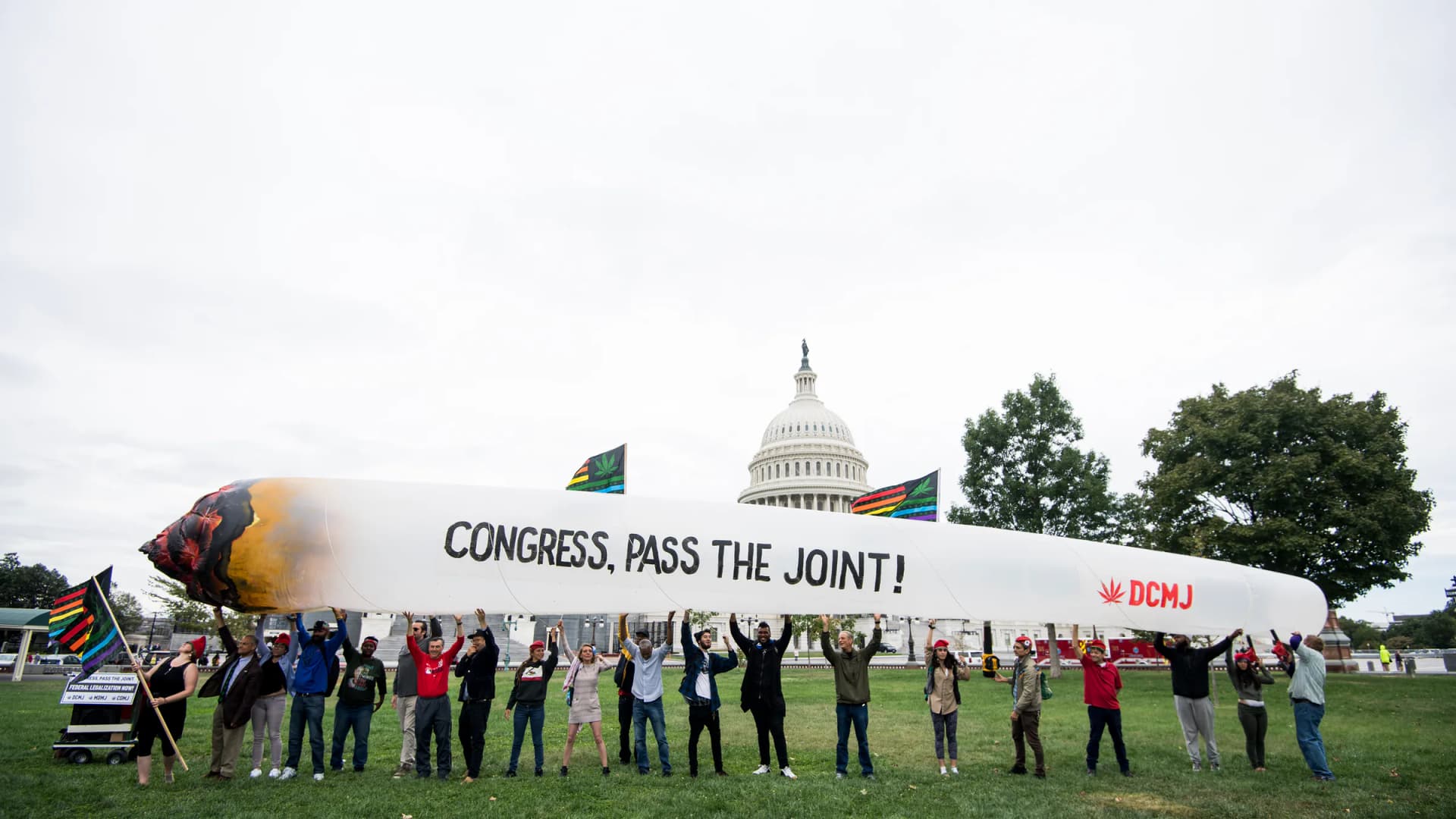
For 90 years, the U.S. government told you cannabis would turn you into a jazz-obsessed murderer. The proof? A church-funded film, 200 fabricated crimes, and a fried egg.
Here is the punchline: the actual science said the opposite every single time, and now the government is quietly agreeing.
A church basement made the funniest drug film ever
In 1936, a church group financed a morality tale called "Tell Your Children." It was meant for church basements. It was shot in three weeks.
Then an exploitation filmmaker named Dwain Esper bought the rights. His prior credits included "How to Undress in Front of Your Husband." You can guess where this went.
Esper recut the film for maximum sleaze and released it under five different titles depending on the region. New England got "Reefer Madness." The South got the original name. Everyone got the same hysteria.
The plot: one puff turns teens into piano-playing psychotics. It was loosely inspired by a real man who killed his family. He was later found to be schizophrenic. Cannabis had nothing to do with it.
Esper never bothered to protect the copyright. So the film fell into the public domain, which is exactly why it survived.
In 1971, Keith Stroup, founder of cannabis reform group NORML, bought a print and screened it on college campuses as comedy. The propaganda became a midnight movie. By 2005, Showtime had turned it into a musical.
The morality tale became the joke. As Open Culture put it, it is one of the most unintentionally hilarious films ever made.
America's first drug czar made it all up
Meet Harry Anslinger, the first Commissioner of the Federal Bureau of Narcotics. He held the job for over 30 years, from 1930 to 1962.
Here is his problem. He came from the Prohibition Bureau, which got disbanded in 1933 when alcohol became legal again. A man without a war needs a new enemy.
He picked cannabis. Some historians note he had once called claims that marijuana causes violence "absurd." Then he needed a cause, and the absurd became his career.
Anslinger kept a "Gore File" of roughly 200 violent crimes he blamed on marijuana. He waved it around Congress as evidence. Researchers later found that all 200 cases were either fabricated or had nothing to do with cannabis.
He also pushed the word "marijuana" over "cannabis" on purpose, to tie the plant to anti-Mexican prejudice.[1] The word in American law was chosen as a propaganda tool.
When a 1944 city study found no addiction and no link to crime, Anslinger called it unscientific and demanded he personally approve all future cannabis research. Subtle.
The doctors kept saying no, and nobody listened
The wild part is how often the experts told the truth and got ignored.
| Year | Who | What they found |
|---|---|---|
| 1894 | British Indian Hemp Drugs Commission | Prohibition "neither necessary nor expedient" |
| 1937 | AMA's Dr. William Woodward | No evidence of cannabis addiction |
| 1944 | La Guardia Committee | No true addiction, no crime link, no gateway |
| 1972 | Shafer Commission | Recommended decriminalization |
In 1937, Dr. William Woodward of the American Medical Association testified that "there is no evidence that the medicinal use of cannabis... has caused or is causing cannabis addiction." Congress passed the Marihuana Tax Act anyway.
The first man arrested under it got 4 years of hard labor for selling two joints.
The National Academy of Sciences found in 2017 there is no substantial evidence cannabis leads to harder drugs. The gateway theory had already been rejected in 1944. And in 1972. People just kept rejecting it.
Nixon's own report told him he was wrong
President Nixon put cannabis in Schedule I, the most restrictive category, as a "temporary" measure while a commission studied it.
The 1972 Shafer Commission report, titled "Marihuana: A Signal of Misunderstanding," contradicted every reason for that classification. Nixon rejected his own commission.
Newly surfaced White House recordings showed Nixon privately admitted marijuana was not particularly dangerous. He kept it Schedule I anyway because it sent the "wrong signal."
His top aide John Ehrlichman later admitted the whole point. The administration wanted to disrupt antiwar protesters and Black communities. "Did we know we were lying about the drugs?" he said. "Of course we did."[2]
D.A.R.E. spent $1 billion to make kids use more drugs
In 1983 came D.A.R.E., the police officer in your classroom holding up a baggie. It reached over 200 million kids across all 50 states and 52 countries.
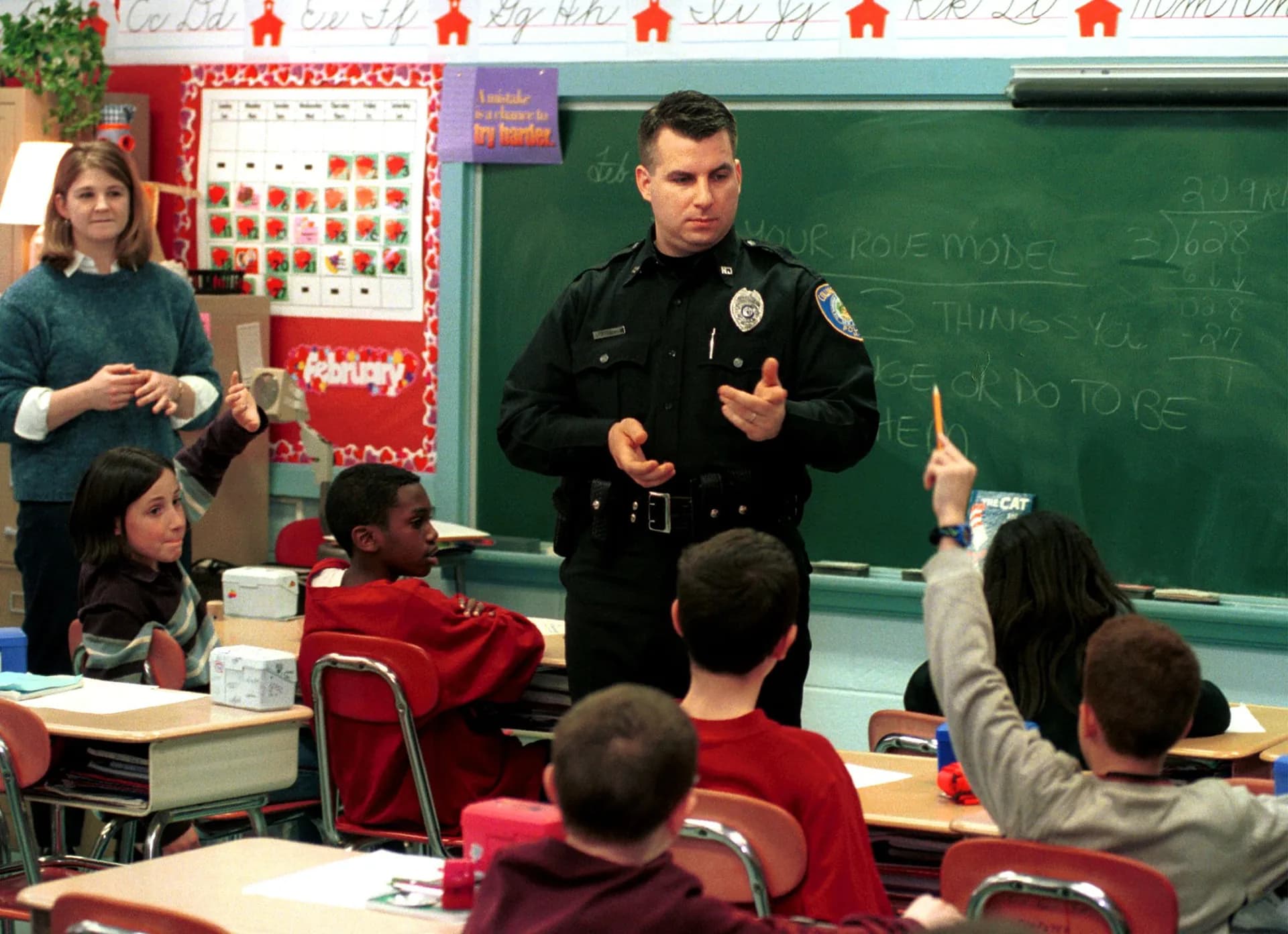
Photo: Sarah J. Glover/Philadelphia Inquirer/Newscom
Collingswood, New Jersey police officer Steve Rydzewski talks to students at Zane North School as part of the DARE program on March 7.
At its peak it cost an estimated $1 billion to $1.3 billion a year. That is a lot of T-shirts.
A 2004 meta-analysis of 11 studies found D.A.R.E. graduates were "indistinguishable" from kids who never took it. One six-year study found suburban graduates reported 3% to 5% higher drug use. They called it the boomerang effect.
In 2001, the U.S. Surgeon General labeled it an Ineffective Primary Prevention Program. It lost federal funding for not being evidence-based. By the mid-2000s, around 60% of districts had dropped it.
The greatest irony? D.A.R.E. shirts became ironic festival fashion, worn proudly by the exact people the program tried to scare.
A fried egg, and a sponsor list you will not believe
In 1987 came the egg. "This is your brain. This is your brain on drugs." Sizzle. It made TV Guide's Top 100 Ads of All Time.
The campaign got roughly $1 million in donated airtime per day for over a decade, more than $2 billion in free media.
Now for the kicker. The group behind it was funded in part by Philip Morris, Anheuser-Busch, and R.J. Reynolds. The tobacco and beer companies were paying to warn you about cannabis.
There is a poetic ending. In 2017, actress Rachael Leigh Cook, who starred in a famous 1997 remake, reprised the role. This time she destroyed the kitchen to attack the racist failures of the drug war itself. It dropped on 4/20.
The full circle nobody saw coming
Here is where 90 years of nonsense lands.
On April 22, 2026, the DEA moved FDA-approved and state-licensed medical marijuana from Schedule I to Schedule III.[6] An expedited hearing beginning June 29 will decide whether cannabis as a whole gets reclassified.
Recreational cannabis is still Schedule I, so the work is not finished. But the direction is clear.
Roughly 70% of Americans support legalization. The government is finally, slowly admitting what the La Guardia Committee said in 1944, what the Shafer Commission said in 1972, and what a fried egg never could.
The reefer was never that mad. The propaganda was.