

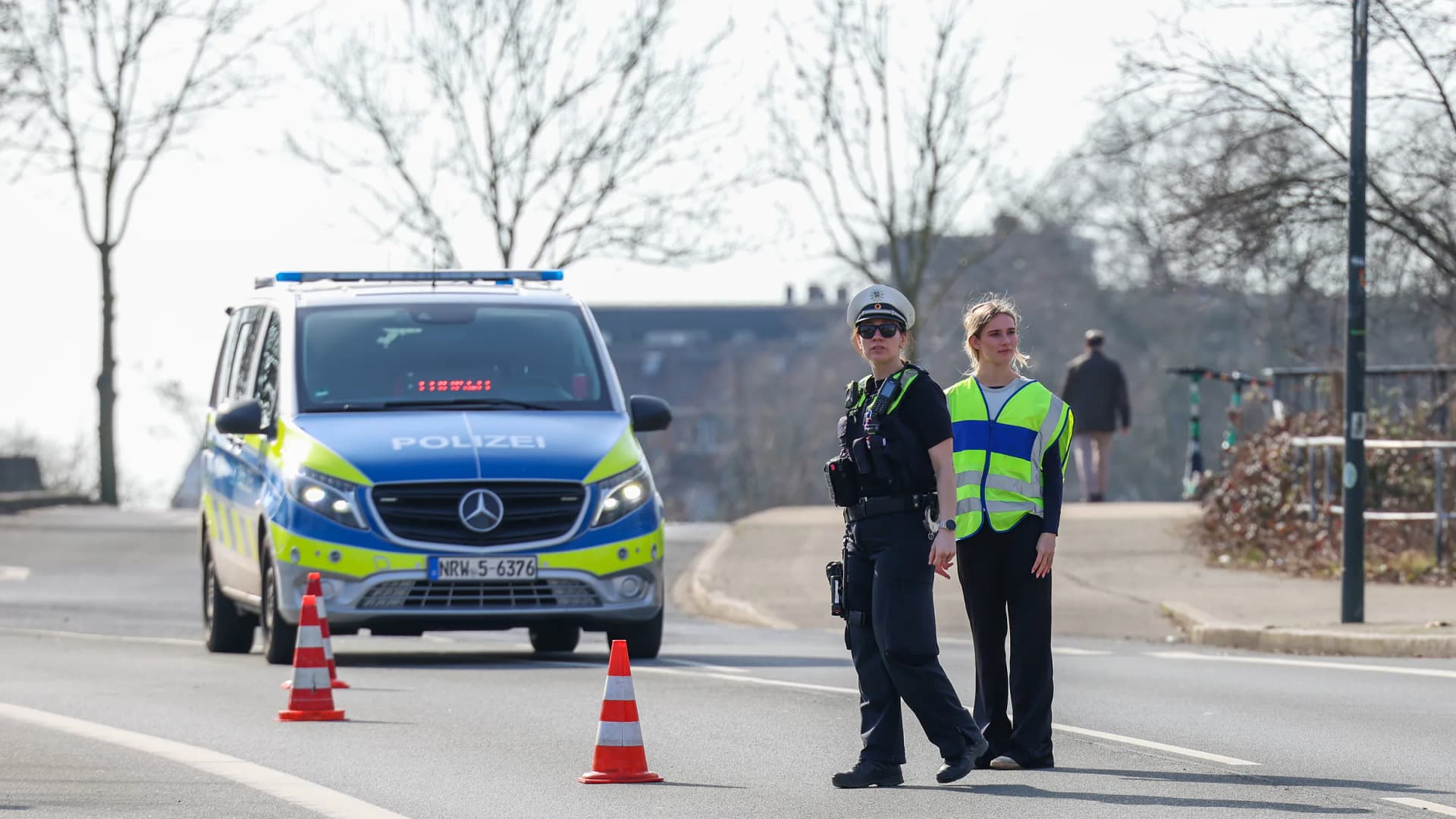
A police officer can now swab your cheek at the roadside and get a cannabis result in minutes. What that result cannot tell anyone is whether you are actually impaired.
That gap sits at the center of a growing fight. States are buying roadside saliva tests fast. But the science says these tools detect recent drug use, not the impairment that makes driving dangerous.
What the roadside test actually measures
The two main devices in U.S. deployment are the Abbott SoToxa and the Dräger DrugTest 5000. Both screen oral fluid (saliva) for several drug classes, including cannabinoids.
They are screening tools, not lab instruments. Each uses a preset cutoff, commonly 25 ng/mL of THC for the SoToxa cannabis cartridge, to flag a positive.
A positive is presumptive. It is supposed to be confirmed later by a lab using mass spectrometry.
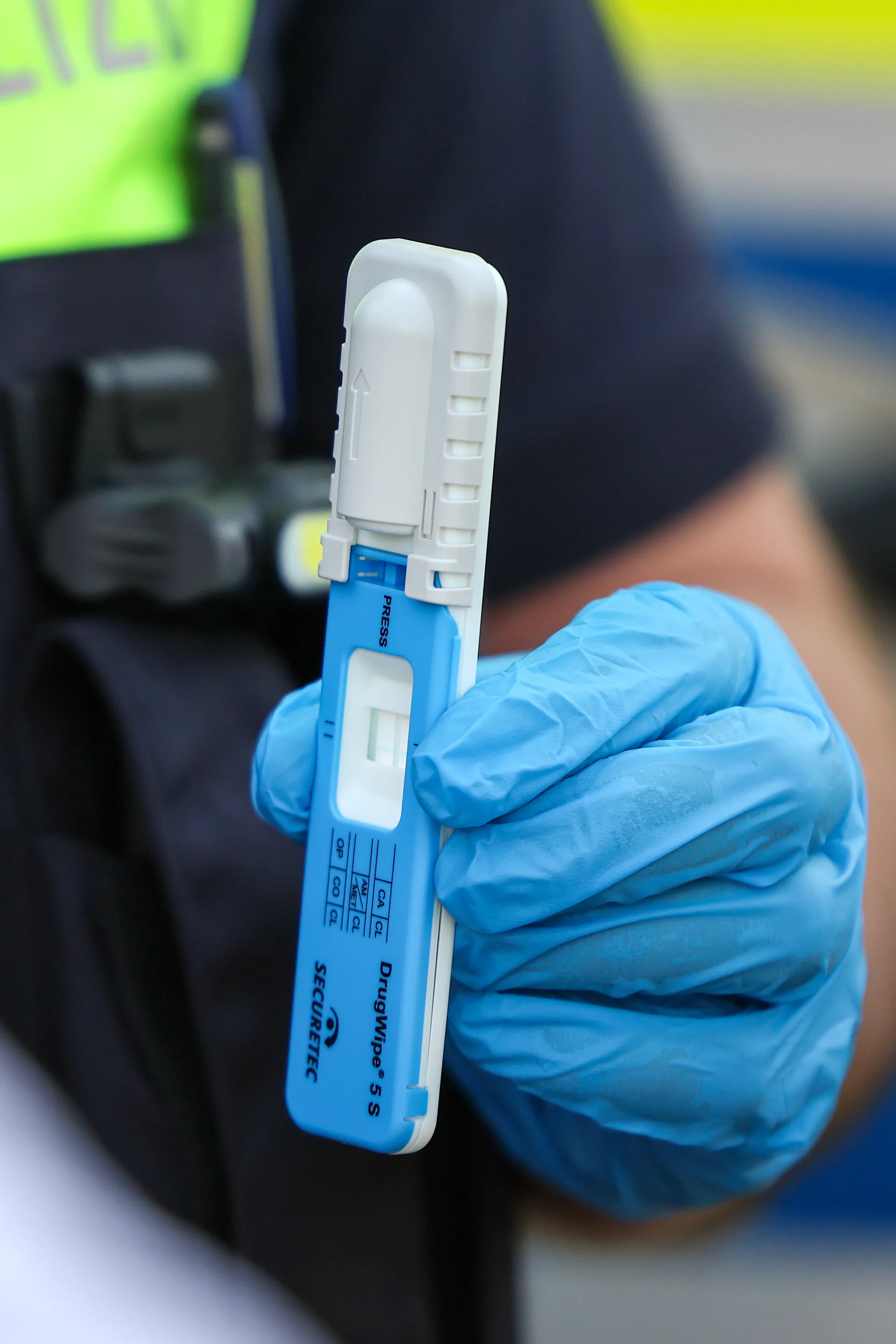
Photo: Christoph Reichwein/dpa/picture-alliance/Newscom
A police officer holds a rapid drug test during a traffic stop in Duesseldorf, Germany, February 26, 2026. The saliva test checks for possible narcotics in road traffic.
Here is the catch. Detecting THC in saliva tells you cannabis was used recently. It does not tell you the person is high right now.
A University of Michigan Ford School policy brief puts it plainly: oral fluid tests do not establish impairment by drugs.[2]
Minnesota's pilot showed the field gaps
Minnesota ran the most detailed real-world test in the country. The state's Office of Traffic Safety deployed both devices with drug recognition experts and reported results to the legislature on Feb. 21, 2025.
The scale was real. 57 drug recognition experts from 41 agencies across 36 counties ran the equipment, using 138 instruments total.
Officers ran 329 oral-fluid tests on 268 people. Some drug turned up in 287 of 329 tests, or 87.2%.[1]
More than one drug showed up in 177 of 329 tests, or about 62%. That complicates any clean link between a single substance and a driver's behavior.
The blind spots mattered more. The state crime lab detected fentanyl 69 times, but neither device panel even tested for it during the pilot, as Government Technology reported. Benzodiazepines matched lab confirmation only 22% of the time.
The pilot also recorded cases that cut both ways. Sometimes an expert saw no impairment but the saliva test detected drugs. Sometimes the expert suspected impairment but the test came back clean.
Mike Hanson, who directs the Minnesota Office of Traffic Safety, still backed the tools. "These are good, solid tools," he told Government Technology.
The accuracy questions are not new
Peer-reviewed research has flagged error rates for years.
A 2018 study in the Journal of Analytical Toxicology evaluated the Dräger DrugTest 5000 in real Norwegian enforcement. It reported false-positive proportions of 14.5% for cannabis, and far higher rates for other drugs, compared against blood above legal limits.
Timing is another problem. A 2024 crossover trial in Drug Testing and Analysis dosed people with medical cannabis oil.[6] Just half an hour after dosing, the Dräger device caught only 50% of users. A second device caught 25%.
So the test can miss someone who just consumed, then flag someone who used hours or days earlier. Neither outcome maps cleanly to road safety.
Even predicting blood THC does not fix it
Some defenders argue a saliva positive at least predicts THC in the blood. A 2024 Canadian study in the Journal of Analytical Toxicology found that among suspected impaired drivers who screened positive, THC was confirmed in 98% of blood samples.[5]
That sounds strong. It still does not solve the core question.
Federal researchers keep saying so. In a National Institute of Justice podcast, NIJ official Frances Scott said the research "pretty conclusively shows that the THC concentration in the blood is not particularly well-correlated with impairment for driving."[4]
Unlike alcohol, there is no clean blood number that means "too high to drive."
States are expanding the tests anyway
The policy is splitting in real time.
In Tennessee, a Fox 17 investigation on Feb. 2, 2026 described SoToxa rolling out through a highway safety grant. The report quoted a lab representative noting the device "measures the active presence of drugs in the person's system, not the level of impairment."
In Michigan, lawmakers were still pushing oral-fluid bills as of Feb. 21, 2026, per WCMU. State Representative Julie Rogers described a two-step approach: "If the device lights up... then the officer would do a second test... sent to a laboratory to determine the amount."
Critics there argue the tests give no indication of a driver's actual impairment for cannabis.
What this means for you
If you use cannabis and drive, a roadside saliva test can flag you even when you are sober. Recent use leaves THC in your mouth long after any high fades.
A positive screen does not prove impairment on its own. But in states adopting these tools, it can feed into a stop, a confirmatory blood draw, and a charge.
The tech everyone wants does not exist yet
The honest answer is that no roadside tool measures cannabis impairment the way a breathalyzer measures alcohol.
Researchers are working on breath testing. In July 2025, the National Institute of Standards and Technology reported a first detection of cannabis on breath after edibles.[3] But NIST chemical engineer Tara Lovestead warned that devices "will still need standards to ensure that they are accurate and used correctly, standards that don't yet exist."
Until those standards arrive, more states will likely authorize saliva screening. The fight will be over how much weight a presence test should carry when nobody can prove what it means for the person behind the wheel.