

One week in July delivered three signals. On July 10, R.J. Reynolds Vapor agreed to pay $14.9 million for a license to a single vaporizer patent held by VPR Brands.[2] On July 15, a patent suit by Natural Extraction Systems against Green Thumb Industries, one of the largest U.S. cannabis operators, landed in Illinois federal court.[1] On July 21, patent lawyers published a public warning: patent assertion entities, better known as trolls, may target cannabis next.[1]
The warning matters most for the hardware side of the industry. Vape components and extraction methods sit at the center of every major cannabis patent fight so far.
Lawyers describe a patent "gold rush"
Patent attorney Ryan McCormick told Forbes that cannabis fits a familiar pattern. "In patent law, we occasionally see a kind of 'gold rush' effect where a previously underexplored area of technology becomes more commercially viable and patent filings on innovations in that field skyrocket," he said.[1]
Photo: VapeExperts/AI
Early filers can win big. "Patents filed earlier in the 'gold rush' are often granted with broader coverage on average than applications filed later due to the rapid growth in prior art patent filings," McCormick said.[1]
The report cited U.S. patent counts with cannabis terminology rising from 14 in 2016 to 29 in 2017 and 39 in 2018, and a 2019 search that found 332 patents mentioning "cannabis."[1] Those are keyword counts from a single report, not a verified tally of enforceable cannabis inventions.
Stephen Kim, chief legal officer at Avicanna, said the risk grows with success. "The more commercially successful a cannabis company may be, the more they may find themselves crossing paths with PAEs, and the more likely those disputes will center around patents," he said.[1]
Federal illegality is no longer a shield
Cannabis companies long assumed that federal prohibition made cannabis patents hard to enforce. Gene Pool Technologies v. Coastal Harvest tested that assumption.
Gene Pool sued Coastal Harvest, a Halo Collective subsidiary, in 2021 over extraction technology. Coastal Harvest argued that marijuana's federal illegality should block the case. In November 2022, the court reportedly rejected that argument because the extraction methods could also apply to legal hemp.[1]

Photo: VapeExperts/AI
The case reportedly ended in August 2025 with a default judgment of nearly $2.9 million in royalty damages after defense counsel withdrew, according to the Forbes report.[1] We have not independently verified the judgment on the court docket. The reported outcome does not make every cannabis patent enforceable. It does mean illegality is not an automatic defense.
Vape patents already pay
Two operating-company disputes show what vaporizer patents are worth right now.
STIIIZY says the International Trade Commission determined in January 2026 that its discontinued products infringed four PAX patents covering leak-resistant pod-and-battery systems. STIIIZY redesigned its pods and built a new all-in-one vape. The company says Customs and Border Protection cleared its redesigned products in three rulings, most recently on July 10, 2026.[1] Those CBP findings come from STIIIZY's own press release; the underlying rulings are not public.
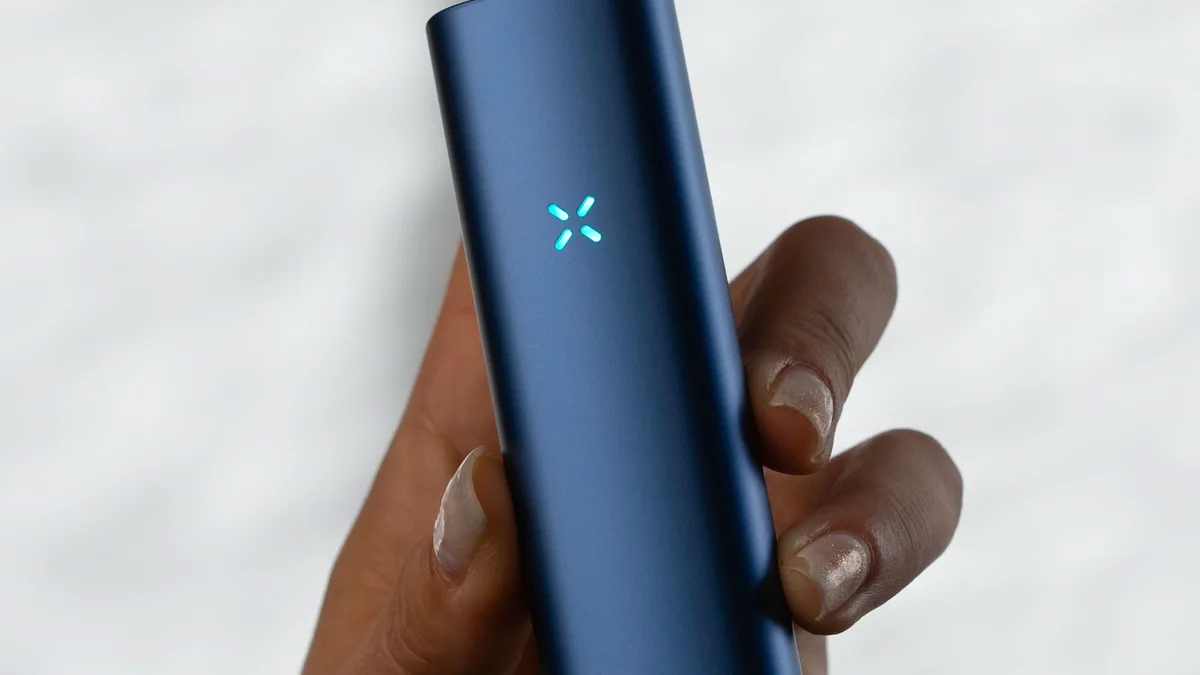
Photo: VapeExperts
A hand holds a PAX Plus vaporizer. Vape hardware patents are already generating lawsuits, and lawyers warn patent trolls are turning their attention to the cannabis industry.
The same day, VPR Brands signed its settlement with Reynolds over U.S. Patent No. 8,205,622, an electronic-cigarette patent issued in 2012. Reynolds agreed to pay $14.9 million for a perpetual, worldwide license, according to VPR's Form 8-K filed July 16. Neither side admitted infringement or liability.[2] VPR asserted the same patent against cannabis-vape supplier Jupiter Research in 2020; that case ended in a 2023 dismissal with no public ruling.[1]
An adjacent nicotine case sets the ceiling. In litigation over the VUSE Alto, Reynolds was ordered to pay Altria about $95.2 million in past damages plus a 5.25% running royalty on pods and power units.[1]
None of these plaintiffs is a classic troll. PAX, VPR and Gene Pool all have commercial or licensing operations. But the cases prove the patents work, and working patents attract buyers.
An unread complaint against Green Thumb
The newest case is the least understood. Natural Extraction Systems' suit against Green Thumb, No. 1:26-cv-08351, reached the Northern District of Illinois on July 15, 2026, after transfer from Florida. The docket index labels it a patent-infringement action but does not identify the asserted patents.[1]
The plaintiff's name suggests extraction IP, and Green Thumb is a major plant-touching operator. Whether Natural Extraction Systems invented its patents or bought them, and whether the claims actually cover cannabinoid extraction, will not be clear until the complaint surfaces. It cannot yet be called a troll case.
Trolls dominate patent courts everywhere else
The broader numbers explain why lawyers are worried. Unified Patents counted 2,510 NPE-related district-court filings in 2025, up 21.6% from 2024, and 970 in the first half of 2026.
NPE share of U.S. district-court patent cases
Source: Unified Patents
Stanford law professor Mark Lemley reached a similar count with the Stanford NPE Litigation Dataset: 7,925 PAE cases among 14,340 patent suits filed from 2015 through the start of 2025, or 55.3%.[6]
The economics favor the plaintiff. Boston University researchers James Bessen and Michael Meurer estimated firms accrued $29 billion in direct NPE-dispute costs in 2011 alone, and found most defendants were small or medium-sized firms.[5] That figure is historical, but the model it describes has not changed: defense costs can make settling rational even against weak claims.
What patent fights could mean for your vape
There is no evidence yet that any cannabis-vape maker has raised prices because of a patent dispute. The channels for a future price effect are visible, though. A 5.25% royalty like the VUSE Alto rate, fully passed through on a $30 vape, works out to about $1.58 before retail markups. A $14.9 million lump-sum license has to be absorbed somewhere. STIIIZY's account shows redesigns require new tooling, testing and inventory even when the redesign wins.[1]
The first consumer effect may not be price at all. Companies facing exclusion orders or demand letters can simply pull a product, strip a feature, or skip a U.S. launch. Fewer choices and slower hardware improvement may arrive before any line-item increase.
The likeliest targets track the hardware itself: oil reservoirs and leak controls, pod-to-battery interfaces, ceramic heaters, airflow and temperature systems, and extraction methods from hydrocarbon to supercritical CO2.[1]
Reform raises the stakes
The timing is not a coincidence, in the lawyers' telling. The DEA held an expedited hearing on moving marijuana from Schedule I to Schedule III from June 29 to July 15.[3] Post-hearing briefs were reportedly due August 17, with a recommendation and final agency decision to follow.[4] One day after the hearing closed, Senate Democrats reintroduced the Cannabis Administration and Opportunity Act, which would deschedule marijuana entirely.[7]

Photo: Martin Falbisoner/Wikimedia Commons (CC BY-SA 3.0)
The west side of the US Capitol in Washington, DC, glows in evening light. Congress would decide the cannabis reforms that lawyers say raise the stakes for patent disputes.
We covered how cannabis companies argued for Schedule III at that hearing. Rescheduling is not legalization, but every step toward a larger federally recognized market makes cannabis defendants richer, and richer defendants are what assertion entities look for.
Jayashree Mitra, an intellectual-property shareholder at Carlton Fields, framed the open question: "With federal legalization gathering steam, is the cannabis industry likely to witness a wave of infringement actions from non-practicing entities looking to cash in on the expanded marketplace?"[1]