


Ten hemp companies can sell intoxicating hemp products in Ohio again. Their competitors cannot.
On July 13, U.S. District Judge Jeffrey J. Helmick granted a preliminary injunction barring Ohio prosecutors from enforcing the hemp provisions of Senate Bill 56 against 10 named companies, along with anyone possessing, selling, distributing or consuming their products.[1] The order holds only while those products count as hemp under current federal law. That condition matters, because the federal definition changes on November 12, 2026.
Ten companies can sell. Their competitors can't
The plaintiffs, led by Titan Logistics Group LLC, sued 96 county and municipal prosecutors' offices in federal court on June 4. Helmick issued a 14-day restraining order on June 15, extended it, and then converted it into a preliminary injunction that lasts while the case proceeds.[1]
The result is a split market. A store can stock a protected plaintiff's THC seltzer but still face enforcement for a nearly identical drink from a non-plaintiff. Protection follows the product's source, not the product type. Under SB 56, unlicensed sales outside dispensaries carry a first-degree misdemeanor for a first offense and a fifth-degree felony after that.[2]
The order's text is not limited to beverages, though drinks have dominated the coverage. It speaks broadly of the plaintiffs' products, so a named plaintiff's edible, flower or inhalable product could qualify, as long as it meets every current federal hemp condition.
Oct. 8, 2025
Gov. Mike DeWine signs an emergency order directing retailers to pull intoxicating hemp products.
Dec. 19, 2025
DeWine signs SB 56 and vetoes a temporary carve-out for hemp beverages.
March 20, 2026
SB 56 takes effect, removing most intoxicating hemp products from ordinary retail.
June 4, 2026
Ten hemp companies sue 96 Ohio prosecutors offices in federal court.
June 15, 2026
Judge Helmick issues a 14-day temporary restraining order.
July 13, 2026
Helmick converts the order into a preliminary injunction.
July 14, 2026
Ohio asks Helmick to stay the injunction pending appeal.
Ohio built a market only Ohioans could enter
Helmick did not rule that Ohio lacks power to regulate hemp. He found that SB 56 likely violates the dormant Commerce Clause, the constitutional doctrine that bars states from favoring their own businesses in interstate trade.[1]
The law lowered Ohio's hemp threshold to 0.3% total THC and treated finished products above 0.4 milligrams of total THC per container as marijuana, routing them into Ohio's licensed, in-state cannabis system.[2] That combination, Helmick wrote, closed the market to out-of-state companies selling federally lawful products.

Photo: VapeExperts/AI
"The inescapable conclusion is that Ohio has chosen to permit only in-state companies to sell intoxicating hemp-derived products and has expressly prohibited out-of-state companies from participating in the same market," he wrote.[1]
Ohio argued that lifting enforcement would endanger public health. Ohio Poison Centers has told lawmakers that accidental cannabinoid poisonings rose 280% after tracking expanded in 2021, with exposures among children under six up more than 350%. Helmick answered that the state never explained why testing, potency limits and age controls could not do the job. "Hyperbole aside, Defendants have other tools in hand to protect public health and safety without impermissibly favoring in-state companies over out-of-state companies," he wrote.[1]
Katharine Neill Harris, a drug policy fellow at Rice University's Baker Institute, has made a similar argument about hemp bans generally. "Without regulatory oversight, illegal products could enter the market, and law-abiding businesses that follow safety protocols may exit the industry," she said.[8]
The federal cap keeps ticking
The injunction does not block the federal law. Congress enacted Public Law 119-37 in November 2025. Starting November 12, 2026, the federal hemp definition switches to total THC and excludes any finished product intended for ingestion, inhalation or topical use that contains more than 0.4 milligrams of total THC per container.[3] We covered that cap and its stakes for inhalable hemp products when Congress passed it.
The federal government has said products meeting the 2018 definition stay lawful through November 11.[4] Helmick's order is expressly conditioned on the plaintiffs' products remaining federal hemp. So unless Congress amends the statute or another court intervenes, the injunction's practical protection for intoxicating products likely ends when the new definition takes effect.
The scale of that change is stark. A typical 5-milligram THC drink holds 12.5 times the coming federal per-container maximum. Industry analysts at Whitney Economics estimate the hemp-derived cannabinoid economy at roughly $28.4 billion, and industry representatives have forecast the cap could eliminate about 95% of existing retail products. Those are industry estimates, not government figures.[7]
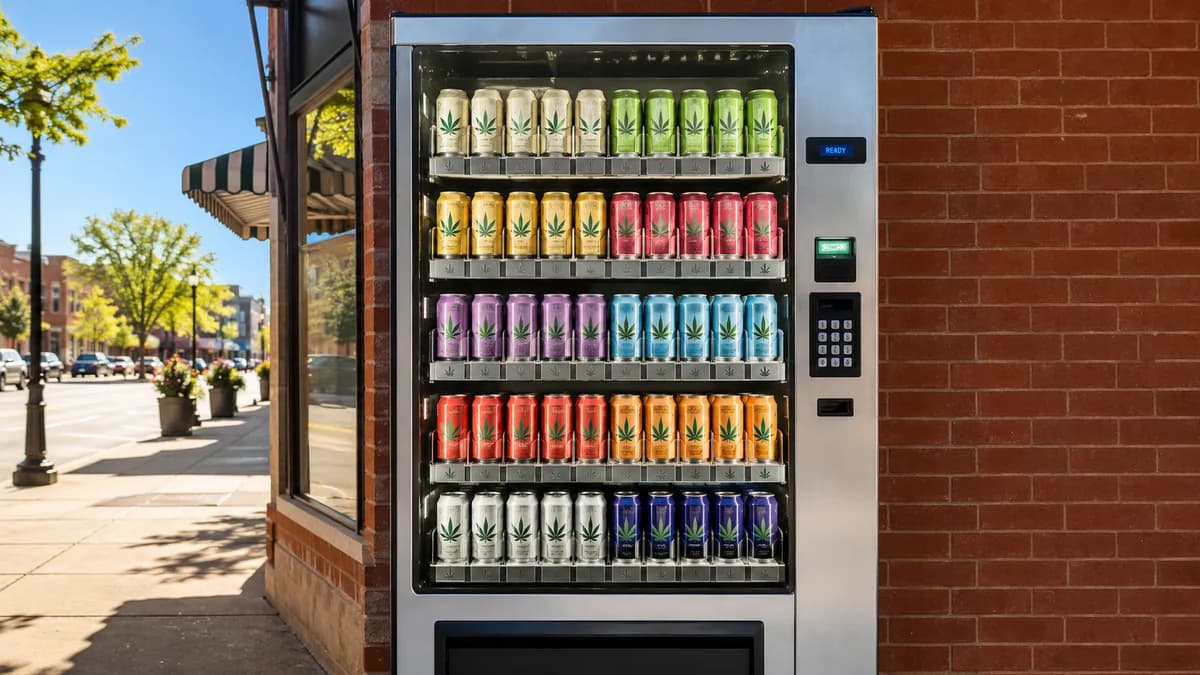
Photo: VapeExperts/AI
Congress could still move. One introduced bill, S. 3474, would replace the cap with serving-size limits, including 5 milligrams of THC per serving for certain edibles and inhalables. As of this writing, the 0.4-milligram rule remains the controlling future federal law.[3]
Ohio wants the order paused
Attorney General Andy Wilson asked Helmick on July 14 to stay the injunction while the state appeals, according to local news reports. No ruling on that request had been made public as of this writing. A preliminary injunction can be appealed immediately, so the Sixth Circuit could affirm, narrow or reverse the order.
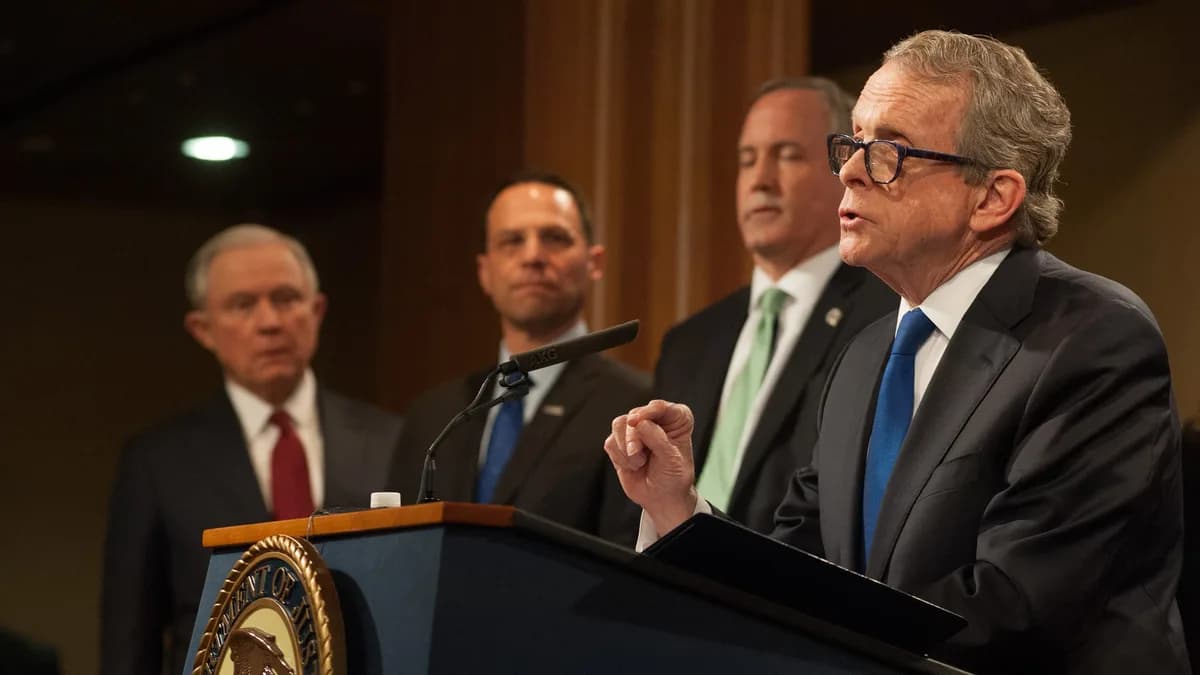
Photo: The United States Department of Justice/Wikimedia Commons (Public domain)
Ohio Attorney General Mike DeWine delivers remarks at a podium bearing the Department of Justice seal as officials stand behind him. His office is party to the Ohio hemp ban case now blocked by a federal judge.
Gov. Mike DeWine has defended the state's early timeline. "Ohio is making good public policy by enacting its own intoxicating hemp ban earlier than federal law," he said in his December veto message rejecting a beverage carve-out.
Where the ruling travels, and where it doesn't
The Ohio decision is not the first courtroom win on this theory. In October 2024, a federal judge in New Jersey held that parts of that state's hemp law violated the dormant Commerce Clause in Loki Brands v. Platkin, while leaving its under-21 rule intact.[5] An Ohio state judge in Sandusky County reached a similar conclusion in April, calling SB 56 "inherently discriminatory on its face." Constitutional law professor Jonathan Entin of Case Western Reserve told the Ohio Capital Journal the principle is straightforward: "States can't enact laws that interfere with or discriminate against interstate commerce."
The theory has limits. The Fourth Circuit upheld Virginia's total-THC law because it applied equally to in-state and out-of-state sellers, and the Eighth Circuit lifted an injunction against Arkansas's restrictions in 2025. And in January, the Ninth Circuit held in Peridot Tree that the dormant Commerce Clause does not protect trade in a federally prohibited market.[6] That reasoning does not defeat the Ohio plaintiffs today, because their products remain federal hemp. After November 12, Ohio could argue it does.

Photo: VapeExperts/AI
For now, the 10 plaintiffs are back on Ohio shelves. Their reprieve is written into the order itself: protection lasts only "so long as the substance or product at issue is legally defined as 'hemp' or a hemp-derived product under federal law."[1] On November 12, that definition changes.