

Medical cannabis stays in Schedule III. On Sept. 9, the U.S. Court of Appeals for the D.C. Circuit refused to freeze the Justice Department's limited rescheduling order while three consolidated challenges move ahead.[1] The court explained itself in a single sentence.
"Petitioners have not satisfied the stringent requirements for a stay pending court review."
That line keeps the April order in force. It does not say the order is legal. The court did not decide whether the challengers have standing, whether Acting Attorney General Todd Blanche could use a treaty clause to skip the normal scheduling process, or what happens in DEA's separate case on broader rescheduling. Adult-use cannabis remains in Schedule I.
We covered the stakes of this test when the challenges reached the D.C. Circuit. The stay ruling is the first result.
One sentence, three cases, nothing settled on the merits
The consolidated cases are SAM, Inc. v. U.S. Department of Justice, Nos. 26-1106, 26-1130 and 26-1136. The petitioners include SAM, NDASA and companies tied to MMJ International Holdings. They asked the court to suspend the order until the case was decided. The court said no.
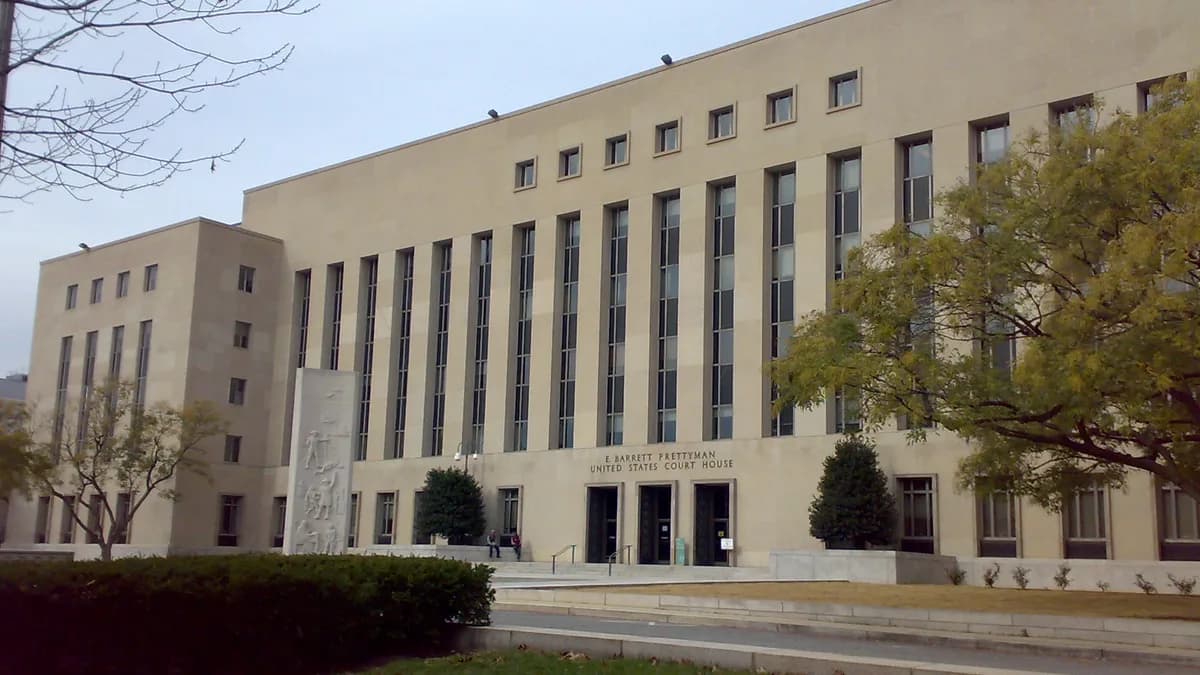
Photo: Bjoertvedt/Wikimedia Commons (CC BY-SA 3.0)
The E. Barrett Prettyman United States Court House in Washington, D.C. stands behind a lawn and hedges under an overcast sky. The building houses the D.C. Circuit, which declined to freeze the cannabis rescheduling.
The court also turned away two state-licensed operators, MedPharm Iowa LLC, doing business as Bud & Mary's, and Tri-Mountain Pure LLC, who wanted to join as parties. They may file as friends of the court instead. The court granted the same amicus status to attorneys David Sergi, David Holland, Robert Hoban and Tyson Daniel.
The parties now have 30 days from Sept. 9, or about Oct. 9, to propose how to organize merits briefing. The court warned that it looks with "extreme disfavor on repetitious submissions." Only after that will it set the actual schedule.
Duane Boise, president of petitioner MMJ International Holdings, framed the result narrowly.
"The federal appeals court left the limited Schedule III order in effect while MMJ's challenge proceeds, but the stay denial did not uphold the order's legality or decide the separate DEA proceeding considering broader marijuana rescheduling," Boise said.
A treaty clause moved medical cannabis, not a science review
Blanche signed Attorney General Order No. 6754-2026 in April. It took effect April 28, 2026, at 91 Fed. Reg. 22714.[2] The order placed two categories in Schedule III: FDA-approved drug products containing marijuana, and marijuana "in any form covered by a state medical marijuana license."
The order relied on 21 U.S.C. §811(d)(1), the international treaty provision of the Controlled Substances Act. It did not complete the ordinary HHS and DEA scheduling process. It also created a DEA registration pathway for state medical manufacturers, distributors and dispensers.
The Congressional Research Service said rescheduling did not, by itself, make all state medical activity federally compliant. DEA registration and the Food, Drug and Cosmetic Act still apply. Adult-use sales remain federally unlawful.[3]
Photo: VapeExperts/AI
Whether §811(d)(1) allowed this shortcut is the central question the merits case will now test.
Mikos says the 280E opening reaches a small slice of the market
Section 280E of the tax code says "no deduction or credit shall be allowed" for a business trafficking in controlled substances "within the meaning of schedule I and II of the Controlled Substances Act."[4] Schedule III activity falls outside that text. Rent, wages and advertising become potentially deductible for qualifying medical operations.
Private estimates put the burden in the billions. Research firm Whitney Economics estimated that cannabis businesses paid roughly $2.24 billion in excess federal taxes attributable to 280E in 2025, and about $15 billion since 2018. Those are private model estimates, not IRS figures.
Businesses holding both medical and adult-use licenses face a question no comprehensive public IRS guidance had answered as of Sept. 13: how to divide income and expenses between a Schedule III activity and a Schedule I one. Adult-use sales stay fully inside 280E.
Robert A. Mikos, LaRoche Family Chair in Law at Vanderbilt Law School, told an Ohio State University Drug Enforcement and Policy Center panel that the tax change is small in practice.
Photo: VapeExperts/AI
"This limited benefit, this relief from section 280E, it actually applies to only a very small segment of the overall state-licensed marijuana market," Mikos said.
State cannabis tax collections grew over the same period. The U.S. Census Bureau reported that 30 states and the District of Columbia collected an estimated $3.55 billion in cannabis excise taxes from July 2025 through June 2026, up 15.7% from $3.06 billion in fiscal 2022.[8] When Census began tracking the category in 2021, 19 states plus D.C. taxed cannabis. The count reached 31 jurisdictions by 2026.
Sam Kamin, Chauncey G. Wilson Memorial Research Chair at the University of Denver Sturm College of Law, argued on the same panel that the split itself is the problem.
"The attorney general's order creates a very nonsensical, complicated, and ultimately impossible status quo where the same marijuana that's on shelves in Colorado or California or Ohio is treated very differently whether someone walks in with a doctor's recommendation or not," Kamin said.
Research barriers ease, but funding does not follow, researchers say
Schedule III lowers DEA control requirements for researchers compared with Schedule I. The April order also opens a path for researchers to obtain material from a DEA-registered state medical operator. Clinical trials still need FDA authorization.
CRS reported that no FDA-approved marijuana-derived product fell within the new FDA-approved branch of the order at the time of its analysis. Mikos put the same point plainly at the Ohio State panel: "There's nothing in the acting attorney general's order that confers FDA approval on marijuana."

Photo: VapeExperts/AI
Mikos, Rebecca L. Haffajee of the Yale School of Public Health and Ziva D. Cooper of UCLA argued in a New England Journal of Medicine perspective that scheduling is the wrong lever.[5]
"Rescheduling can accomplish its primary purpose of generating clinically meaningful data only if the U.S. Congress and executive branch allocate more funding for doing that work," they wrote. "Rescheduling does not provide that funding."
Adult-use waits on a DEA judge with no deadline
The broader question sits in a different building. DEA Chief Administrative Law Judge Derek C. Julius held an 11-day merits hearing on rescheduling all marijuana from June 29 to July 15.[6] DEA and seven opposing parties filed post-hearing briefs on Aug. 17.
DEA argued for a broad move to Schedule III. The agency told the judge that marijuana "has a currently accepted medical use within the United States" and is safe under medical supervision.[7]
Between Aug. 20 and 26, Julius ordered 294 corrections to a record of roughly 2,500 pages. The corrected transcript runs about 2,533 pages.
Julius will issue a recommendation. DEA Administrator Terry Cole then makes the final agency decision, which would almost certainly draw new petitions for judicial review. No decision deadline has been announced.
Mikos predicted DEA may keep the medical-only line. The Blanche order justified the medical category partly by keeping controls on nonmedical supply, and that treaty reasoning could complicate any extension to adult use. That is his analysis, not an agency plan.
Vape hardware rules do not move with the schedule
The order reclassified specified cannabis. It did not touch the rules that govern the vaporizers used to consume it.
Federal paraphernalia law, 21 U.S.C. §863, still covers equipment primarily intended to introduce an unlawfully possessed controlled substance into the body. The statute carries exceptions for authorized conduct and traditional tobacco products, so intended use and authorization matter.[9] A dry herb vape does not change legal character because some cannabis changed schedules.
Shipping rules stand too. The federal ENDS definition under the PACT Act reaches products that aerosolize "nicotine, flavor, or any other substance," plus components, liquids and accessories. USPS Publication 52 continues to restrict mailing them, with narrow exceptions.[10]
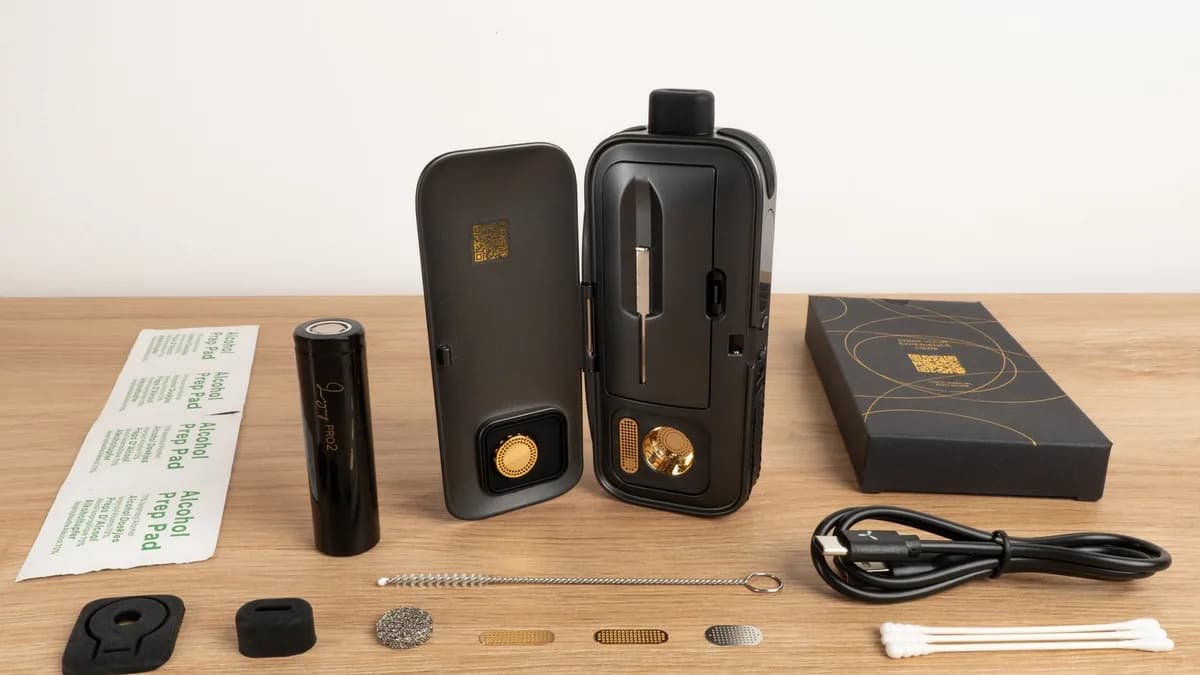
Photo: VapeExperts
An AirVape Legacy Pro 2 vaporizer sits open beside its battery, screens, cleaning tools and charging cable. Devices like this remain under existing vape hardware rules regardless of where cannabis lands on the federal schedule.
FDA's tobacco framework is unchanged as well. As of Aug. 28, 2026, the agency said it had authorized 48 e-cigarette products, and it stressed that authorization does not mean the products are safe or "FDA approved."[11] A THC cartridge gains no tobacco authorization from the CSA change.
A state-licensed vapor product likewise gains no FDA approval, labeling or interstate marketing permission from rescheduling alone. State testing, emissions, battery and packaging rules stay in place unless states rewrite them.
What the calendar now looks like
The next fixed date is about Oct. 9, when the parties must tell the court how they propose to brief the case. Attorneys at the law firm Harris Sliwoski note that the D.C. Circuit's usual sequence gives petitioners about 40 days for an opening brief once a schedule is set, DOJ 30 days to respond, and petitioners 21 days to reply.
On that pace, they say, argument in late winter or spring 2027 is plausible. The court has ordered none of it yet.
Until then, medical cannabis licensees operate under an order the court has agreed not to stop but has not agreed to keep. Adult-use operators wait on a judge's recommendation with no date attached. The one sentence of Sept. 9 is, for now, the only word the court has spoken.