

Legalization is doing one job and failing another. A new national study finds cannabis arrests have dropped sharply since states started legalizing. But the racial gap that has defined enforcement for decades has barely moved.
The number that stands out: prison admissions for drug offenses fell 34% for white people and stayed flat for Black people.
The racial justice case was central to how legalization got sold. The data now shows arrests can fall without the disparities closing.
What the new study actually found
The study, summarized by Cornell University, shows real progress on arrests.[1] It was published May 1, 2026, in the American Economic Journal: Economic Policy. Researchers led by Angélica Meinhofer of Weill Cornell Medicine tracked 11 states over 13 years.
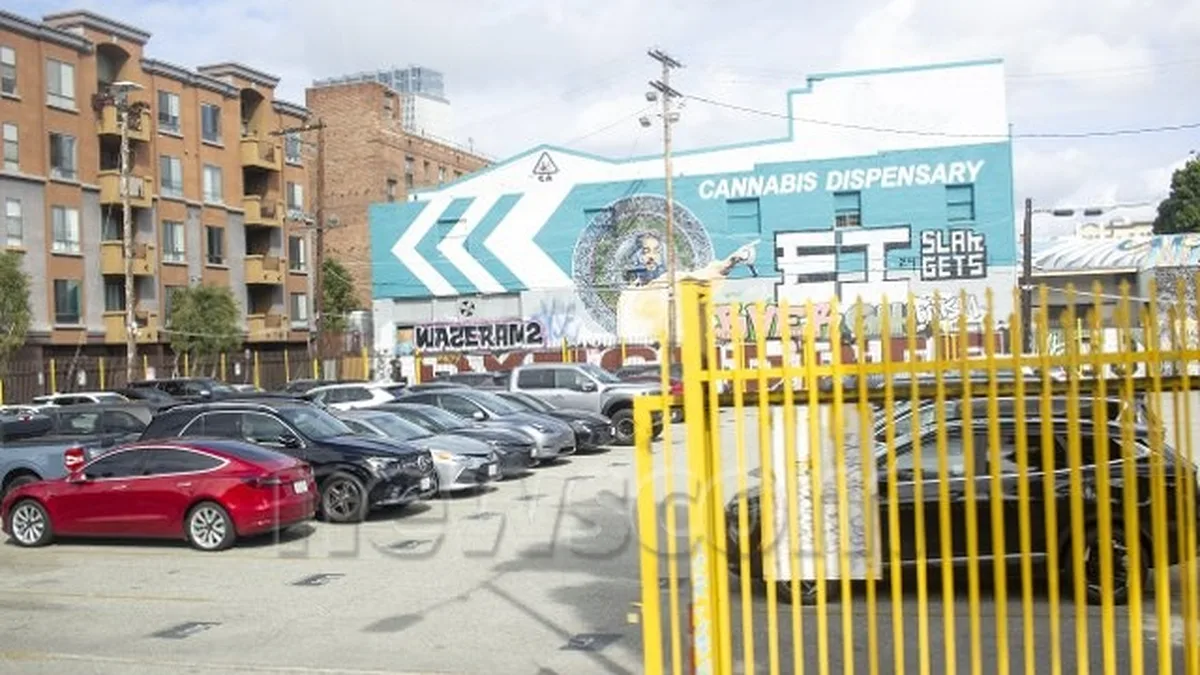
Photo: John Marshall Mantel/ZUMAPRESS/Newscom
Cars fill a parking lot in front of a building with a mural reading "Cannabis Dispensary" behind a yellow fence in Los Angeles.
Cannabis possession arrests dropped 62% for white individuals and 51% for Black individuals. Sales arrests declined 44% for white and 49% for Black populations.
But the deeper measures barely moved. Prison admissions for drug offenses fell by a third for white people and did not change for Black people.
The researchers also noted homicide rates among Black individuals appeared to decline, driven by fewer gun-related deaths.
Their conclusion is blunt: legalization alone is not enough. Record expungement, changes to law enforcement incentives, and targeted community investment are needed to close the gap.
The disparity that won't budge
Black and white Americans use cannabis at roughly equal rates. The arrest numbers tell a different story.
The ACLU found Black people were 3.73 times more likely than white people to be arrested for cannabis possession in its 2013 report. Its 2020 follow-up updated that figure to 3.64 times using newer data.
A decade of reform barely moved it. The Drug Policy Alliance still cites a 3.6x gap in 2025.
In some states the gap is far worse: 9.4x in Kentucky and 7.3x in Iowa.
Arrests of Black people actually rose
One finding cuts against the whole reform narrative.
The National Academies of Sciences compared cannabis possession arrests from 2002 to 2004 against 2017 to 2019.[2] Arrests for white people fell about 23% to 25%.
Arrests for Black people rose 26% to 28% over the same period, across two independent datasets.
The total scale is staggering. NORML estimates over 30 million Americans have been arrested for cannabis at the state or local level over roughly 50 years.
Maryland's pardons show what action looks like
Maryland Governor Wes Moore, the only Black governor in the country, has used clemency more aggressively than anyone.
In June 2024 he pardoned more than 175,000 cannabis convictions, the largest state cannabis pardon in U.S. history. On Juneteenth 2025 he added pardons for 6,938 more convictions, bringing the total above 181,000.[3]
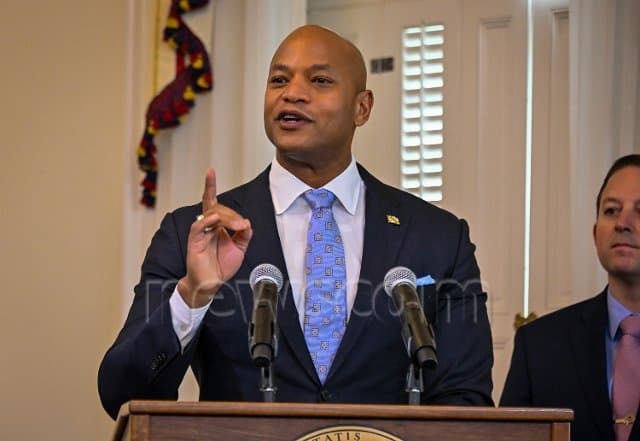
Photo: Kim Hairston/TNS/Newscom
Maryland Gov. Wes Moore gives remarks before signing bills with Senate President Bill Ferguson and House Speaker Joseline Pena-Melnyk in Annapolis, Maryland, on January 27, 2026.
Moore framed the move plainly. People in his state could not get a barber's license, a student loan, or a home loan because of a misdemeanor cannabis conviction from the 1980s. He said the pardons would have a disproportionate impact on African Americans because the war on cannabis had been a war on Black communities.
Maryland's Expungement Reform Act took effect January 31, 2026. All pardoned cannabis convictions are now hidden from public view on the state's court search system.
Most state justice bills died in 2025
Maryland is the exception, not the rule.
The Last Prisoner Project reviewed the 2025 legislative session and found most cannabis justice bills failed, as first reported by Marijuana Moment.[6] Record-sealing and release bills fell short in Florida, Georgia, Alaska, and Missouri. Expungement bills failed in Massachusetts and New York. Virginia's governor vetoed a retroactive resentencing bill.
Adrian Rocha, the group's Director of Policy, said dozens of relief bills were introduced and then quietly buried without a hearing.
The group put it sharply: legalization is advancing, but justice is still being denied. People are profiting off an industry that others are still being punished for.
Rescheduling is not the fix either
The federal picture is shifting, but not toward justice.
In April 2026 the Justice Department placed FDA-approved and state-licensed medical marijuana products in Schedule III.[5] Recreational cannabis remains Schedule I.
A new DEA administrative hearing on broader rescheduling begins June 29, 2026, just two weeks after Juneteenth. It will be the most consequential federal cannabis regulatory event in decades.
But rescheduling does not legalize cannabis, expunge records, or fund affected communities. The MORE Act, reintroduced in August 2025, would do all three. It has no realistic path through the current Congress.
What this means
If you live in a state that has legalized, your odds of getting arrested for personal cannabis use have dropped a lot. That is real. But an old conviction can still block a job, a loan, or housing unless your state has acted to clear it.
Pardons and expungement are not automatic in most places. If you carry a past cannabis conviction, check whether your state offers record sealing, because the data shows many statehouses have not delivered it.
The gap researchers want closed
The new study and the National Academies report reach the same place. Legalization reduces arrests. It does not, on its own, undo the harm.
The National Academies urged states to systematically evaluate and revise their cannabis social equity policies, and to track arrest data by race.
As Juneteenth 2026 arrives, the question is no longer whether legalization helps. It clearly does. The question is whether lawmakers will do the harder work the arrest numbers prove is still undone.