

Legal cannabis crossed a line in 2025 that it had never crossed before. Jobs and sales fell in the same year.
The 2026 U.S. Cannabis Jobs Report from Vangst, a cannabis staffing firm, and Whitney Economics, a cannabis consultancy, counts 412,500 full-time-equivalent jobs in early 2026, down from 425,002 a year earlier.[1] Vangst calls the drop 2.7%; the published totals imply a loss of 12,502 jobs, closer to 2.9%.[2] Legal retail sales fell 3.3% in calendar 2025, to $29.1 billion from $30.1 billion in 2024.[1]
Jobs have fallen before. Employment dipped from 428,059 in early 2022 to 417,493 in early 2023, rebounded to 440,445 in early 2024, then slid to 425,002 in early 2025.[7] But in each of those down years, sales kept rising. Calendar 2024 revenue grew 4.5% even as headcount shrank.[8] The report says 2025 is the first time both national indicators declined together since adult-use sales began in Colorado and Washington in 2014.[1]
Estimated US legal-cannabis jobs by report year
Source: Leafly / Vangst-Whitney Economics jobs reports
More cannabis moved, less money made
The report attributes the revenue drop to price compression, not shrinking demand. Consumers bought roughly the same number of items, or slightly more, but paid less as wholesale oversupply pushed retail prices down.[1] "There's simply too much harvest for the industry to manage," the report states.[1]
Michigan is the clearest case. Retailers sold roughly 260,000 more pounds of cannabis flower in 2025 than in 2024, yet annual revenue fell about $113 million, or 3.4%, from roughly $3.29 billion to $3.17 billion. The average adult-use flower price dropped from $95.08 per ounce in December 2023 to $69.20 in December 2024 and $58.20 in December 2025.[4]
Economic research supports the pattern. A 2025 peer-reviewed study of British Columbia wholesale data found regulated cannabis demand was price elastic: a 10% price decrease was tied to a 14% increase in quantity purchased.[6] Cheaper cannabis moves more units. It just does not move enough of them to grow the dollar total.
Rosalie Liccardo Pacula, a health economist at the USC Schaeffer Center, has argued the squeeze was built into legalization. "The legal industry's initial profits attracted new growers at the same time existing growers expanded their production. Supply increased, and prices sunk further," she wrote in a 2025 analysis.[5]
NORML read the same numbers differently. The advocacy group's analysis said state-legal sales "held firm" in 2025, still exceeding $29 billion despite the year-over-year dip.[3]
New York hires while California cuts
The contraction was uneven. Six markets posted double-digit employment growth, led by New York, which added 16,160 jobs, up 129%, to roughly 28,660. Maryland added 3,500, Ohio 2,596, and New Jersey 2,468.[2]
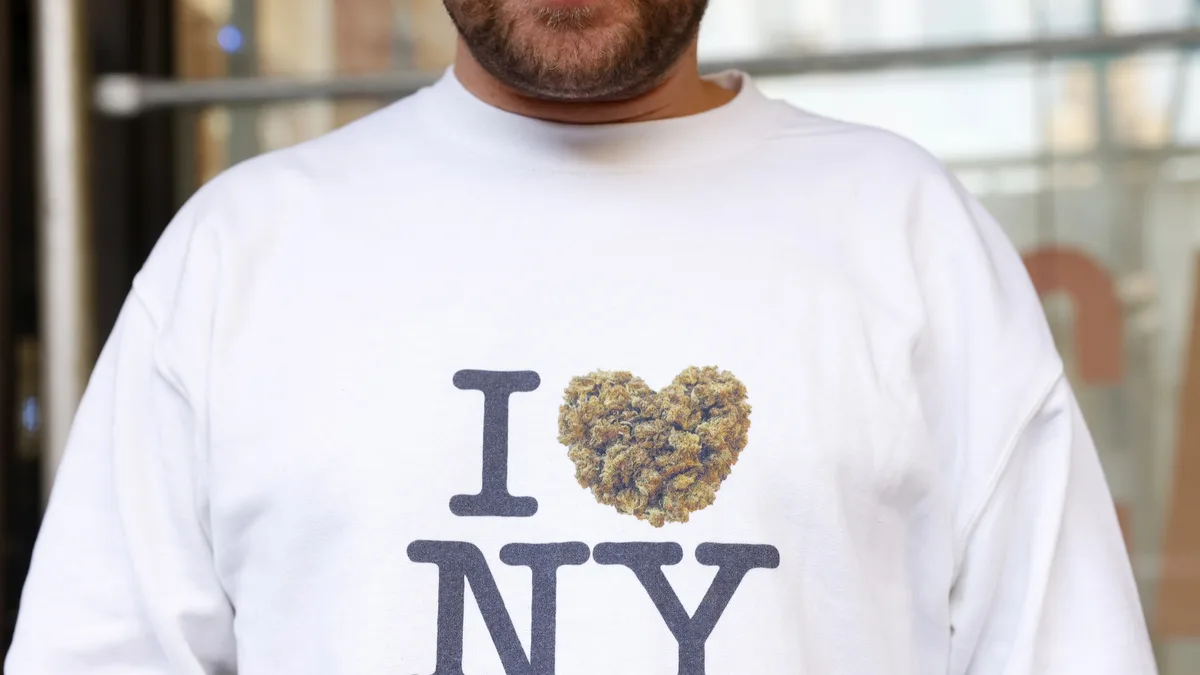
Photo: John Angelillo/UPI/Newscom
A man wears an I Love NY sweatshirt with a heart made of marijuana outside Housing Works Cannabis Co. in New York City on Dec. 29, 2022. The dispensary opened that day as the city's first legal recreational shop.
The largest losses came in mature markets: California lost 17,123 jobs, Florida 5,270, Illinois 3,000, Michigan 2,500, and Arkansas 1,920. California remained the biggest cannabis employer at about 57,500 jobs, ahead of Michigan at 42,500 and New York.[2]
Licensing tells the same story. More than a dozen states cut their active license counts in 2025, and the nationwide total fell by more than 1,200. Retail was the only major license category to grow.[1]
Estimates, not a federal count
One caution. There is no Bureau of Labor Statistics category that isolates state-legal cannabis work, and no federal tally of national cannabis sales. The headline figures are modeled estimates from a staffing company and a consultancy with a stake in the industry's health. State tax data from Michigan, California, and Colorado independently confirm the mature-market trend of falling revenue, but not the exact national totals.[4]
Where the jobs go next
The report expects labor demand to keep shifting away from cultivation, which accounts for about 31% of cannabis employment and sits most exposed to further oversupply-driven cuts.[1] Manufacturing is projected to gain share as consumers keep moving toward processed formats: vapes, concentrates, edibles, beverages, and pre-rolls.[1] For flower vaporizer users, the near-term picture in oversupplied states is cheap flower, heavy discounting, and ample shelves, though Pacula's analysis suggests fewer small farms will survive to supply it. Small growers, she wrote, will compete like craft breweries and boutique wineries, on distinctiveness rather than price.[5]
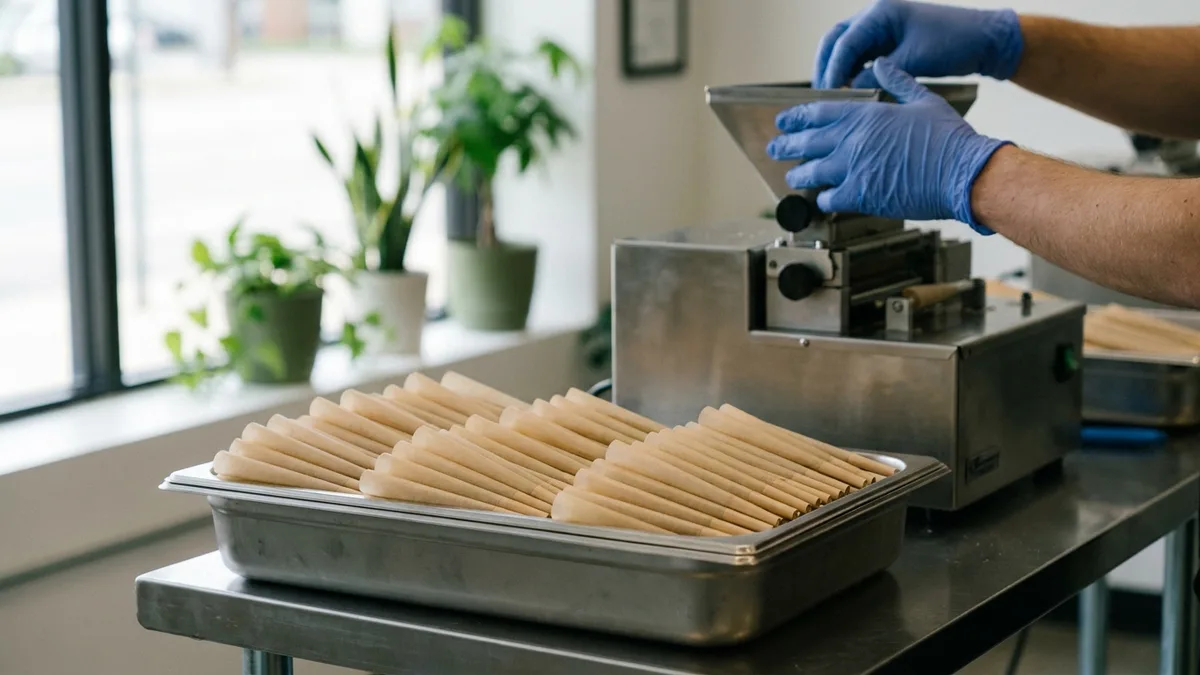
Photo: VapeExperts/AI
Cannabis equities rebounded in the second quarter even as these fundamentals weakened, a split we covered in our mid-year cannabis stock report.
Whitney Economics says the down year will not repeat. Founder Beau Whitney told readers the market hit an inflection point in 2025, with new states still creating jobs. "We are forecasting 2026 legal revenues to be $30.5 billion, an increase of 4.9% since 2025," Whitney said. Monthly state sales data through the fall will show whether New York, Maryland, and Ohio can grow fast enough to prove him right.