

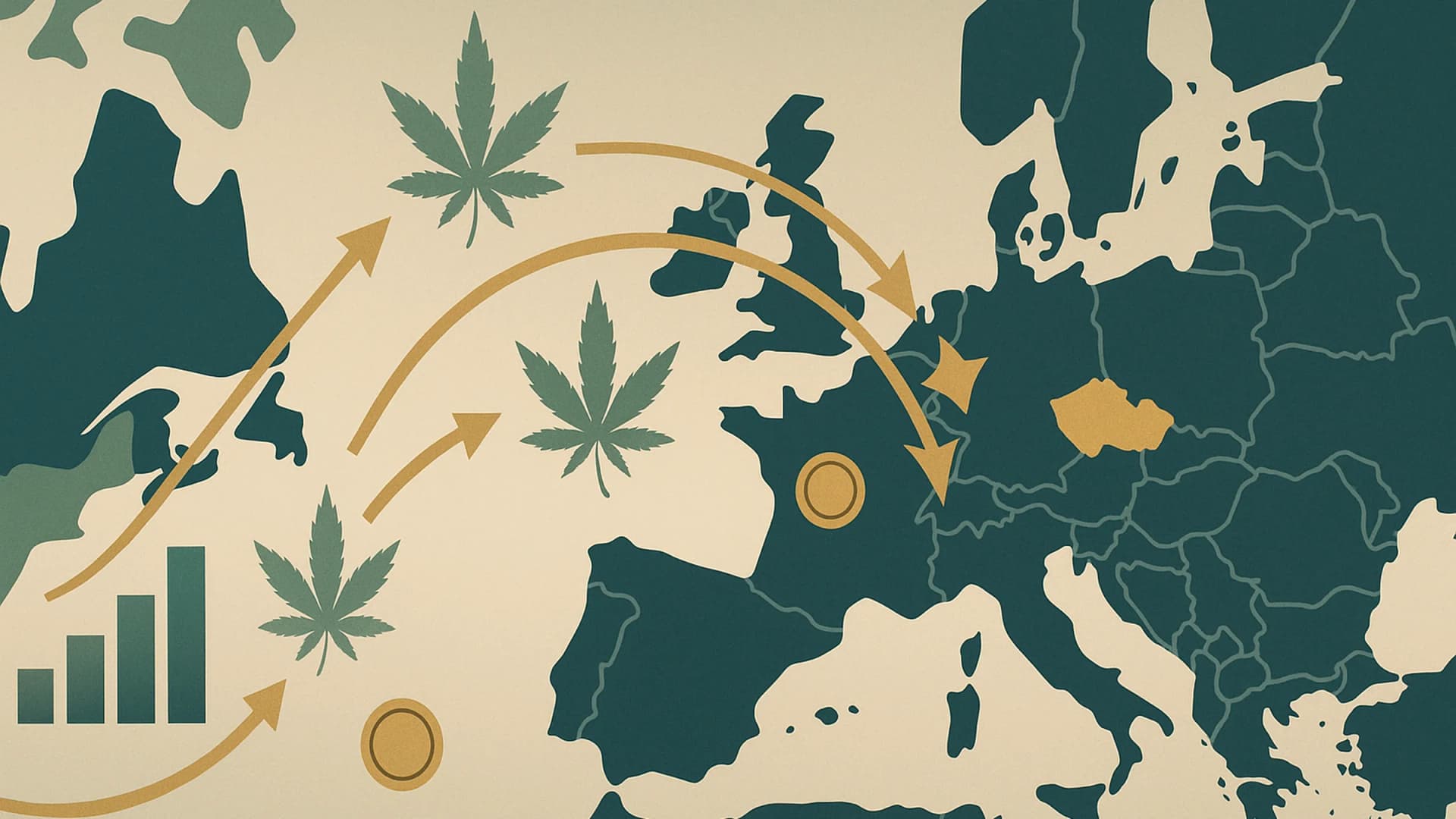
Canadian money is buying up Europe's cannabis market, fast. In just six months, from September 2025 to February 2026, three Canadian companies spent nearly €200 million in upfront cash to acquire European assets.
That spending signals what analysts have predicted for years: Europe's fragmented cannabis industry is consolidating into a continental market, and the biggest players want in before it does.
The buying spree that defined the moment
The headline deal came in February 2026. Organigram agreed to acquire Sanity Group for up to €250 million, the largest cross-border cannabis acquisition targeting Europe since Curaleaf bought EMMAC in 2021.
The deal pairs €113.4 million upfront with €113.8 million in earnouts. It is also a bet on Germany.
Two other Canadian moves set the table. In September 2025, High Tide paid €26.4 million for 51% of Remexian, Germany's largest medical cannabis importer. In December, Cronos spent €57.5 million for CanAdelaar, the largest cultivator in the Netherlands' adult-use trial.
A German bank stepped in too. In February 2026, Enua secured a €25 million debt facility from Deutsche Bank, the largest bank-backed cannabis credit line in German history.
Photo: Michael Piepgras/imageBROKER/Newscom
The Deutsche Bank logo and signage are displayed on the brick facade of a building branch.
"This transformational acquisition will bring together two market leaders, extend our commercial footprint into Europe, and strengthen our competitive edge in the world's largest federally legal cannabis markets," said James Yamanaka, Organigram's CEO.
Why Germany is the prize
The buying targets one country above all. Germany accounts for more than 30% of Europe's medical cannabis market, and its growth is steep.
Germany imported over 201 tonnes of medical cannabis in 2025.[3] That is up from 72.85 tonnes in 2024 and 32.5 tonnes in 2023, a roughly 520% jump in two years.
The federal regulator BfArM had to keep raising its limits. In October 2025 it lifted the import cap to 192.5 tonnes after volumes blew past the prior 122-tonne ceiling.

Photo: Sebastian Kahnert/dpa/Newscom
Cannabis plants grow in a flower room at the pharmaceutical company Demecan in Ebersbach, Saxony, Germany, on Wednesday, Jan. 21, 2026.
Domestic sales roughly doubled in 2025. Estimates range from about €670 million to as much as €2 billion, depending on how the figures are counted. Europe's total legal medical cannabis market is projected to pass €1.5 billion in 2026.
The market is no longer just Germany
What makes Europe attractive now is that the demand is spreading.
The UK's medical cannabis market also doubled in 2025, with annual sales topping GBP 200 million. Poland raised its 2025 import quota to 20 tonnes. The Czech Republic's medical prescriptions hit 314 kg by September 2025, nearly matching all of 2024, with 90% of costs reimbursed by public insurers.
Four EU/EEA nations now allow some form of adult-use cannabis: Germany, Malta, Luxembourg, and the Czech Republic. In March 2026, 25 countries across the region permitted medical cannabis in some form.[5]
The companies building across borders
The winning strategy, analysts say, is the platform: one company operating across many countries, spanning medical, adult-use pilots, and CBD.
Cantourage Group SE reported €92.8 million in 2025 revenue, up 82.3% from 2024[2], with UK business now more than 20% of its total.
Sanity Group, Organigram's target, grew revenue from €9 million in 2023 to €60 million in 2025. It distributes through more than 2,000 pharmacies and around 5,000 physicians, and runs Grashaus Projects inside Switzerland's Basel recreational pilot. It also has expansion plans in the UK, Poland, and Czechia.
"Together we are poised to unlock significant growth opportunities, especially as new European markets open to both medical and recreational cannabis programmes," said Finn Hänsel, Sanity Group's CEO.
Remexian, now a High Tide subsidiary, imports from 19 source countries and stocks over 200 medical products. Enua plans to enter the UK in early 2026 and Poland by year-end, funded by its Deutsche Bank line.
The regulatory cloud over Germany
Not every signal points up. The same German market drawing all this cash faces a possible crackdown.
A draft amendment to Germany's medical cannabis law would restrict telemedicine prescriptions and mail-order dispensing. The Federal Cabinet approved the bill in October 2025. It is expected to face a final Bundestag vote in spring or summer 2026.
The change would hit revenue for companies that rely on the current telemedicine pipeline, including Sanity Group, Cantourage, and Remexian.
"Germany enters 2026 with a clear risk of regulatory tightening in medical cannabis, even if the exact timing and final shape of the rules remain uncertain," said analyst Alfredo Pascual.
Germany's commercial adult-use pilot, known as Pillar 2, remains stalled. Over 60 applications have been filed with the BLE, and none approved.
Where the next markets open
The bets stretch beyond Germany. France's permanent medical cannabis framework cleared Brussels in June 2025 and the Conseil d'État in August 2025, leaving only ministerial signatures. Projections suggest up to 800,000 eligible patients and turnover above €800 million by 2035.
Switzerland's National Council Health Committee approved a draft law for full legalization in July 2025, with retail sales, home cultivation, and a cannabis tax. The earliest possible start is summer 2026.
The Czech Republic legalized personal cultivation on January 1, 2026, and has signaled it wants a regulated commercial system next.
One barrier still blocks a true continental market: there is no EU-wide harmonization of medical cannabis rules. A peer-reviewed study published in October 2025 called for regional agreements[4] to allow mutual recognition of prescriptions and standardized travel certificates.
What this means
If you use medical cannabis in Germany, watch the spring 2026 vote closely. A telemedicine and mail-order crackdown could change how you get prescriptions and products, especially in rural areas.
For the rest of Europe, the trend points toward more choice. As companies build cross-border supply, patients in newly opened markets like France and the Czech Republic should see wider access in the years ahead.
What comes next
Analyst Arnau Valdovinos argues the long-expected consolidation wave is finally arriving, with proven revenue, willing capital, and an expanding addressable market all in place.
The deals so far have set valuation benchmarks across the sector. Platform operators spanning multiple countries are expected to command the highest valuations, and more buying is likely through 2026.