


A dispensary that loses its entire inventory to a fire can still walk away with nothing. Cannabis businesses across the United States are paying more for less coverage in 2026, and the rescheduling order many hoped would fix it changed almost nothing.
Property insurance for indoor cannabis growers jumped 25% to 40% in 2025 and 2026, while commercial auto premiums for cannabis fleets run two to three times their 2024 levels.
That is the core problem. Cannabis is now a $115 billion contributor to the U.S. economy, yet most operators still can't buy the same insurance any other business takes for granted.
Cannabis is too legal to ignore and too illegal to insure
Cannabis is legal for medical use in 47 states and for adult recreational use in 24 states. It is also still illegal under federal law.
That conflict has scared off the big national insurers. Most cannabis coverage lives in the non-admitted, or surplus lines, market, where only specialized carriers operate and prices run high.
The National Association of Insurance Commissioners has said conflicting state and federal laws have largely discouraged insurers from joining the market. Major national carriers have stayed out over fears of regulatory backlash.
The result is thin coverage at steep prices. Many businesses default to self-insurance, which means they cover their own losses.
The coverage on offer doesn't match the risk
Typical cannabis policies cap out at $1 million per occurrence and $2 million aggregate. Many operators actually need $5 million to $10 million or more.
A typical dispensary pays $1,000 to $5,000 a month for cannabis-specific insurance. For that, it often gets limits too low to survive a real disaster.
Cash makes it worse. About 70% of cannabis businesses still operate primarily in cash, which raises theft risk and complicates every part of underwriting.
Why prices keep climbing
Underwriting has tightened fast, especially for cultivation. Carriers are now wary of grow operations without LED lighting and extraction setups using volatile solvents.
The claims are piling up. Kieran O'Rourke, Director of Underwriting at Cannasure Insurance Services, said operators have logged fire losses from electrical overload, spoilage from equipment failures, and rising crime claims.
"The assailants are getting more sophisticated in their burglary attempts," O'Rourke said.
Lawsuits are a second pressure. Potency variance suits, labeling disputes, and consumer class actions are now part of the risk landscape, O'Rourke said, and even modest settlements carry heavy defense costs.
Not every line is rising. Workers' comp rates are flat or down about 5% in mature states, and directors and officers premiums have fallen 15% to 20% from their 2024 highs. Those are the exceptions.
The rescheduling order that wasn't a fix
On December 18, 2025, President Trump signed an executive order directing officials to expedite moving marijuana from Schedule I to Schedule III.[2]
On April 23, 2026, Acting Attorney General Todd Blanche issued a final order placing FDA-approved marijuana products and state-licensed medical marijuana in Schedule III, effective April 28.[1]
Here is the catch. The order covers medical and FDA-approved products only. Recreational marijuana stays in Schedule I.
David Blades of AM Best put the limit plainly: "The executive order does not guarantee access to banking or insurance."
Banking has not opened either. JPMorgan, Bank of America, Wells Fargo, and Citi still do not serve plant-touching cannabis businesses, and federal rules requiring banks to file suspicious activity reports on cannabis transactions remain in effect.
The bills that would actually help are stuck
Two pieces of legislation matter most for insurance.
The SAFER Banking Act would protect banks that serve state-legal cannabis. It passed the Senate Banking Committee on a bipartisan 14-9 vote but has not reached a floor vote.
The CLAIM Act would give insurers a direct federal safe harbor to write cannabis policies without fear of prosecution. It has been introduced but not enacted.
Without it, sponsor Rep. Nydia Velázquez warned, "a legal cannabis distributor whose product is ruined from a flood or fire could lose all their capital and their livelihood."
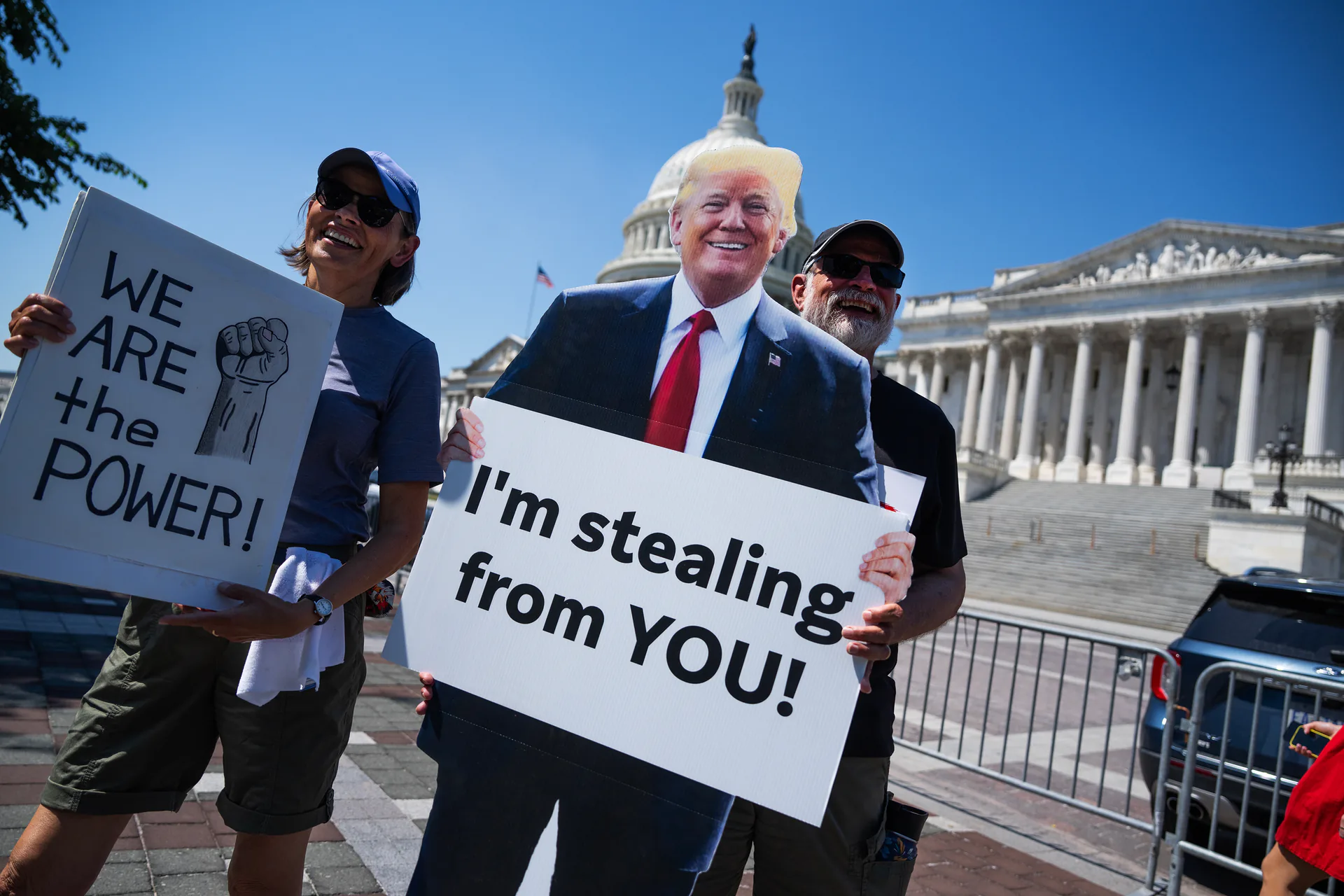
Photo: Tom Williams/CQ Roll Call/Newscom
Demonstrators hold a cutout of President Donald Trump on the East Front of the U.S. Capitol on May 20, 2026. Cannabis banking and insurance bills remain stalled in Congress.
There is also no federal crop insurance for marijuana. The USDA covers hemp under the Farm Bill,[4] but marijuana growers are shut out of the Federal Crop Insurance Program entirely.
A dangerous feedback loop
Falling prices for cannabis itself are now pushing operators to drop coverage. As businesses cut overhead to survive, more go uninsured.
That creates a loop. More uninsured losses push premiums higher for everyone still buying coverage, which pushes more operators to drop out.
Burns & Wilcox underwriter Julia Merritt summed up the shift: "The market has clearly shifted from a growth mode to a sustainability mode."
What happens next
The pivotal date is June 29, 2026, when the DEA holds an administrative hearing on rescheduling all marijuana, including recreational, to Schedule III.
Broader rescheduling would lift the heavy 280E tax burden for all operators, improve cash flow, and could draw more carriers and reinsurers into the market. AM Best points to reinsurers as the real gatekeepers, since they set the capacity and pricing primary carriers can offer.
But rescheduling alone won't legalize cannabis federally or open interstate commerce. Until Congress moves on banking and insurance, the gap stays open, and the bill keeps landing on operators.